The short version
- Scientists have identified a meteorite found in the Sahara as a 4.1-billion-year-old piece of Martian crust, making it one of the oldest known samples from the Red Planet.
- Chemical analysis indicates the rock formed from magma and was later altered by underground water, supporting theories that early Mars possessed conditions suitable for life.
- While the discovery provides valuable data on Mars' ancient mantle and surface history, experts emphasize that targeted sample return missions are still necessary to fully understand the planet's evolution.
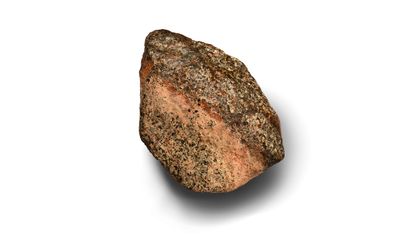
A nearly two-pound stone discovered in the Sahara Desert in 2022 has been confirmed as a Martian meteorite dating back at least 4.1 billion years. Published findings in the journal Science reveal that this object, designated Teghaza 001, represents one of the oldest known physical samples from Mars. The discovery offers researchers a tangible link to the Red Planet’s formative era, a period that predates the oldest rocks currently found on Earth.
The identification process involved rigorous geological analysis by an international team of scientists. Researchers examined zircon crystals within the stone, utilizing the decay of uranium into lead to determine its age. They corroborated these results by analyzing isotopes of rubidium and strontium, which yielded consistent estimates. This dual-method approach strengthens the confidence in the dating, placing the rock’s formation shortly after Mars itself coalesced approximately 4.5 billion years ago.
Prior to this finding, only two other meteorites provided glimpses into such an ancient Martian history: Allan Hills 84001 and Northwest Africa 7034. However, Teghaza 001 differs significantly in its composition. Unlike its counterparts, this rosy-colored stone is composed of volcanic minerals that indicate it originated as magma. It cooled to become part of the planet’s outermost crust before undergoing chemical changes driven by interactions with subsurface water.
The evidence of water alteration is particularly significant for planetary science. Mars is now a dry, dusty world, but this meteorite contributes to a growing body of research suggesting the planet was once much wetter. The presence of water in the rock’s history aligns with broader theories that early Mars had the necessary ingredients and environmental conditions to potentially harbor life, although the findings do not directly confirm the existence of biological organisms.
Geochemical data suggests the meteorite likely originated from the Noachian southern highlands of Mars. The team identified thirteen possible source locations on the planet where the orbital observations match the chemical makeup of Teghaza 001. This specificity allows scientists to compare the sample with remote sensing data, providing a more detailed picture of what the Martian mantle and crust looked like billions of years ago.
The unique geochemistry of this third ancient sample provides a new perspective on Mars’ internal structure. By comparing it with previous finds, researchers can better understand the diversity of mantle sources on the planet. This variation helps refine models of how Mars evolved geologically during its first billion years, a critical window for understanding why the planet diverged so sharply from Earth’s developmental path.
Despite the significance of this discovery, experts caution that chance findings like Teghaza 001 have limitations. Planetary scientists note that without knowing the exact origin point on Mars, there are many unanswered questions regarding the broader context of the sample. The random nature of meteorite delivery means these fragments represent only a tiny, uncurated fraction of the planet’s geological record.
To address these gaps, the scientific community continues to advocate for targeted sample return missions. Recent efforts include the Japan Aerospace Exploration Agency’s launch of a spacecraft aimed at recovering material from Phobos, one of Mars’ moons. Because Phobos may contain dust ejected from Mars during impacts, such missions could provide additional context. Ultimately, bringing back samples from specific, known locations remains essential for comprehensively understanding the Red Planet’s complex history.
The study underscores the value of both terrestrial discoveries and space exploration in piecing together planetary evolution. While Teghaza 001 provides a rare snapshot of ancient Mars, it also highlights the need for more systematic data collection. As researchers analyze this and other samples, they move closer to answering fundamental questions about the habitability of our solar system’s neighbors.
This finding adds a crucial piece to the puzzle of early Martian geology. It confirms that volcanic activity and water interaction were prevalent during the planet’s youth. For scientists studying the origins of life and planetary formation, such ancient rocks are invaluable resources, bridging the gap between theoretical models and physical evidence from deep time.
Sources behind this briefing
Go to the original reporting
- Smithsonian Magazine↗This Rosy Stone Spotted in the Sahara Turned Out to Be a 4.1-Billion-Year-Old Meteorite From Mars, One of the Oldest Ever Found