The short version
- Researchers have developed an AI tool that predicts the emergence of sunspots by analyzing acoustic wave fluctuations within the Sun's interior.
- The system offers a lead time of up to twelve hours, potentially improving safety protocols for astronauts and satellite operations during deep-space missions.
- While promising, the model requires further validation against historical solar events before it can be integrated into operational forecasting systems.
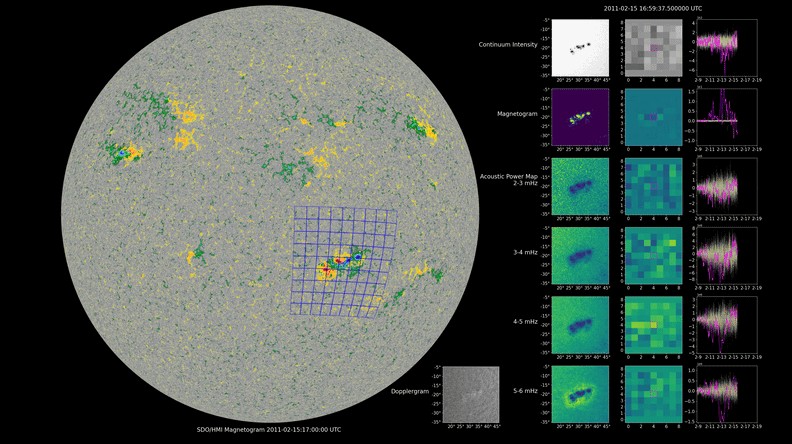
A collaborative team of astrophysicists and data scientists has introduced a novel machine-learning approach capable of forecasting the emergence of active regions on the Sun up to twelve hours prior to their appearance on the surface. This development marks a significant shift in space weather prediction, moving beyond reactive monitoring of visible phenomena toward proactive detection of subsurface activity. The research, conducted under NASA’s COFFIES initiative, leverages advanced artificial intelligence to identify subtle precursors that were previously too faint or complex for traditional analysis methods.
Current operational forecasts rely heavily on observing active regions already present on the solar surface. Agencies such as the National Oceanic and Atmospheric Administration’s Space Weather Prediction Center and the United States Air Force track these visible sunspots to estimate the likelihood of solar flares and coronal mass ejections. These eruptions release high-energy radiation and charged particles that can disrupt radio communications, damage satellites, and pose serious health risks to astronauts. By extending the prediction window before these regions become visible, the new model aims to provide critical additional time for mitigation strategies.
The core innovation lies in how the system processes data from NASA’s Solar Dynamics Observatory. Instead of analyzing the entire solar surface simultaneously, the AI utilizes a sliding-window transformer architecture. This method allows the model to focus on recent data sequences while retaining memory of broader patterns over longer timelines. It specifically targets tiny reductions in acoustic activity and magnetic field strength that occur as intense magnetic fields rise from the solar interior toward the surface.
Detecting these signals is akin to identifying a slight change in rhythm within a very noisy orchestra, according to Alexander Kosovichev, a co-investigator at the New Jersey Institute of Technology. Because the magnetic structures are not directly visible while still submerged beneath the photosphere, scientists must rely on indirect effects. The AI captures fluctuations in acoustic waves caused by forming sunspot regions as they begin their upward journey. These subtle changes serve as early indicators that an active region is about to break through the surface.
The COFFIES project brings together researchers from NJIT, Princeton University, and NASA’s Ames Research Center. This interdisciplinary collaboration was essential for bridging heliophysics expertise with advanced computational resources. The team utilized supercomputing capabilities at Ames to process the vast amounts of data required to train the model. Their findings were published in the Journal of Geophysical Research: Machine Learning and Computation, highlighting the growing intersection between deep learning and solar physics.
This predictive capability holds particular importance for NASA’s Artemis missions, which aim to return humans to the Moon, as well as future crewed expeditions to Mars. In deep space, astronauts are exposed to higher levels of radiation without the protection of Earth’s magnetosphere. Accurate forecasting of severe space weather events is therefore vital for ensuring crew safety and protecting sensitive equipment. Early warnings could allow mission controllers to adjust schedules or direct personnel to shielded areas before a storm arrives.
Despite these promising results, the model is not yet ready for real-time operational use. The research team plans to validate the approach across a wider range of known solar events to fine-tune its accuracy and reliability. Transitioning from experimental research to operational forecasting requires rigorous testing to ensure that predictions are consistent and actionable. Agencies continue to collaborate on integrating new research capabilities into comprehensive space weather monitoring systems.
The success of this AI-driven approach demonstrates the potential for deep machine learning to enhance our understanding of heliophysics. By capturing time-based pattern changes that were previously elusive, the technology offers a more nuanced view of solar dynamics. As humanity expands its presence in space, improving the precision and lead time of space weather forecasts will remain a critical priority for safeguarding both technological infrastructure and human explorers.
Future iterations of the model may further refine the ability to predict not just the emergence of active regions, but also their potential for producing severe eruptions. The sliding-window architecture provides a flexible framework that can be adapted as more data becomes available. This ongoing refinement process underscores the iterative nature of scientific discovery and the importance of continuous validation in developing reliable predictive tools.
The integration of AI into solar monitoring represents a broader trend in using computational power to solve complex physical problems. As datasets grow larger and more detailed, machine learning models offer new ways to extract meaningful insights from noise. This work by the COFFIES team illustrates how interdisciplinary collaboration can drive innovation in fields where traditional methods have reached their limits.
Sources behind this briefing
Go to the original reporting
- NASA↗NASA’s COFFIES Uses AI to Predict Storm-Causing Active Regions on Sun

