The short version
- President Hakainde Hichilema has been declared the winner of Zambia's presidential election, securing approximately 60% of the vote for a second five-year term.
- Main challenger Brian Mundubile is currently in self-imposed exile at a UN agency in Lusaka, citing threats to his life after authorities raided his home and arrested opposition figures.
- International observers described voting day as largely peaceful but raised concerns about late electoral reforms, media restrictions, and unverified reports of intimidation in several provinces.
Zambia’s President Hakainde Hichilema has been officially re-elected for a second five-year term, marking the culmination of an electoral process that was widely anticipated to favor the incumbent but concluded under significant tension. The national electoral commission announced that Hichilema secured roughly 60% of the vote, a decisive margin over his closest competitor, Brian Mundubile, who garnered approximately 38%. The remaining twelve candidates trailed significantly behind these two primary figures. This victory represents a historic moment for Hichilema, who had previously failed in five attempts to win the presidency before his initial election in 2021.
The path to this result was marked by controversy and uncertainty, particularly regarding the status of the opposition. Mundubile, aged 55, initially claimed victory and alleged voting irregularities without providing concrete evidence to support these assertions. His political party, the National Republican Party for Unity and Progress (NRPUP), stated that Mundubile is currently located in a secure facility under the protection of an international human rights body due to credible threats against his safety. Local media reports indicate that Mundubile and his running mate, Makebi Zulu, have entered self-imposed exile at a United Nations agency in the capital city of Lusaka, fearing potential arrest.
Tensions escalated sharply following a raid on Friday by armed personnel at Mundubile’s residence in Lusaka. Authorities accused several leading opposition figures of plotting an insurrection and alleged that high-grade military weapons were being stored at the property. Mundubile vehemently denied these claims, describing the incident as a fabrication and stating that security forces knocked down his gate with an armored vehicle, broke doors and windows, and opened fire. He characterized the raid as an attempt on their lives, though government officials maintain that criminal charges are being pursued against those detained.
Hakainde Hichilema’s election agent, Mulambo Haimbe, contested Mundubile’s account of the raid, labeling the remarks as incorrect. Haimbe emphasized that the judicial system would address any disputes should the opposition choose to challenge the election outcome. Despite the turmoil, Hichilema released a statement expressing humility regarding the trust placed in his administration. He framed the election as a demonstration of Zambia’s commitment to peace, law, and order, asserting that the nation resolves differences through democratic processes rather than violence.
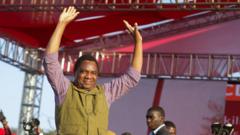
In the capital, hundreds of supporters from Hichilema’s United Party for National Development (UPND) took to the streets to celebrate the declaration. Dressed in the party’s signature red colors, they gathered in public spaces to mark the occasion. This display of support underscores the incumbent’s strong base, even as questions linger about the legitimacy and transparency of the electoral process. Zambia has a longstanding record of peaceful transfers of power since returning to multiparty democracy in 1991, making this election another test of that democratic tradition.
International observers provided a mixed assessment of the proceedings. While regional and international missions described election day as largely peaceful, they urged all parties to remain calm and respect the official results. However, concerns were raised regarding late electoral reforms and restrictions on media freedom during the campaign period. The European Union observation mission warned that limitations placed on opposition campaigning may have created an uneven playing field, potentially influencing the final outcome.
Specific incidents of violence and intimidation were noted by observers, though verification remained difficult. Samuel Tembenu, leading the observer mission from the Southern African Development Community (Sadc), reported unverified accounts of assault, abduction, and property damage in five provinces. Additionally, the brief suspension of vote counting by the electoral commission, cited as a response to violence against polling staff and theft of ballot papers, drew criticism for risking the credibility of the process and undermining voter confidence.
It remains unclear whether the opposition will formally challenge the election results given Mundubile’s current absence from public life. His party indicated that he would communicate directly with the Zambian people and media once circumstances allowed for safe engagement. As Hichilema begins his second term, the administration faces the task of addressing these lingering disputes while maintaining the stability that has characterized Zambia’s recent political history. The coming weeks will likely reveal whether legal challenges emerge or if the opposition accepts the commission’s findings.
Sources behind this briefing
Go to the original reporting
- BBC World↗Zambia's Hichilema re-elected president as main rival in hiding over alleged threats

