The short version
- New York Liberty star Breanna Stewart emphasized the need for WNBA venues to serve as safe, inclusive environments amid growing public debate over transgender participation in women's sports.
- Indiana Fever forward Sophie Cunningham stated that her recent comments opposing transgender competition have attracted new fans and increased visibility for the league.
- Security personnel at a recent game asked fans to cover shirts with messages regarding transgender athletes, a decision the league later reversed, acknowledging the right to wear such apparel.
The Women's National Basketball Association is confronting an intensifying cultural debate regarding the participation of transgender women in professional basketball. The controversy has moved beyond online discourse and into physical arenas, manifesting as rallies outside stadiums and internal discussions about league inclusivity. New York Liberty forward Breanna Stewart has emerged as a vocal advocate for maintaining the league’s reputation as a sanctuary for diverse fans and players. She expressed concern that recent events threaten the welcoming atmosphere that has historically defined the WNBA experience.
The current tension stems largely from comments made by Indiana Fever forward Sophie Cunningham in an ESPN profile published last month. Cunningham stated her opposition to transgender girls and women competing in female athletic categories. Her remarks have ignited a polarized response, drawing both support and criticism from various segments of the public. While no transgender player has ever competed in the WNBA, the league’s collective bargaining agreement restricts participation to women without providing specific definitions regarding gender identity or sex assigned at birth. This ambiguity has left room for interpretation and debate among players, fans, and officials.
Stewart addressed the situation during a press interaction on Saturday morning, ahead of a game against the Indiana Fever in New York. She noted that rallies representing opposing viewpoints had gathered outside venues, including before the Liberty-Fever matchup. Stewart characterized these gatherings as attempts to capitalize on the league’s platform for attention. Her primary concern was ensuring that fans traveling from both New York and Indiana could feel secure and accepted within the arena environment. She stressed that the ability of attendees to express themselves freely is a cornerstone of the WNBA community.
In contrast to Stewart’s focus on safety and inclusion, Cunningham viewed the attention surrounding her comments as beneficial for the league. Speaking before the game, she suggested that the controversy had introduced basketball to new audiences who might not have otherwise engaged with the sport. Cunningham argued that increased visibility inspires young people and expands the fan base. She described the influx of interest as a positive development, emphasizing that exposure to the talent and environment of professional women’s basketball can be transformative for newcomers.
The debate has also led to operational challenges for league security personnel. During a game in Atlanta last Sunday between the Dream and the Fever, security staff asked at least three fans to cover shirts displaying messages about transgender participation in women’s sports. The WNBA later issued a statement clarifying that these fans should have been permitted to wear their apparel without interference. This incident highlights the difficulty league officials face in balancing free expression with the desire to maintain order and prevent conflict during games.
Stewart acknowledged the importance of free speech, stating that restricting opinions would raise broader societal concerns. However, she drew a line at efforts to divide teams, players, or opponents. She described the WNBA as an incredibly inclusive organization that actively fights against division. Stewart warned that allowing external forces to fracture the league’s unity would undermine the platform it provides for its athletes and supporters. Her stance reflects a broader effort by many players to protect the integrity of their professional environment from political polarization.
Stewart’s position on inclusivity is consistent with her previous actions as an ally to the transgender community. Last year, she faced online backlash when one of her signature shoe designs featured a Harry Potter theme. The author of the series, J.K. Rowling, has been criticized for her views on transgender issues. In response to the controversy, Stewart donated royalties from the shoe sales to The Trevor Project, a nonprofit organization dedicated to suicide prevention and crisis intervention for LGBTQ+ youth. This gesture reinforced her commitment to supporting marginalized communities within the sports world.
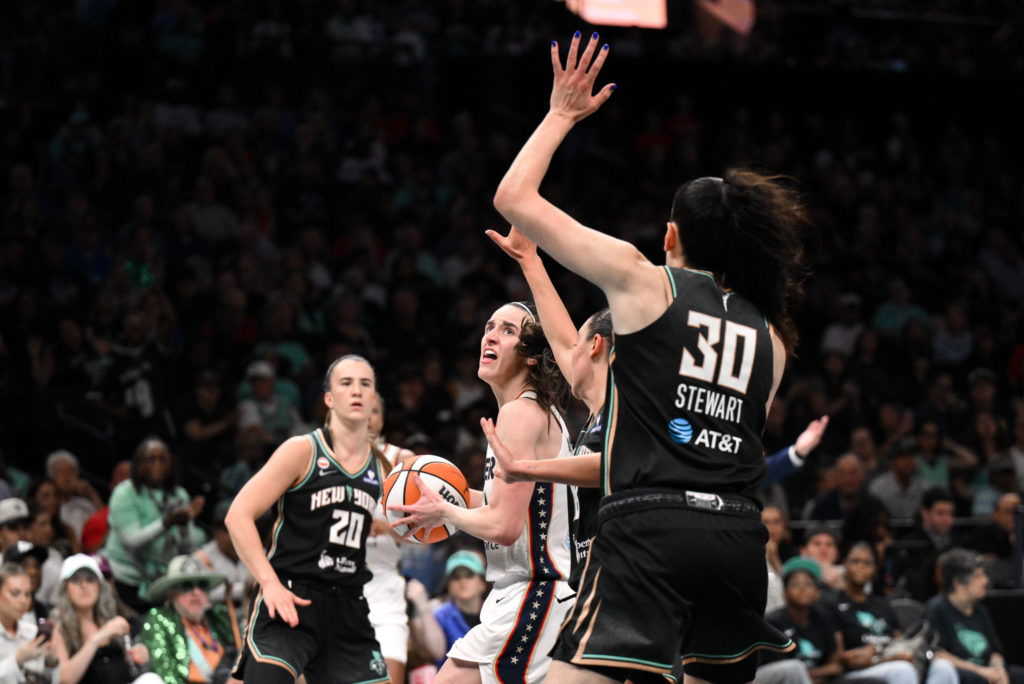
The Liberty defeated the Fever 109-102 on Saturday night, but the outcome of the game was secondary to the surrounding cultural dynamics. The incident underscores the WNBA’s unique position as a league that has long championed social justice and diversity. As debates over gender identity in sports continue to evolve nationally, the league finds itself at the center of a complex conversation about inclusion, competition, and free expression. Players like Stewart are working to ensure that the arena remains a space where fans can engage with the sport without fear or hostility.
Looking ahead, the WNBA must navigate these tensions while maintaining its competitive integrity and fan engagement. The lack of specific language in the collective bargaining agreement regarding gender identity means that future cases may require careful adjudication. League officials will likely need to develop clearer guidelines to address similar situations as they arise. For now, players are focusing on preserving the inclusive culture that distinguishes the WNBA from other professional sports leagues.
The situation remains fluid, with no immediate resolution in sight. The differing perspectives of Stewart and Cunningham illustrate the deep divisions within the broader public discourse. While some view the controversy as a threat to inclusivity, others see it as an opportunity for growth and visibility. The WNBA’s response to these challenges will likely influence how other sports organizations handle similar issues in the future. The league’s ability to balance competing interests while protecting its core values will be tested in the coming months.
Sources behind this briefing
Go to the original reporting
- PBS NewsHour↗Breanna Stewart wants WNBA arenas to be safe space as transgender debate sparks rallies at games

