The short version
- An open-wheel race is scheduled for late August on a track spanning Pennsylvania Avenue, with vehicles expected to reach speeds near 200 mph.
- Penske Corporation is funding the majority of infrastructure modifications, including welding over 220 manhole covers and erecting thousands of protective walls.
- The event is part of a broader series of celebrations organized by President Trump, drawing mixed reactions regarding the balance between historical commemoration and political spectacle.
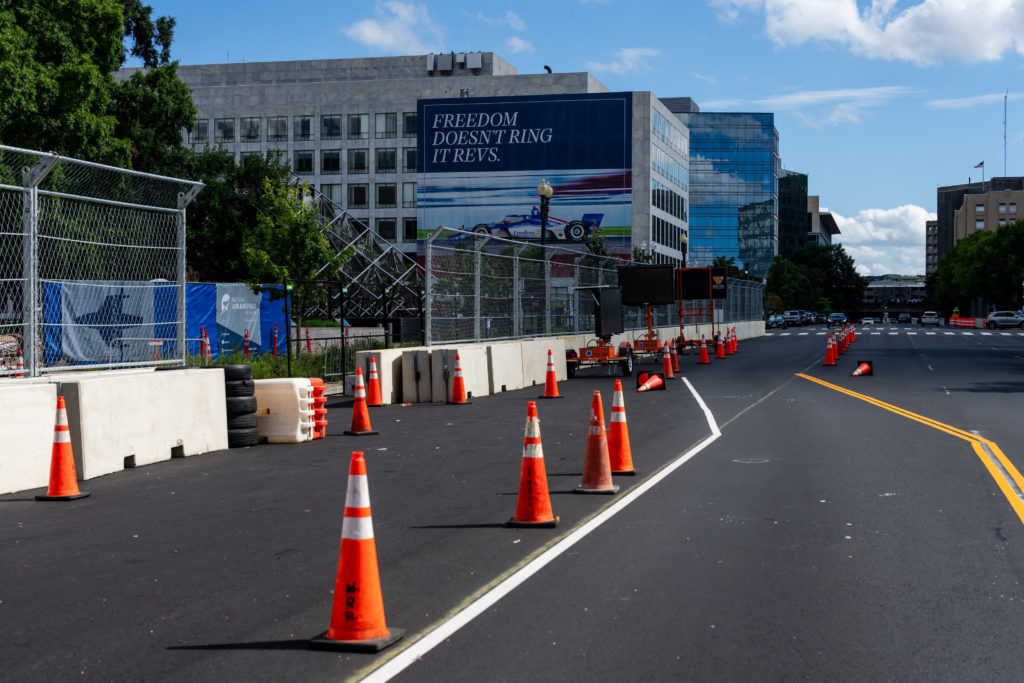
Washington D.C. is undergoing significant physical transformation to accommodate an open-wheel automobile race scheduled for August 22 and 23. The event, known as the Freedom 250 Grand Prix, will see high-performance vehicles traverse a 1.66-mile circuit that includes seven turns and stretches along Pennsylvania Avenue. While the standard speed limit on this thoroughfare is 25 mph, race cars are expected to travel at speeds approaching 200 mph, creating a stark contrast between daily urban life and the temporary racing environment.
The logistical preparations involve substantial engineering efforts to ensure safety and track integrity. Organizers have identified more than 220 manhole covers along the route that pose a risk of being dislodged by the aerodynamic downforce of the cars. To mitigate this, crews are welding these covers in place. Additionally, approximately 50 covers that sit too deep in the pavement are being fitted with silicone inserts to eliminate bumps that could destabilize vehicles traveling at high velocity.
Infrastructure costs for the event are primarily shouldered by Penske Corporation, led by Roger Penske, who received the Presidential Medal of Freedom in 2019. Bud Denker, president of Penske Corporation and chair of the race, stated that the company is paying for the vast majority of expenses, including road construction and improvements. He estimated that the cost for improving roughly one-third of the track would remain under $3 million, a figure he noted is lower than expenditures for similar events in other locations, such as Markham, Ontario.
The District of Columbia is contributing limited resources, primarily handling minor repaving tasks. The city’s roads are generally in good condition due to regular maintenance cycles, including resurfacing every four years for presidential inaugurations and recent work following a military parade on Constitution Avenue. Despite the relatively low cost of road repairs, the physical barriers required for the event are substantial. Organizers are installing 1,800 concrete walls, each weighing 10,000 pounds, to ring the track perimeter.
Security measures are also being integrated into the track design. Metal detectors will be positioned at key points and manned by Secret Service agents. The race is permitted to proceed in rainy conditions unless lightning strikes occur or significant puddling creates hazardous driving surfaces. This flexibility aims to ensure the event runs as scheduled, reflecting the high priority placed on its execution.
Public interest in the event appears robust. A lottery system was used to distribute tickets, with approximately 288,000 requests received for an estimated capacity of 130,000 spectators per day. The race will feature a 90-minute pre-race show and military flyovers, elements designed to enhance the spectacle. Federal agencies, including the Departments of Interior and Transportation, are assisting with permitting issues rather than providing funding. This support allows for activities such as vendor sales and vehicle displays on the National Mall, which are typically restricted.
The IndyCar race is the latest in a series of major events organized by President Donald Trump to mark America’s 250th birthday. Previous celebrations included a UFC fight on the White House South Lawn, a rally on the National Mall, and a fireworks display for Independence Day. These events have drawn attention for their scale and the prominent role played by the president in their organization.
Historical perspectives on these celebrations vary. Michael D. Hattem, a historian, suggested that the events focus less on the specific history of the nation’s founding and more on contemporary political themes. In contrast, White House spokesman Davis Ingle emphasized that the administration is focused on national renewal and patriotism, arguing that the president is not seeking personal recognition but rather ensuring a spectacular celebration for the country.
The future of racing in Washington remains uncertain. While President Trump has expressed interest in hosting more races in the capital, organizers are not committing to additional events. Bud Denker described the upcoming race as potentially unique, stating it might be the only one of its kind held in D.C. The event represents a significant intersection of sports, politics, and urban logistics, testing the city’s ability to host high-speed motorsports in a densely populated historic district.
As the date approaches, the focus remains on the technical execution of the race and the safety of spectators and participants. The combination of high speeds, complex infrastructure modifications, and large crowds requires precise coordination among local, federal, and private entities. The outcome will likely influence perceptions of how major national celebrations are managed in the nation’s capital.
Sources behind this briefing
Go to the original reporting
- PBS NewsHour↗D.C. prepares to host IndyCar street race as part of Trump's Freedom 250 celebrations

