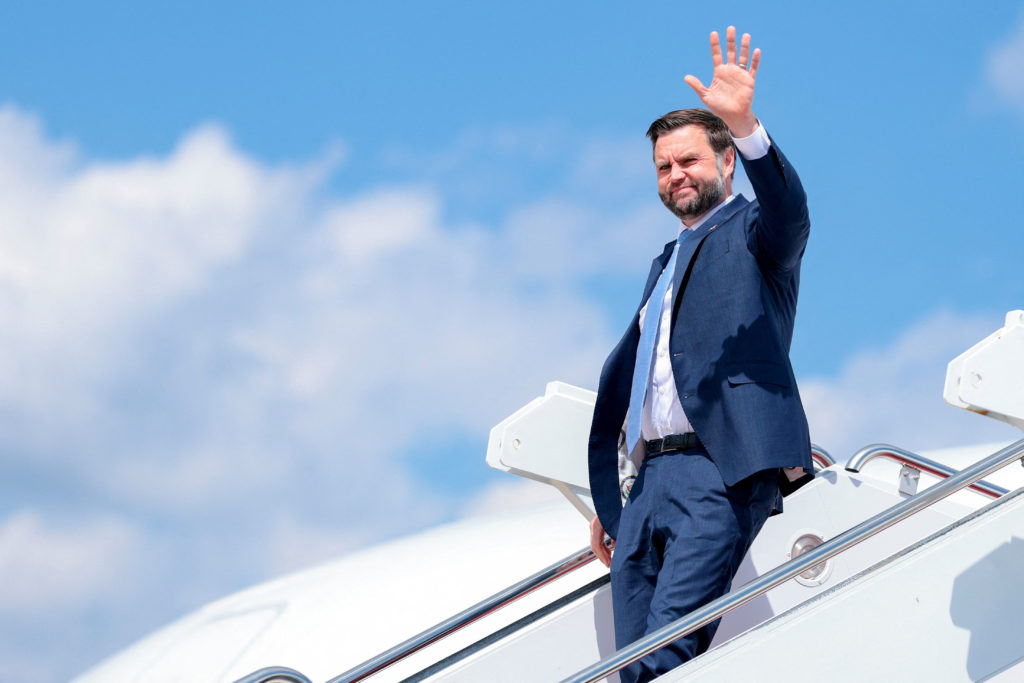
The short version
- Vice President JD Vance is scheduled to address the Republican Jewish Coalition, aiming to ease concerns regarding his recent comments on Israel and his ties to Tucker Carlson.
- Conservative Jewish activists express uncertainty about Vance's true sentiments, citing his criticism of Israeli officials and failure to disavow a commentator linked to antisemitism.
- The event highlights broader generational and ideological divides within the Republican Party over support for Israel and the handling of antisemitic rhetoric.
Vice President JD Vance is set to deliver a speech at the annual gathering of the Republican Jewish Coalition in Las Vegas, an appearance that carries significant weight given current political sensitivities. The event, which will not be open to news media, presents a critical opportunity for the vice president to address lingering doubts among conservative Jewish activists regarding his stance on Israel and his associations with polarizing figures. This moment arrives during a period of heightened tension concerning antisemitism across the political spectrum, just ahead of midterm elections where Republicans are seeking to frame Democrats as hostile toward Jewish communities and their ally in the Middle East.
Despite these efforts, the Republican Party is grappling with its own internal fractures. Vance’s recent remarks have sparked confusion and discomfort among some coalition members who question his commitment to traditional pro-Israel positions. Last month, he suggested that certain Israeli officials were attempting to manipulate American public opinion to extend the conflict with Iran. Such comments have led some observers to view him as more skeptical or equivocal toward Israel compared to President Donald Trump, a perception that has unsettled influential Jewish conservatives who rely on steadfast support from Republican leadership.
Compounding these concerns is Vance’s continued association with Tucker Carlson, a conservative commentator who previously hosted Nick Fuentes, an individual widely recognized for antisemitic views. Although Vance has expressed general support for Israel, he has not explicitly disavowed Carlson, a stance that has drawn criticism from prominent figures within the conservative movement. Bruce Pearl, a well-known pro-Israel advocate and college basketball coach, stated earlier this year that Vance would need to reject Carlson to earn his backing. Pearl warned that maintaining such connections could exacerbate antisemitism by elevating similar voices within the party.
The atmosphere at the Republican Jewish Coalition summit reflects these deep-seated anxieties. Terry Platt, a member from New York, noted that there is a palpable sense of unease regarding Vance’s participation, with some attendees expressing disappointment and confusion about his true intentions. This sentiment echoes broader frustrations within the conservative Jewish community, which has used recent summits to confront antisemitism directly. A year ago, the event shifted from celebrating diplomatic successes to condemning internal party failures after Heritage Foundation President Kevin Roberts refused to distance the organization from Carlson following his interview with Fuentes.
Vance’s specific criticisms of Israeli leadership have further complicated his standing. In June, he sharply rebuked members of Israel’s government for opposing President Trump’s efforts to resolve the war with Iran, suggesting they were attacking their most powerful ally. Later, in a July podcast appearance, he claimed that elements within the Israeli system were deliberately trying to derail negotiations by influencing American public opinion. These statements have been interpreted by some as undermining the longstanding alliance between the United States and Israel, raising questions about Vance’s strategic priorities and diplomatic approach.
The political landscape surrounding Israel support is shifting, particularly among younger voters. While Republicans generally maintain stronger backing for Israel than Democrats, a generational divide is emerging. Younger Republicans are increasingly likely to believe that the United States provides too much support to Israel, mirroring trends seen in Democratic polling. An AP-NORC poll released in July indicated that roughly half of Democrats believe Israel has committed genocide against Palestinians, an accusation vehemently denied by both Israeli and U.S. officials but highlighted by some human rights organizations.
For influential Jewish conservatives, these shifts are disconcerting. They have long relied on the Republican Jewish Coalition to push back against antisemitism and ensure that elected officials stand firmly with the Jewish community. Representative Lisa McClain of Michigan emphasized the importance of this work, stating that it begins within their own ranks. The coalition’s annual summit has become a focal point for addressing these issues, serving as both a platform for advocacy and a mirror reflecting internal party struggles.
As Vance prepares to speak, the stakes are high. His ability to reassure conservative Jewish activists will likely depend on how clearly he articulates his support for Israel and distances himself from controversial figures like Carlson. The outcome of this address could influence perceptions of his leadership qualities and his viability as a potential successor to President Trump in 2028. With the Republican Party navigating complex internal dynamics, Vance’s words may help clarify whether he can bridge existing divides or if they will deepen further.
The broader implications extend beyond individual speeches. The tension between traditional pro-Israel advocacy and emerging skepticism within the GOP highlights a significant realignment of political alliances. As antisemitism concerns surge and generational attitudes shift, Republican leaders must carefully balance loyalty to longstanding allies with evolving voter sentiments. Vance’s upcoming address will be closely watched as a test case for how the party manages these competing pressures in an increasingly polarized environment.
Ultimately, the Republican Jewish Coalition summit serves as a barometer for the health of conservative Jewish engagement with the GOP. If Vance fails to alleviate concerns, it could signal deeper fractures within the party’s base. Conversely, a successful address might demonstrate his ability to navigate complex political landscapes and unify disparate factions. The coming days will reveal whether his efforts resonate with key stakeholders or if they exacerbate existing tensions, shaping the trajectory of Republican politics in the years ahead.
Sources behind this briefing
Go to the original reporting
- PBS NewsHour↗Vance will address Republican Jewish Coalition amid lingering tension over Israel and antisemitism

