The short version
- Endurance Energy deployed a prototype power plant at the Axial Seamount, generating net-positive electricity for nearly nine seconds before a software safety shutdown halted operations.
- The test utilized a drilled well that proved too shallow and narrow to deliver sufficient hydrothermal fluid, forcing engineers to connect the system to a natural vent instead.
- Experts note that while technically feasible, subsea geothermal projects face higher costs and complex operational hurdles compared to land-based alternatives.
A pioneering test of underwater geothermal energy has demonstrated that it is technically possible to generate net-positive electricity from the seafloor, marking a significant milestone for renewable energy exploration. The experiment, conducted by Seattle-based startup Endurance Energy, took place near the Axial Seamount in the northeast Pacific Ocean during September 2026. Although the power generation lasted only a brief period, the successful production of more electricity than the system consumed validates the core concept of tapping into deep-ocean heat sources.
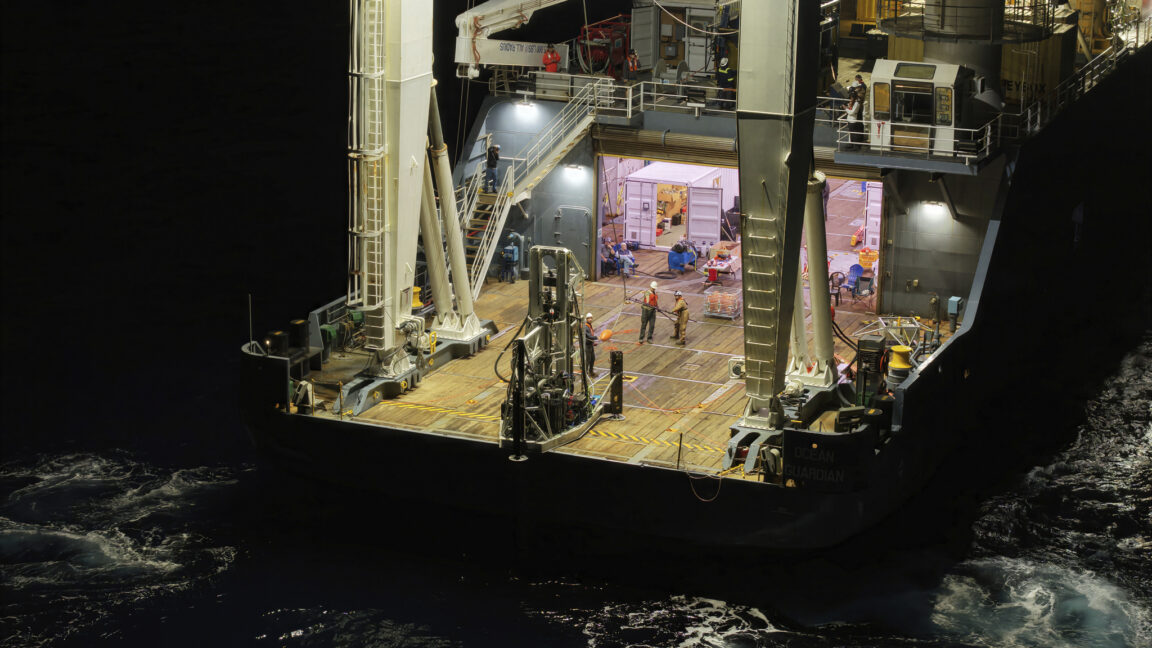
The deployment involved a three-week operation using a specialized subsea lander drill launched from the ship Ocean Guardian. Engineers drilled two holes approximately 5,000 feet below the surface, reaching depths that exceed 2.5 times the height of the One World Trade Center. Both boreholes began venting hydrothermal fluid at temperatures around 500 degrees Fahrenheit. The team then cased and cemented the second hole to create a stable well structure, preparing it for connection to their prototype power plant.
The central component of this effort is Adélie, a 100-kilowatt power plant designed to vaporize incoming hot fluid to spin a turbine and drive an electric generator. To facilitate remote monitoring and control, the system was connected to the Regional Cabled Array, a vast undersea network of fiber-optic and electric cables funded by the National Science Foundation and operated by the University of Washington. This infrastructure allowed the Seattle command center to oversee operations in real time from thousands of miles away.
However, the initial phase of the test encountered immediate logistical setbacks. The drilled well, which extended only 52 feet into the seafloor with a diameter of just two inches, failed to deliver enough hydrothermal fluid to sustain power generation. Company leadership acknowledged that keeping the well small and shallow was a deliberate choice for this first proof-of-concept phase, focusing on demonstrating the ability to drill, case, cement, and cap a well underwater rather than maximizing output.
To proceed with the energy generation test, engineers redeployed the Adélie unit to a nearby natural vent where hydrothermal fluid was already flowing at approximately 538 degrees Fahrenheit. On September 27, the team initiated the power run. Over the course of nearly thirty seconds, the turbine accelerated to about 26,000 revolutions per minute, enabling the generator to produce 60 watt-hours of electricity. This marked the first time a subsea geothermal system had achieved net-positive power output.
During this brief window, the system produced a median of roughly 2 kilowatts of net power, peaking at 16.5 kilowatts for approximately 8.7 seconds. This achievement represents a critical threshold in deep-sea energy development, proving that the mechanical and thermodynamic principles can work in an underwater environment. The success relied on the unique advantages of the deep ocean, including unlimited cold seawater for cooling and the immense water pressure that helps keep the system pressurized and compact.
Despite this breakthrough, the operation was abruptly terminated by a software safety protocol. As the system spun up, it relied on battery power to run pumps, thrusters, and controls before the generator could take over. A battery module recorded a brief spike in current and then ceased reporting data. The onboard software interpreted this loss of signal as a potential hazard and automatically shut down the plant to prevent damage, relying on the last known reading from the faulty module.
Industry observers caution that technical feasibility does not guarantee economic viability. Roland Horne, a professor at Stanford University, noted that while such projects are possible, they will likely be more expensive than land-based geothermal operations. Endurance Energy aims to address these challenges in future tests by drilling deeper wells, up to 260 feet, to access greater volumes of fluid. The company’s long-term goal is to provide reliable, renewable energy alternatives for Pacific island nations and other regions currently dependent on imported fossil fuels.
The next steps for Endurance Energy involve refining the drilling technology to create wider and deeper wells that can sustain continuous power generation. Overcoming the high installation and operational costs associated with deep-sea infrastructure remains a significant hurdle. If successful, this technology could offer a stable baseload power source for remote coastal communities, reducing their reliance on volatile fuel markets and lowering carbon emissions in regions vulnerable to climate change impacts.
Sources behind this briefing
Go to the original reporting
- Ars Technica↗Startup taps underwater volcano as energy source in "proof point" test

