The short version
- Ukrainian forces struck two major oil refineries deep inside Russia, aiming to disrupt revenue streams funding the war effort.
- Russian drone attacks caused widespread blackouts in Kherson and killed at least eleven people across multiple regions.
- Both nations are intensifying strikes on energy and transport infrastructure as frontline positions remain largely static.
Ukraine has launched significant strikes against oil processing facilities located deep within Russian territory, marking an escalation in its campaign to target the economic foundations of the ongoing war. President Volodymyr Zelensky confirmed that Ukrainian forces hit the Bashneft-Novoil refinery in the Bashkortostan republic and the Slavneft-Yanos facility in the Yaroslavl region. These sites are situated approximately 1,300 kilometers and 700 kilometers from the Ukrainian border, respectively, demonstrating an extended reach for Kyiv’s military operations.
The stated objective of these attacks is to limit the oil revenues that Moscow utilizes to finance its military campaign. Zelensky emphasized that these actions are intended to strengthen the prospects for diplomacy by pressuring Russia economically. He also reported that Ukrainian naval forces in the Black Sea had struck two military patrol boats and vessels associated with Russia’s shadow fleet, which are used to export sanctioned oil despite international restrictions.
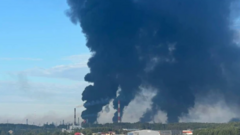
In response to the strike on Slavneft-Yanos, Yaroslavl regional governor Mikhail Evraev described the event as the largest enemy drone attack experienced by the region. He reported that falling debris damaged storage tanks at the refinery, resulting in multiple fires. Emergency services were deployed to extinguish the blaze, and four individuals were injured in the incident. Evraev stated that 93 drones were intercepted over the Yaroslavl region during the overnight operation.
Visual evidence corroborates the severity of the damage at the Slavneft-Yanos site. Verified images and video footage shared on social media show large plumes of smoke rising from the facility, with at least four distinct fires visible. The energy infrastructure in Yaroslavl has been a recurring target for Ukrainian forces, suggesting a strategic focus on disrupting regional industrial output.
While authorities in Bashkortostan have not issued public comments regarding the reported attack on the Bashneft-Novoil refinery, the pattern of strikes indicates a coordinated effort to degrade Russia’s fuel production capabilities. This approach contrasts with earlier phases of the conflict, where Ukrainian operations were more focused on frontline defenses and immediate tactical gains.
Simultaneously, Russian forces have intensified their own aerial campaign against Ukrainian infrastructure. At least eleven people were killed in overnight attacks across several regions. In the Kharkiv region, three fatalities occurred in Balakliya when drones struck private residential buildings, causing fires in two structures. Two additional deaths and eight injuries were reported in Lozova after a drone attack on a train station.
Further casualties were recorded in the central Dnipropetrovsk region, where five people died from Russian strikes. In the Black Sea port of Odesa, one person was killed when two dry cargo ships were hit. The Russian military claimed to have intercepted or shot down 605 Ukrainian drones overnight and stated that their forces targeted fuel, energy, and transport facilities, as well as drone storage sites.
The impact on civilian infrastructure in Ukraine has been severe, particularly in the south. The city of Kherson experienced a total blackout after a critical infrastructure facility was struck. Internet monitoring group NetBlocks observed significant disruption to connectivity in the region, with access dropping to approximately 31% at its lowest point. Connectivity remained unstable, hovering around 69% by midday, aided only by the use of generators and backup power supplies.
This mutual escalation in attacks on energy and transport networks occurs as the vast frontline remains virtually static and mediation efforts have failed to produce a breakthrough. Both sides appear to be shifting strategy toward inflicting economic pain and degrading each other’s logistical capabilities. The intensification of strikes on major cities and industrial sites underscores the growing desperation and determination on both sides.
As the conflict enters its fourth year, the targeting of deep infrastructure suggests that neither side is willing to concede ground without significant cost. The destruction of oil refineries in Russia and power grids in Ukraine highlights the expanding scope of the war beyond traditional battlefield engagements. The human toll continues to rise, with civilians bearing the brunt of these strategic decisions.
Sources behind this briefing
Go to the original reporting
- BBC World↗Ukraine hits two oil refineries deep in Russian territory

