The short version
- Uefa President Aleksander Ceferin has explicitly stated he will not run for the Fifa presidency in March 2027, despite being viewed as a leading potential candidate.
- The decision follows intense backlash against Fifa President Gianni Infantino after he abandoned a controversial plan to sell commercial rights stakes to private investors.
- While European and other confederations have withdrawn support for Infantino, African and South American bodies remain loyal, creating a divided global football landscape.
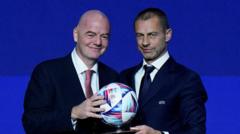
Aleksander Ceferin, the president of Uefa, has formally removed himself from consideration to succeed Gianni Infantino as head of Fifa. The announcement clarifies the leadership vacuum that has emerged within international football governance following a significant crisis of confidence in Infantino’s administration. Ceferin, who has long been regarded as a plausible contender for the top job, indicated that he does not intend to stand for election at the upcoming Fifa Congress scheduled for March 2027.
Ceferin provided two primary reasons for his decision. First, he expressed a strong personal attachment to his current role and a desire to enjoy life outside of high-stakes political maneuvering. Second, he argued that maintaining his credibility is more effective if he remains uninvolved in the Fifa presidential race. By staying out of the contest, Ceferin believes he can preserve his standing as an independent voice within European football rather than becoming a partisan actor in a global power struggle.
The context for this leadership uncertainty stems from Infantino’s recent reversal on a major commercial initiative. The Fifa president had proposed creating a new entity, Fifa Forward Enterprise, to manage the commercial and ticketing rights of all Fifa competitions. Under this plan, 21 percent of the enterprise would have been sold to a private investment company. The proposal triggered immediate and severe opposition from across the football community, leading Infantino to scrap the plan after widespread condemnation.
Uefa led the charge against the initiative, with its member associations voting to boycott future World Cups unless the proposal was abandoned. In an open letter issued jointly by Uefa, Concacaf, and the Asian Football Confederation, these bodies accused Infantino of breaking trust through deception. The backlash has resulted in several national football associations withdrawing their formal support for the Fifa president, signaling a fracture in his political base.
Despite the erosion of support from European and other confederations, Infantino retains backing from key regions. Conmebol, the governing body for South American football, and Caf, which oversees African football, continue to endorse him. Samuel Eto’o, president of the Cameroonian Football Association and a former Barcelona striker, defended Infantino’s record. He argued that the scrapped project could have reset the balance of power in global football, ensuring that talent from smaller nations does not disappear into larger federations.
Eto’o emphasized that Infantino has expanded opportunities for nations that previously lacked access to major tournaments like the World Cup. He highlighted the development assistance provided to African federations and suggested that the president’s efforts have helped smaller countries gain seats at competitive tables. This perspective underscores the geopolitical divide within Fifa, where developing regions often view commercial expansion as a pathway to growth, while established European bodies see it as a threat to sporting integrity.
Ceferin criticized Infantino’s approach, describing the scrapped plan as worse than the proposed European Super League, which collapsed in 2021 after intense scrutiny. He noted that Uefa had no prior knowledge of the Fifa proposal and only learned of it through media reports while he was on holiday. Ceferin accused Infantino of adopting an arrogant stance toward Europe, suggesting that the Fifa president forgot the support he received from Uefa during his earlier career.
Infantino has spent recent weeks traveling globally to rally public support. He met with Caribbean Football Union members in the Dominican Republic and attended the E-Sports World Cup in Paris, where he was joined by French President Emmanuel Macron, Saudi Crown Prince Mohammed bin Salman, and Portuguese forward Cristiano Ronaldo. These appearances appear aimed at demonstrating broad international backing despite the institutional criticism from confederations.
Looking ahead, Ceferin predicted that Infantino will either step down due to a lack of support or face a challenge in the March election. He noted that the support deficit extends beyond voting blocs to include fans, players, coaches, and former athletes. While Ceferin will not be among the candidates, he expects another contender to emerge, ensuring that the upcoming Fifa Congress will likely feature a contested leadership battle rather than a smooth re-election.
The situation highlights the ongoing tension between commercial interests and traditional sporting values in global football. As Infantino navigates this period of instability, the withdrawal of support from home nations and major confederations suggests that his authority is significantly weakened. The outcome of the March 2027 election will determine whether Fifa continues under current leadership or transitions to a new direction shaped by the concerns raised by Uefa and its allies.
Sources behind this briefing
Go to the original reporting
- BBC Sport↗Uefa chief Ceferin rules out Fifa presidency bid
