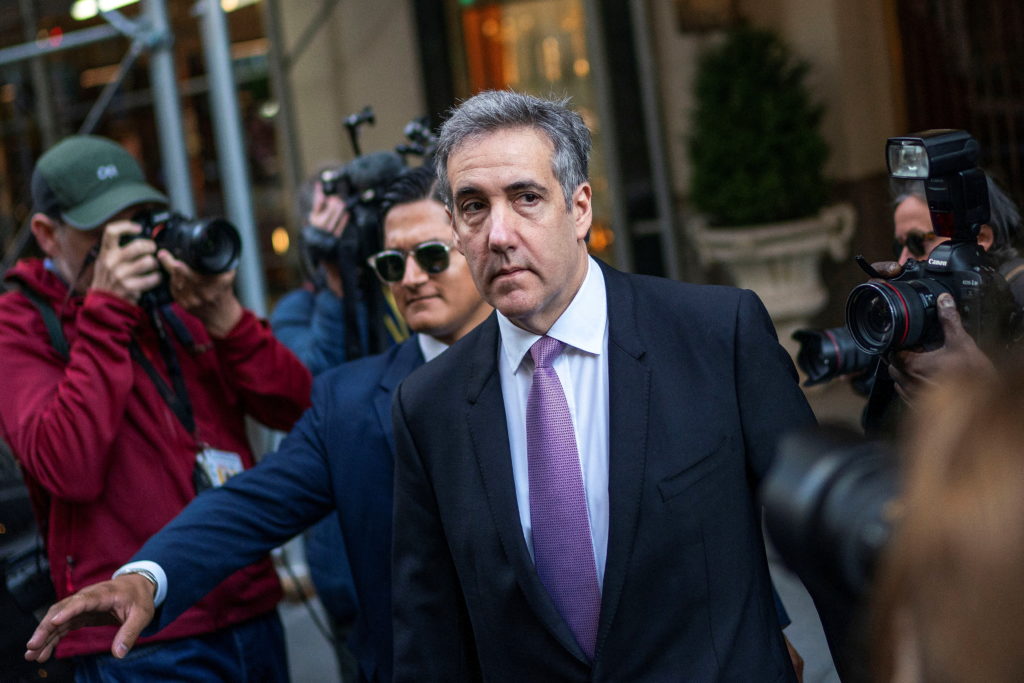
The short version
- President Trump is set to tape an interview with Michael Cohen, his former personal attorney who previously testified against him in court and before Congress.
- The appearance signals a public thaw in their relationship, joining other recent reconciliations between the president and former allies such as Elon Musk and Ron DeSantis.
- Cohen has recently criticized prosecutors in the hush-money case, suggesting he felt pressured to testify against Trump, while maintaining that their long history of friendship persists despite past conflicts.
President Donald Trump is scheduled to appear on the radio program of Michael Cohen, his former personal attorney and political operative who once served as a key witness against him in both criminal and civil legal proceedings. The taped interview is expected to air on WABC Thursday evening and again on Sunday, marking a significant public reunion between two men whose relationship has been defined by intense loyalty followed by bitter litigation and mutual recrimination.
Cohen confirmed the upcoming appearance through his online newsletter, framing the event as a continuation of a fifteen-year friendship that survived periods of severe conflict. He acknowledged that their dynamic had become a form of political combat but insisted that positive memories from their earlier years remain valid despite subsequent hostilities. The White House did not issue a formal comment on Cohen’s statements or explicitly confirm the booking, though Trump’s official schedule listed a radio interview taping for Thursday morning.
This development places Cohen among a growing list of individuals who experienced public falling-outs with the president only to return to his circle of influence or goodwill. Recent examples include Elon Musk and Florida Governor Ron DeSantis, both of whom had strained relations with Trump before re-establishing closer ties. However, the rift with Cohen was notably more personal and legally consequential than those other disputes.
Cohen previously described himself as someone willing to take a bullet for Trump during the president’s rise to power. That loyalty fractured dramatically when Cohen pleaded guilty in 2018 to campaign finance violations and lying to Congress. He served prison time for his role in arranging payments to Stormy Daniels and Karen McDougal, which he characterized at the time as efforts to cover up Trump’s extramarital affairs.
The legal consequences of that breakdown were severe for Trump. Cohen’s testimony in 2019 before Congress alleged that Trump had a history of inflating asset values to secure favorable loans and tax benefits. Similar testimony contributed to a 2023 civil fraud trial finding that Trump and his companies engaged in long-term deception regarding his wealth. Although a New York appeals court later overturned a $550 million judgment from that case, Trump continues to seek judicial relief for remaining aspects of the litigation.
Perhaps most critically, Cohen’s testimony was central to Trump’s 2024 criminal conviction on thirty-four felony counts of falsifying business records related to the hush-money payment. Prosecutors argued the payments were illegal attempts to influence the 2016 presidential election. Cohen’s role as a star witness made him a primary target for Trump’s defense team, which sought to undermine his credibility throughout the trial.
In recent months, however, Cohen has shifted his narrative regarding those legal proceedings. He has publicly criticized prosecutors, claiming he felt pressured to testify against Trump in both the criminal hush-money case and the civil fraud matter. While Trump has not issued warm public statements about Cohen, he has shared social media posts linking to Cohen’s comments about prosecutorial pressure, signaling a tacit acceptance of Cohen’s revised stance.
Cohen’s 2020 memoir, titled Disloyal, offered a scathing portrait of Trump as an organized crime figure and manipulator. Yet even in that text, Cohen expressed lingering affection for the president, noting that his care for Trump had not entirely vanished. The upcoming radio interview suggests that this residual connection has evolved into a more overt reconciliation, allowing both men to move past the legal battles that once defined their public interaction.
The significance of this reunion extends beyond personal dynamics. It reflects a broader strategy of consolidating support by neutralizing former critics and integrating them back into the political fold. For Trump, restoring ties with Cohen may help mitigate the impact of past testimony by presenting a united front against previous legal adversaries. For Cohen, it offers a platform to reshape his public narrative from that of a whistleblower to a reconciled ally.
Observers will likely watch for further indications of how this renewed relationship affects ongoing political and legal discussions. Whether this marks a permanent shift or a temporary tactical alignment remains unclear. What is evident is that the boundaries between former enemies and current allies in Trump’s orbit continue to blur, complicating efforts to predict future alliances and conflicts within his political ecosystem.
Sources behind this briefing
Go to the original reporting
- PBS NewsHour↗Michael Cohen, Trump's former fixer-turned-enemy, is hosting the president on his radio show

