The short version
- President Trump and First Lady Melania Trump participated in a ceremonial lap ahead of the historic IndyCar race through downtown Washington.
- The event is part of a broader series of spectacles marking the nation's 250th anniversary, funded largely by Roger Penske with significant city infrastructure modifications.
- Critics and observers note the focus on ceremonial pageantry coincides with political challenges regarding foreign policy conflicts and rising fuel costs.
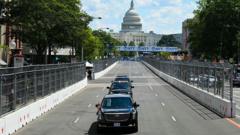
President Donald Trump and First Lady Melania Trump arrived at the streets of Washington, D.C., to oversee the commencement of the Freedom 250 Grand Prix, an IndyCar race that marks a historic first for professional road racing in the nation's capital. The couple completed a ceremonial lap of the 1.7-mile circuit aboard the presidential limousine known as The Beast, a tradition that underscores the administration's emphasis on ceremonial duties during this second term. As the vehicle crossed the finish line, a new Air Force One aircraft performed a flyover, adding to the military spectacle that has characterized recent national events.
The race serves as the culmination of a summer-long series of festivities designed to celebrate the United States' 250th birthday. Organizers have framed the event as a showcase of American power and freedom, with Trump previously describing the roaring engines as a symbol of liberty unlike any seen before. The track winds past iconic landmarks including the Washington Monument, various museums on the National Mall, and concludes with the U.S. Capitol building visible in the background. Twenty-five professional drivers are set to compete over 147 laps, covering a total distance of 250 miles, a deliberate nod to the semiquincentennial anniversary.
Logistical preparations for the event have been extensive, requiring significant modifications to the city's infrastructure. Washington, D.C., typically enforces a maximum speed limit of 55 mph, making the prospect of vehicles reaching speeds up to 190 mph a stark departure from daily norms. To ensure safety, crews bolted down more than 200 manhole covers to prevent them from being dislodged by the aerodynamic suction of the open-wheel cars. Additionally, road resurfacing was undertaken, with the District of Columbia handling some repaving while Roger Penske, owner of the IndyCar series and a longtime associate of the president, covered the vast majority of costs associated with track construction and improvements.
The event has drawn substantial public interest, with organizers estimating attendance of approximately 140,000 spectators. Many attendees secured free general admission through a lottery system, while premium viewing packages commanded prices around $3,600 for two passes. The influx of visitors and the high-speed nature of the race necessitated widespread road closures and a temporary three-hour airspace restriction at Ronald Reagan Washington National Airport to accommodate military flyovers. These measures highlight the complex coordination required to host such a large-scale sporting event in a densely populated urban center.
This Grand Prix is the latest in a series of high-profile events hosted by the Trump administration to mark the nation's anniversary. Earlier celebrations included an Ultimate Fighting Championship bout on the White House lawn, a massive fireworks display on July 4th, and a state fair headlined by the president after several musical acts withdrew. These gatherings have been characterized by their emphasis on spectacle, Americana, and the presence of the president's inner circle. An executive order signed earlier this year declared that the race would inspire awe and respect, positioning the sport as quintessentially American.
The focus on ceremonial pageantry has drawn attention amid broader political challenges. The administration is currently navigating a conflict with Iran that began nearly six months ago, a situation that has contributed to rising gasoline prices and increased concerns among Republican officials about voter sentiment ahead of the midterm elections. Critics suggest that the president's engagement in sporting events and celebratory spectacles may be perceived as a distraction from pressing economic issues, including cost-of-living concerns that are affecting households across the country.
Roger Penske played a pivotal role in bringing the race to Washington, leveraging his relationship with the president to secure the event. His involvement includes not only financial backing but also the organizational effort required to transform city streets into a viable racing circuit. The decision to host the race in D.C. reflects a broader strategy of imprinting the administration's legacy on the capital, which has included other visible changes such as large banners displaying the president's image and renovations to White House interiors.
As the cars prepare to take the track, the event stands as a testament to the intersection of politics, sports, and national identity. The juxtaposition of high-speed motorsports against the backdrop of historic monuments offers a unique visual narrative for the semiquincentennial celebrations. While the race promises excitement and entertainment for attendees, it also serves as a focal point for discussions about the role of the presidency in shaping public events and the priorities of the current administration.
The outcome of the race itself remains uncertain, with drivers facing seven crucial turns and the challenge of navigating a course that demands precision at high speeds. The event concludes a busy summer of national celebrations, leaving observers to assess the impact of these spectacles on public perception and political discourse. As the festivities wind down, attention may shift back to the policy challenges that have persisted throughout the year, including foreign relations and domestic economic stability.
In the coming days, the city will begin the process of restoring normal traffic patterns and removing temporary structures installed for the race. The legacy of the Freedom 250 Grand Prix will likely be measured not only by its success as a sporting event but also by its role in the broader narrative of America's 250th birthday. The administration's use of such events to project strength and unity continues to define its approach to governance and public engagement.
Sources behind this briefing
Go to the original reporting
- BBC World↗Trump arrives at high-speed IndyCar race through Washington's streets
- PBS NewsHour↗Trump will kick off the IndyCar race before cars zoom through Washington's streets

