The short version
- The president has posted multiple AI-generated images pairing him with George Washington and World War II generals.
- These posts coincide with reports of low morale on deployed naval vessels and difficulties in negotiating with Iran.
- Analysts suggest the imagery serves to project a legacy of foundational leadership during a period of political vulnerability.
President Donald Trump has increasingly turned to artificial intelligence-generated content on his social media platform as he faces intensifying scrutiny over foreign policy and domestic approval metrics. In recent weeks, the president has shared a series of synthetic images that place him alongside prominent historical American figures, including George Washington and World War II generals. This digital strategy appears designed to bolster his public image at a time when his administration is grappling with significant challenges regarding the ongoing conflict with Iran and internal military morale issues.
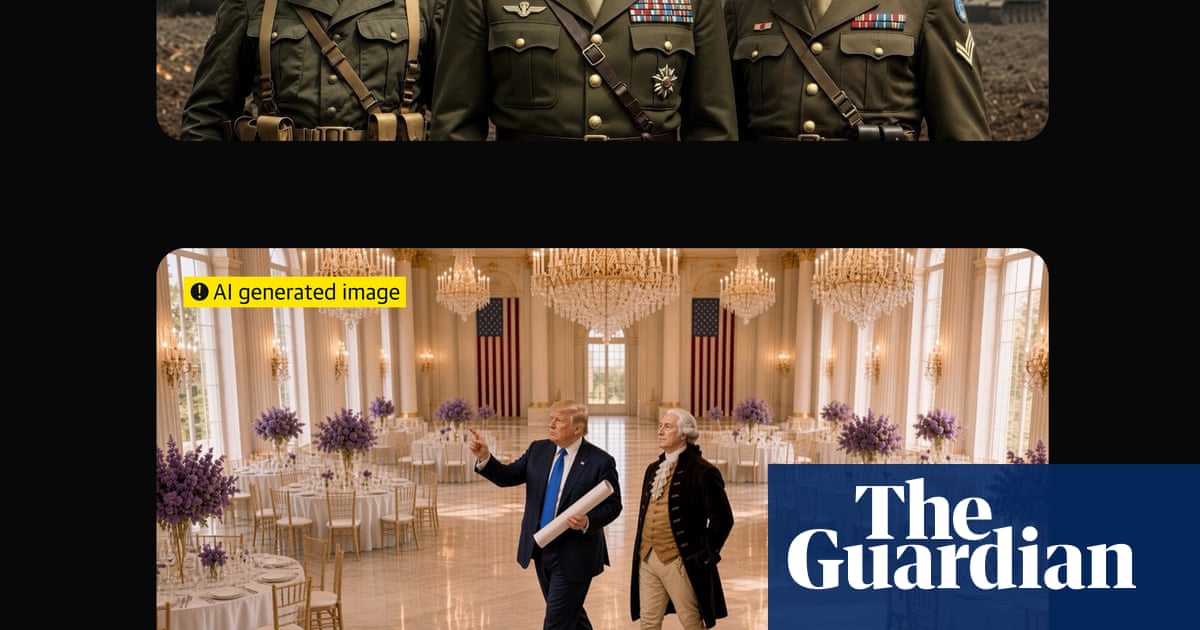
The visual campaign began earlier this month with posts depicting Trump standing beside George Washington in what appears to be a rendering of the White House ballroom. The initial post showed the two figures side by side, followed quickly by three additional images featuring similar settings. In one variation, the pair looks into the distance; in another, Trump holds a document while pointing upward. These posts were made without explanatory captions, leaving the intended message to be inferred from the visual context alone.
The frequency of these posts increased over the following days. On a subsequent day, Trump shared an image of himself and Washington seated at a table with quills poised over a map, suggesting a collaborative planning effort. This was followed shortly by an image showing the two men on horseback, with Washington mounted on a white horse and Trump on a black one. The rapid succession of these posts suggests a deliberate effort to saturate his feed with this specific narrative thread.
A video posted on Sunday offered a more dynamic version of this theme. The clip showed Washington and Trump walking through the ballroom, taking turns pointing at the ceiling as if inspecting construction progress. This focus on the ballroom is not new; the president has previously described the renovation as a key legacy project. When political pressure mounts, he often retreats to topics related to this physical transformation of the executive mansion, using it as a tangible symbol of his tenure.
The timing of these posts correlates with reports of deteriorating conditions aboard the USS Abraham Lincoln. The aircraft carrier has undergone a record-breaking deployment, and recent accounts highlight poor living conditions and low morale among the crew. Simultaneously, the administration is struggling to finalize a diplomatic deal with Tehran. Against this backdrop of operational friction and diplomatic stalemate, the AI-generated content offers a stark contrast, presenting an idealized version of presidential authority and historical significance.
Angelo Carusone, president and CEO of Media Matters, interpreted these moves as an attempt to equate Trump’s status with that of the nation’s first president. He noted that the technology allows the president to project his imagination into reality, effectively positioning himself as a founder rather than just an occupant of the office. Carusone compared this digital legacy building to the posthumous naming of landmarks after Washington, suggesting Trump is constructing a living monument to his own presidency while still in power.
The White House did not directly address questions about whether the president believes he has interacted with historical figures who died centuries ago. Instead, a spokesperson emphasized the role of Truth Social as a direct communication channel that bypasses traditional media filters. The statement described the platform as the most powerful and popular social media network, asserting that it allows the president to share his authentic voice without contextual distortion from biased outlets.
Beyond the Washington imagery, Trump has also posted AI-generated content featuring military themes. One image showed him in uniform, flanked by Generals George Patton and Douglas MacArthur on a battlefield. In this depiction, Trump is adorned with six rows of medals, outnumbering those displayed by the historical generals combined. The background includes burning tanks, reinforcing a narrative of wartime leadership. This visual rhetoric seems aimed at securing a legacy as a successful commander-in-chief, complementing his efforts to be remembered for architectural and foundational contributions.
The use of AI in this manner raises questions about the intersection of technology and political messaging. By leveraging synthetic media, the president can craft specific narratives that might be difficult or impossible to achieve through traditional photography or video production. This approach allows for precise control over the visual association between his administration and revered historical icons, potentially shaping public perception during a period of declining approval ratings.
As the situation in Iran remains unresolved and domestic criticism persists, the reliance on these digital artifacts may continue. The strategy reflects a broader trend of using technology to manage political narratives, but it also highlights the challenges facing the current administration. Whether this approach will effectively counteract negative reporting or simply serve as a distraction remains to be seen, but it underscores the lengths to which the president is willing to go to maintain his desired public image.
Sources behind this briefing
Go to the original reporting
- The Guardian World↗AI slopper in chief: Trump turns to social media amid tough questions

