The short version
- President Trump held an impromptu press event to highlight White House construction rather than address the Republican Party's significant losses in the midterm elections.
- Polling data indicates that many voters viewed the president as a liability, with majorities in several key states citing excessive support for Trump as a reason for rejecting GOP Senate candidates.
- Despite urging supporters to treat his name as if it were on the ballot during the campaign, Trump now argues he was not responsible for the election results.
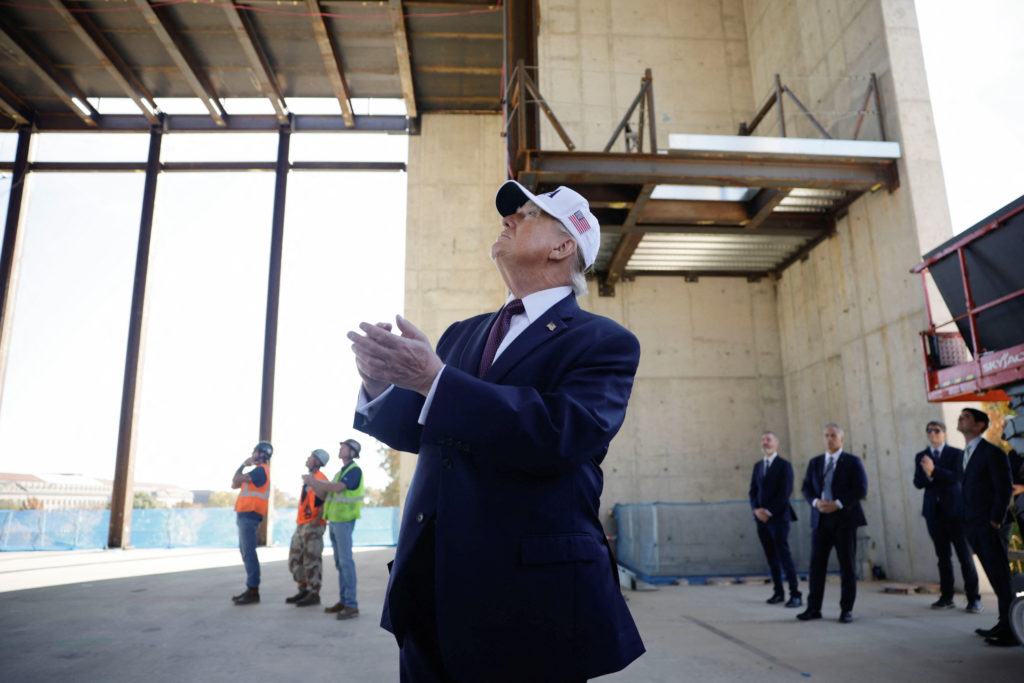
President Donald Trump chose to spend Wednesday morning justifying a major White House renovation project rather than addressing the historic defeat suffered by his party in the midterm elections. Inviting reporters into a large construction site, the president spoke for nearly twenty minutes about the installation of a new ballroom, a structure he described as unprecedented in scale. He watched crews place what he claimed was the final beam of the project and signed the construction materials before briefly taking questions. The event was not on his original schedule, suggesting a deliberate pivot away from the political fallout that had unfolded just hours earlier.
The Republican Party faced sweeping losses across the country, resulting in Democrats regaining control of Congress. These victories included surprising wins in states that have long been considered strongholds for the GOP, such as South Carolina and Kansas, where no Democratic senator had been elected since 1932. In Texas, Democrats broke a decades-long streak of being shut out of statewide races. Despite the magnitude of these defeats, Trump made no mention of the election results during his remarks about the building project, focusing instead on the physical expansion of the executive mansion.
When pressed by reporters, the president insisted that he would have won if his name had appeared on the ballot. He argued that while his recent rallies generated significant enthusiasm among supporters, this energy failed to transfer to the Republican candidates running for office. This stance marks a sharp contrast to the campaign strategy he employed in the weeks leading up to the election, during which he repeatedly urged voters to pretend he was a candidate himself. An analysis of his speeches and rallies since September revealed that he used variations of this phrase in thirty out of thirty-nine events, sometimes repeating it multiple times within a single address.
Public opinion data suggests that Trump’s presence on the campaign trail may have hindered rather than helped Republican efforts. According to an Associated Press voter poll, approximately two-thirds of voters believed the president was focusing on the wrong issues during the campaign cycle. The overwhelming majority of these individuals supported Democratic candidates for the House of Representatives. Furthermore, in states such as Ohio, Iowa, Maine, and North Carolina, majorities of voters indicated that Republican Senate candidates were too supportive of the unpopular president, a factor they cited as influencing their decision to vote against them.
Trump’s refusal to accept responsibility for the election outcome aligns with a pattern established during his previous term. After Republicans lost control of the House in 2018, he blamed defeated members of his own party, criticizing lawmakers who had attempted to distance themselves from him. He mocked several losing representatives for not embracing his leadership, using similar rhetoric to deflect blame then as he does now. This approach contrasts with traditional presidential responses to midterm setbacks, where leaders typically acknowledge some level of personal or administrative responsibility.
Historical precedent shows that presidents usually engage in some form of public reflection following significant electoral losses for their party. Barack Obama described the 2010 midterm results as a shellacking, while George W. Bush referred to the 2006 Democratic victories as a thumping. Both leaders publicly shouldered at least part of the blame for their parties’ failures. Trump, however, has consistently defied such norms, beginning his efforts to avoid accountability well before the ballots were cast. In August, he told reporters that while voters might be angry with Republicans, they were not angry with him personally.
The disconnect between the president’s narrative and the polling data is stark. Only four in ten voters nationwide approved of how Trump was handling the presidency at the time of the election. Despite this low approval rating, he maintained on his social media platform that a landslide victory would have occurred had he been running. This insistence on personal invincibility, coupled with the tangible losses suffered by Republican candidates, highlights a growing tension between the president’s self-perception and the political reality faced by his party.
As the full extent of the Republican defeat becomes clear, Trump appears poised to continue deflecting blame rather than engaging in substantive soul-searching. The focus on the White House ballroom serves as a symbolic gesture of continuity and expansion, even as the party’s influence in Congress contracts. Whether this strategy will resonate with his base or further alienate moderate voters remains uncertain, but it underscores a persistent refusal to acknowledge the role his leadership played in the election’s outcome.
The immediate future for the Republican Party involves navigating a new political landscape where they hold fewer seats in both chambers of Congress. Trump’s continued emphasis on personal popularity and construction projects suggests that he does not intend to alter his governing style or campaign tactics in response to the voters’ message. This approach may set the stage for further friction between the White House and Republican lawmakers who must now work with a Democratic-controlled Congress.
Observers note that the president’s behavior reflects a long-standing tendency to pass responsibility onto others when facing setbacks. By framing the election results as a failure of candidate quality rather than leadership, Trump seeks to insulate himself from criticism. However, the data indicates that many voters viewed his involvement as a negative factor, complicating any attempt to dismiss the results as unrelated to his presidency. The coming months will likely test whether this narrative can withstand scrutiny in a changed political environment.
Sources behind this briefing
Go to the original reporting
- PBS NewsHour↗WATCH: Trump previews ballroom construction the day after voters rejected GOP rule


