The short version
- Donald Trump characterized his relationship with Andy Burnham as stronger than it was under Keir Starmer, despite significant policy friction.
- The leaders clashed over the UK’s push for global AI safety standards and its decision to transfer Chagos sovereignty to Mauritius.
- Burnham sought US assistance in de-escalating the Iran conflict and raising the case of detained Hong Kong activist Jimmy Lai with Chinese officials.
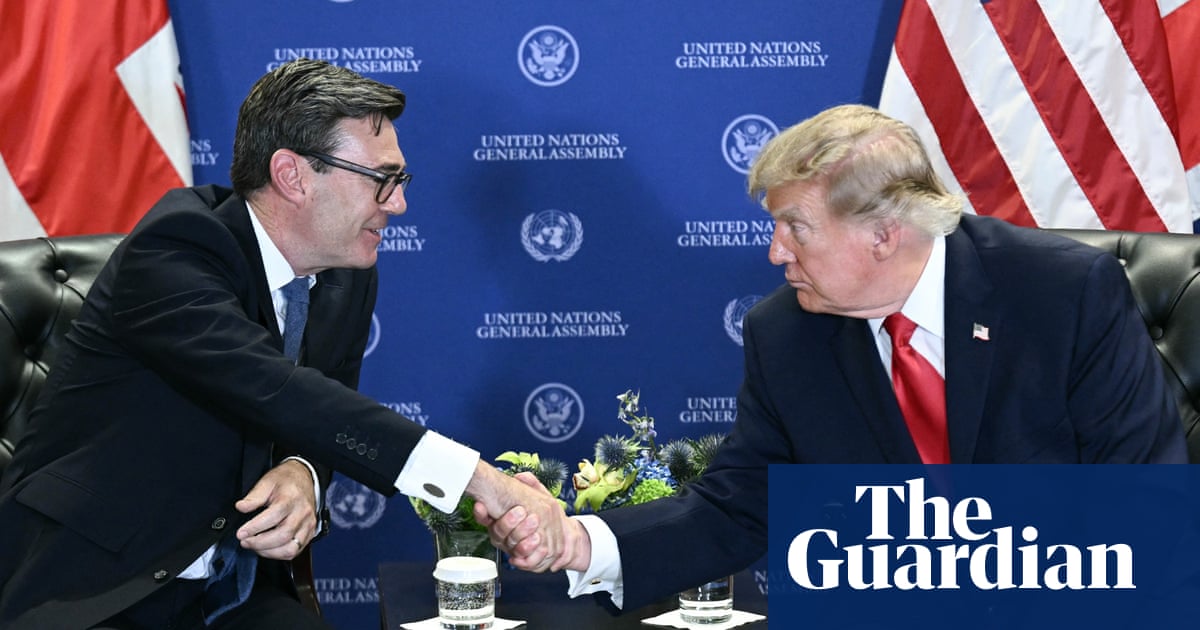
Donald Trump and Andy Burnham held their first face-to-face meeting at the United Nations General Assembly in New York, emerging with a public declaration of improved bilateral ties despite underlying tensions on several critical geopolitical issues. The US president described Burnham as a natural businessperson with significant assets, asserting that relations between Washington and London are currently stronger than they were during the tenure of former Prime Minister Keir Starmer. This assessment marks a notable shift from Trump’s previous characterization of Burnham as extremely liberal and merely the mayor of a town, suggesting a deliberate effort by both sides to establish a functional working dynamic early in Burnham’s premiership.
The diplomatic overture comes against a backdrop of significant friction regarding the ongoing conflict in Iran. Burnham arrived in New York with explicit instructions to urge de-escalation, citing the severe economic pressure that rising global energy prices are placing on the British economy. In contrast, Trump used his address to reinforce a hardline stance, threatening to annihilate Iran if it does not sign a peace deal and warning that he would drive the nation into hell if it refuses to back down. The US president acknowledged that allies are feeling pain due to cost-of-living increases but argued that prices will drop once the conflict concludes, framing the current economic strain as a necessary cost to prevent Tehran from acquiring nuclear weapons.
Artificial intelligence regulation emerged as another major point of divergence during the summit. Burnham outlined a vision for the UK to act as an honest broker in establishing a single set of global principles and standards to guard against rogue AI, positioning this agenda as a central focus for the UK’s upcoming G20 presidency. He also faces pressure to join an initiative led by Finland and Norway, supported by more than twenty countries, which would require AI companies to submit models for safety testing before commercial launch. Trump vehemently rejected these efforts, dismissing warnings about existential threats from AI as a hoax and declaring that the United States will encourage rather than rein in the technology’s growth.
The US president framed his opposition to global AI controls as a defense of American innovation, stating that the nation does not retreat from frontiers or shrink from challenges. He characterized the potential of artificial intelligence as surpassing the Industrial Revolution and vowed not to stifle its development. This ideological clash highlights a fundamental disconnect between the UK’s desire for international safety frameworks and the US administration’s commitment to unfettered technological expansion, setting the stage for continued diplomatic friction as global standards are debated in multilateral forums.
Disagreements also surfaced regarding the Chagos Islands, where Trump expressed strong disapproval of the UK’s agreement to transfer sovereignty to Mauritius while retaining a lease on the Diego Garcia military base. He labeled the deal terrible and ridiculous, questioning why ownership was suddenly claimed after decades of silence. Despite his criticism, Trump suggested that Burnham might reconsider the arrangement, noting the strategic importance of the location. Burnham nodded in acknowledgment during this exchange, though no immediate reversal of policy was indicated, leaving the status of the islands and the military base as an unresolved point of contention.
On other diplomatic fronts, Burnham secured a commitment from Trump to raise the case of Jimmy Lai, a Hong Kong dissident imprisoned in China, during upcoming talks with President Xi Jinping. British officials indicated that Lai could potentially reside in the UK if released, marking a specific area of cooperation between the two governments. Trump notably avoided commenting on the UK’s decision to ban trade with West Bank settlements, deflecting questions on the matter back to Burnham. This selective engagement suggests a pragmatic approach where both leaders focus on areas of mutual interest while sidestepping issues that could derail their broader relationship.
UK officials reported relief that the meeting proceeded according to plan, noting that Trump’s demeanor was mostly cordial despite previous criticisms. The presence of Foreign Secretary Ed Miliband and National Security Adviser Jonathan Powell alongside Burnham underscored the seriousness with which London approached the negotiations. While the public rhetoric emphasized improved relations, the substance of the discussions revealed persistent challenges in aligning foreign policy objectives. The success of this initial engagement will likely depend on whether both administrations can manage these divergences without allowing them to undermine broader strategic cooperation.
Looking ahead, the dynamic between Washington and London appears fragile but functional. Trump’s assertion that relations are up suggests a willingness to engage with Burnham personally, even as policy differences remain stark. The UK faces the difficult task of balancing its economic interests, particularly regarding energy prices, with its diplomatic efforts to promote international norms on AI and human rights. As both leaders navigate the complexities of global geopolitics, the ability to maintain dialogue despite these fundamental disagreements will be a critical test of their newly established rapport.
Sources behind this briefing
Go to the original reporting
- The Guardian US↗Trump praises relations with Burnham despite tensions over AI and Iran

