The short version
- Researchers used clumped isotope thermometry on T. rex enamel to estimate an average body temperature of approximately 36 degrees Celsius.
- This thermal profile aligns closely with modern elephants and large flightless birds, rather than the cooler ranges seen in contemporary crocodilians.
- The findings indicate that T. rex maintained a stable internal temperature significantly higher than its Late Cretaceous environment, suggesting active thermoregulation.
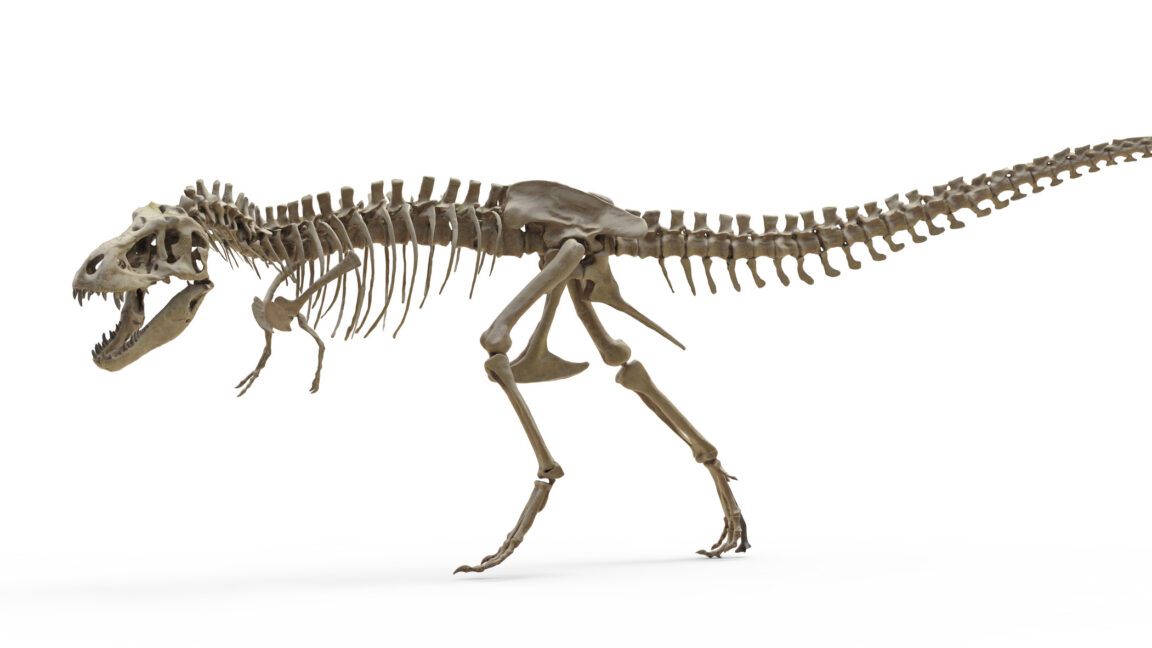
A new study led by geochemists at the University of California, Los Angeles, has provided fresh insight into the physiological capabilities of Tyrannosaurus rex. By analyzing fossilized teeth from Montana’s Hell Creek Formation, researchers determined that these massive predators likely maintained a body temperature of approximately 36 degrees Celsius. This measurement places T. rex in the same thermal range as modern elephants and large flightless birds such as ostriches and emus, offering concrete data to a long-standing debate about dinosaur metabolism.
The investigation was spearheaded by Randon J. Flores and Robert A. Eagle, who utilized a technique known as clumped isotope thermometry. Previous attempts to gauge dinosaur body temperatures relied on oxygen isotopes found in bones and teeth. However, those earlier methods faced significant limitations because the isotopic ratios were influenced not only by temperature but also by the chemical composition of water within the animal’s body—a variable that remains unknown for extinct species. The new approach circumvents this issue by focusing on how rare, heavy isotopes of carbon and oxygen bond together within carbonate minerals in tooth enamel.
The frequency of these clumped bonds depends strictly on the temperature at which the mineral formed. Because tooth enamel develops inside a living organism, it preserves a record of the animal’s internal body temperature independent of external water chemistry. The team analyzed three T. rex teeth provided by the Natural History Museum of Los Angeles County. Two of these specimens belonged to a young adult individual estimated to weigh more than three tons, while the third was an isolated partial tooth from a different animal.
Before deriving temperature estimates, the researchers had to verify that millions of years underground had not altered the chemical integrity of the fossils. They focused on enamel due to its superior resistance to post-burial alteration compared to bone or dentin. Multiple checks confirmed the samples’ reliability; for instance, the enamel and dentin from the same teeth displayed different isotopic signatures, a pattern unlikely if the chemistry had been uniformly changed after burial. Infrared spectroscopy further supported the preservation quality, showing that the fossil enamel resembled that of modern alligators in structure and carbonate content.
The resulting temperature readings were consistent across the samples. The two teeth from the juvenile T. rex yielded temperatures of 37.3 degrees Celsius and 35.9 degrees Celsius, respectively. The isolated tooth from the second individual registered at 34.7 degrees Celsius. When averaged, these figures produce a mean body temperature of 36.3 degrees Celsius, with a margin of error of plus or minus 2.5 degrees. This range is notably cooler than that of smaller flying birds, which typically average above 41 degrees Celsius, but aligns well with large mammals and ratites.
To contextualize these findings, the team compared the T. rex data with teeth from crocodilians that inhabited the same rivers and floodplains during the Late Cretaceous. The crocodilian samples averaged 30.9 degrees Celsius, consistent with modern relatives that regulate their temperature by moving between water and basking spots. The thermal gap between the apex predator and its contemporary reptiles mirrors the difference observed today between large mammals and crocodilians, reinforcing the distinct physiological strategies of these groups.
A critical question remained: whether T. rex actively generated this heat or simply retained warmth from its environment due to its massive size. To address this, scientists examined clumped isotopes in fossil freshwater mussels from the same geological formation. These mollusks primarily record summer water temperatures, which averaged around 26 degrees Celsius. Additionally, high-resolution climate models of the Late Cretaceous indicated that even under hotter scenarios, peak summer temperatures at Hell Creek reached only about 33 degrees Celsius, with mean annual temperatures near 21 degrees Celsius.
The data clearly show that T. rex was consistently warmer than its surroundings. However, the authors caution that body temperature alone does not definitively prove endothermy, or warm-bloodedness. Large animals can maintain stable internal temperatures simply because their bulk slows heat loss, a phenomenon known as gigantothermy. While the results suggest T. rex actively managed its thermal state rather than passively reflecting ambient conditions, the exact metabolic mechanisms remain an area for further exploration.
This research marks a shift from earlier depictions of T. rex as sluggish, cold-blooded reptiles that required sunlight to become active. It also refines the more recent view of these dinosaurs as highly active, bird-like creatures. By providing direct thermal evidence, the study bridges the gap between indirect physiological indicators and concrete metabolic data. Future work may expand this technique to other dinosaur lineages to determine whether such thermal strategies were widespread or unique to specific groups.
The implications extend beyond paleontology, offering a clearer picture of how large terrestrial animals functioned in prehistoric ecosystems. Understanding whether T. rex relied on internal heat generation or mass-based retention helps clarify its ecological role, hunting capabilities, and energy requirements. As analytical methods continue to improve, scientists may uncover more nuanced details about the daily lives and biological constraints of these iconic creatures.
Sources behind this briefing
Go to the original reporting
- Ars Technica↗T. rex teeth indicate it ran as warm as an elephant

