The short version
- Ahmed Hassoun was sentenced to life in prison for inciting civil war and complicity in killings during the Assad regime.
- The court ruled that the religious establishment provided justification for military operations, including the use of barrel bombs.
- The United States simultaneously rescinded Syria’s designation as a state sponsor of terrorism and removed HTS from terror lists.
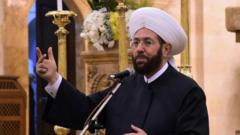
A Damascus court has sentenced Ahmed Hassoun, the former grand mufti of Syria, to life in prison after convicting him of multiple charges related to his role during the civil war. The verdict represents a significant milestone in the transitional government’s efforts to hold former regime officials accountable for atrocities committed between 2011 and 2021. Hassoun, who served as the country’s top Muslim cleric from 2005 until the fall of Bashar al-Assad’s government, was found guilty of inciting civil war, sectarian strife, and intentional killing.
The Fourth Criminal Court determined that the official religious establishment under Hassoun’s leadership was instrumental in providing ideological cover for state military and security operations. According to court findings reported by state media, the mufti’s office helped justify public support for violent campaigns, including the dropping of barrel bombs on populated areas. These unguided explosive devices were used extensively by regime aircraft against rebel-held territories, resulting in thousands of civilian deaths over the course of the conflict.
Prosecutors presented evidence that Hassoun actively supported the regime through religious lectures, media interviews, and public statements. A key piece of testimony involved a 2015 interview during the battle for Aleppo, where he urged civilians to flee rebel-controlled eastern districts and suggested that areas launching attacks should be completely destroyed. The court also found that he accepted money and gifts in exchange for intervening in the release of detainees held by security agencies and provided financial backing to Liwa al-Quds, a pro-regime militia.
Hassoun denied all charges during the proceedings, arguing that video clips used against him were taken out of context. He maintained that his actions were intended to save lives rather than facilitate violence. Despite his defense, Judge Fakhr al-Din al-Aryan imposed a life sentence for inciting civil war and sectarian conflict, along with additional terms of twenty years for incitement to intentional killing, ten years for principal participation in such killings, and three years for abuse of office.
This conviction is the tenth involving a high-ranking figure from the Assad era under Syria’s new transitional authorities. Earlier this month, the same court sentenced former President Bashar al-Assad, his brother Maher, and seven other senior officials to death in absentia for crimes against humanity. Only one defendant, Atef Najib, faced trial in person among that group. In a separate case, Wassim Assad, another cousin of the former president and a militia commander, was sentenced to death after being convicted of murder and other crimes.
The trials have offered a measure of closure for many Syrians who have long sought accountability for the devastation wrought by thirteen years of war. The conflict killed more than 600,000 people and displaced twelve million others, beginning when the regime responded to peaceful pro-democracy protests with lethal force. However, human rights advocates continue to call for greater transparency regarding how these verdicts are reached, emphasizing the need for fair and open judicial processes in the post-conflict era.
In a parallel development affecting Syria’s international standing, the United States announced it had rescinded its designation of Syria as a state sponsor of terrorism. This decision, made after forty-seven years, aligns with previous commitments to provide sanctions relief and foster economic stability. Treasury Secretary Scott Bessent stated that the move aims to encourage investment and support political normalization in the region.
The U.S. also removed Hayat Tahrir al-Sham (HTS), the Islamist group led by interim President Ahmed al-Sharaa, from its list of specially designated global terrorist organizations. HTS, formerly known as al-Nusra Front, severed ties with al-Qaeda in 2016 and led the rebel offensive that ousted Assad in late 2024. The removal follows last year’s decision to revoke HTS’s status as a foreign terrorist organization and delist Sharaa individually, signaling a broader shift in American policy toward the transitional administration.
These judicial and diplomatic developments underscore the complex transition underway in Syria. While domestic courts pursue retributive justice for past atrocities, international actors are recalibrating their engagement to support reconstruction and stability. The sentencing of Hassoun highlights the extent to which religious institutions were co-opted by the former regime, while the U.S. policy changes reflect a pragmatic approach to dealing with the new political reality in Damascus.
As Syria navigates this fragile period, the balance between accountability and reconciliation remains a central challenge. The life sentence handed down to Hassoun serves as a stark reminder of the human cost of the civil war, while the lifting of U.S. designations offers a pathway toward economic recovery. Observers will closely watch how these measures influence public trust in the transitional government and the broader trajectory of national healing.
Sources behind this briefing
Go to the original reporting
- BBC News↗Syria court sentences Assad-era grand mufti to life in prison

