The short version
- The suspect responsible for the mass shooting in Kraków’s Main Market Square has died in hospital following injuries sustained during a confrontation with armed police.
- Six people were killed in the attack, including four Polish citizens and two foreigners, while three additional family members of the gunman were found dead at his residence.
- Polish authorities have opened a terrorism investigation, citing evidence that the attacker was motivated by ultra-nationalistic and far-right ideologies.
The individual suspected of carrying out a deadly shooting in Kraków has died in hospital, Polish police confirmed early Monday. The 24-year-old man, who had been in critical condition following a shootout with law enforcement officers, succumbed to his injuries after the attack that shocked Poland and drew international condemnation. His death marks the end of an immediate threat but leaves authorities and families grappling with the aftermath of one of the most severe acts of violence in recent Polish history.
The incident unfolded on Saturday afternoon in the city’s Main Market Square, a historic hub typically crowded with tourists and locals. Witnesses described the suspect driving into the square at high speed before opening fire indiscriminately. Armed police responded rapidly, engaging the gunman within minutes of the initial shots. Officials stated that this swift intervention prevented further casualties, though six people were killed and seventeen others were injured in the chaos.
Among the deceased are four Polish nationals, a British citizen, and an Austrian woman. The wounded include five foreign tourists from Britain, Austria, Germany, Portugal, and Russia, as well as two police officers, one of whom remains in serious condition. The attack has drawn expressions of solidarity from abroad, with UK Prime Minister Andy Burnham describing the violence as appalling and offering support to those affected by the tragedy.
In a separate development that deepened the horror of the event, investigators discovered three additional bodies at the suspect’s home after the shooting. Police identified the victims as the gunman’s father, aged 53, his mother, 52, and his sister, 21. While the exact circumstances surrounding their deaths remain under investigation, their discovery has added a complex layer to the unfolding narrative of the crime.
Polish prosecutors have launched a terrorism investigation into the events, characterizing the attack as a terrorist offense. Interior Ministry officials indicated that early analysis suggests the suspect was influenced by far-right ideologies. The interior minister described the attacker as holding radical and ultra-nationalistic views, noting that patches and emblems found on his clothing are currently being examined by specialists to determine their specific affiliations.
The suspect, identified in local media reports as Michal O., reportedly possessed a firearms permit and may have acquired the weapons used in the attack from his family home. He was dressed in military-style fatigues and a bulletproof vest during the assault. The combination of his attire, the nature of the violence, and the ideological markers found on his person has led authorities to treat this not merely as a criminal act but as a politically motivated terror incident.
This event has intensified concerns about extremism in Poland, coming shortly after a series of school stabbings in October that resulted in one death. Officials have linked those earlier incidents to extremist content consumed online, raising questions about the broader societal impact of such ideologies. The Kraków shooting represents a significant escalation in violence, prompting Prime Minister Donald Tusk to label it a drastic case of terrorism unlike previous experiences in the country.
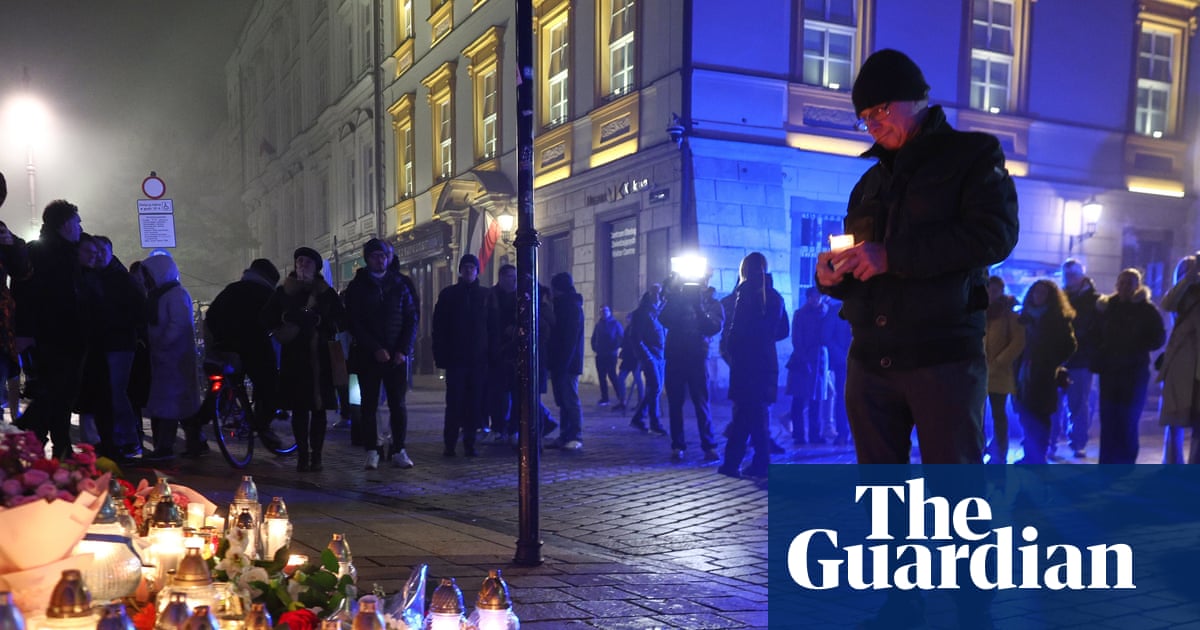
Poland has entered two days of national mourning to honor the victims. As the investigation continues, authorities are working to piece together the timeline and motives behind the attack. The focus now shifts from immediate containment to understanding how such radicalization occurred and what measures might prevent similar tragedies in the future. The nation remains in a state of shock as it processes the loss of life and the breach of security in one of its most iconic public spaces.
Sources behind this briefing
Go to the original reporting
- The Guardian World↗Kraków shooting suspect who killed six has died, say police in Poland
- BBC News↗Krakow shooting suspect has died in hospital, police say


