The short version
- The Supreme Court heard oral arguments regarding whether federal law prevents state and local governments from suing fossil fuel companies for climate-related damages.
- Oil industry lawyers argued that the Clean Air Act and constitutional principles grant exclusive federal authority over pollution, preempting state-level deception claims.
- Boulder County attorneys countered that their lawsuit seeks compensation for fraud rather than regulatory control of emissions, distinguishing it from environmental regulation.
The United States Supreme Court began its new term by addressing a pivotal legal challenge to the growing wave of climate litigation brought by state and local governments. On Monday, justices heard arguments in Suncor Energy Inc v County Commissioners of Boulder County, a case that could determine whether federal law blocks municipalities from pursuing damages against fossil fuel producers for alleged deception regarding climate change risks. The outcome will likely influence more than two dozen similar lawsuits currently pending in courts across the country.
Boulder County and the city of Boulder filed their original complaint in 2018, accusing ExxonMobil and Suncor Energy of misleading the public about the dangers of burning fossil fuels. The plaintiffs seek financial compensation to cover costs associated with extreme weather events, including wildfires, floods, and infrastructure damage. While the case has survived multiple appeals in both state and federal courts, the oil companies are now asking the nation’s highest court to declare that federal law preempts such state-level claims entirely.
Kannon Shanmugam, representing ExxonMobil and Suncor Energy, argued that allowing these suits to proceed would enable thousands of municipalities to effectively set national and international energy policy through jury verdicts. He characterized the litigation as an unprecedented attempt to use state law to regulate global conduct, asserting that climate change is a unique issue requiring legislative solutions rather than judicial remedies. Shanmugam warned that if Boulder’s legal theory stands, it could open the door to catastrophic liability for selected fossil fuel producers based on localized grievances.
In response, Kevin Russell, counsel for Boulder, maintained that the lawsuit does not seek to limit emissions or regulate industry activity. Instead, he framed the case as a straightforward claim of deception, arguing that nothing in the Clean Air Act or the Constitution prohibits states from seeking damages when companies have misrepresented known risks. Russell emphasized that imposing financial liability for fraud is distinct from enacting environmental regulations, and that local governments should not be barred from recovering costs for harms they have suffered.
A significant procedural question arose during the hearing regarding whether the Supreme Court has jurisdiction to intervene at this stage. Typically, cases must reach a final ruling in lower courts before appealing to the high court. However, the justices agreed to hear the matter while the state case remains ongoing. Several justices expressed skepticism about intervening prematurely, with Justice Clarence Thomas questioning whether the court should decide the issue before any substantive ruling has been issued. Legal experts noted that this jurisdictional hurdle might be Boulder’s strongest defense against dismissal.
The core legal debate centered on federal preemption, specifically whether the Clean Air Act or constitutional provisions grant the federal government exclusive control over interstate pollution. Oil industry lawyers contend that these federal frameworks invalidate state claims tied to climate pollution. Conversely, Boulder’s attorneys argue that their case involves secondary effects of fraud rather than direct pollution control. The justices probed both arguments, with some conservative members appearing inclined to agree that federal law might preempt at least portions of the county’s claims.
Justice Samuel Alito recused himself from the case after revealing he holds stock in oil companies involved in related litigation. His absence leaves the court with an even split among conservative justices, creating the possibility of a tie vote. In such a scenario, the lower court’s decision would stand, allowing the case to proceed toward trial. With only five conservative justices participating, Boulder needs to persuade just one to join the three liberal justices to secure a victory for the plaintiffs.
The broader implications of this case extend beyond Colorado. Conservative groups and politicians have filed numerous briefs supporting the oil companies, while some states have enacted laws barring similar lawsuits. The Trump administration has also intervened in several state cases to block their progress. As the industry ramps up efforts to shield itself from climate liability, the Supreme Court’s decision will signal whether local governments can continue to hold fossil fuel producers accountable for alleged misinformation campaigns.
Legal analysts remain divided on how the court will rule. Some observers noted that justices focused heavily on the merits of the preemption argument rather than jurisdictional technicalities, which raised concerns for Boulder’s position. Others pointed out that industry lawyers struggled to provide clear legal justifications for their claims. Regardless of the outcome, the case highlights the intense legal battle over who bears the financial burden of climate-related damages and whether state courts have a role in addressing global environmental challenges.
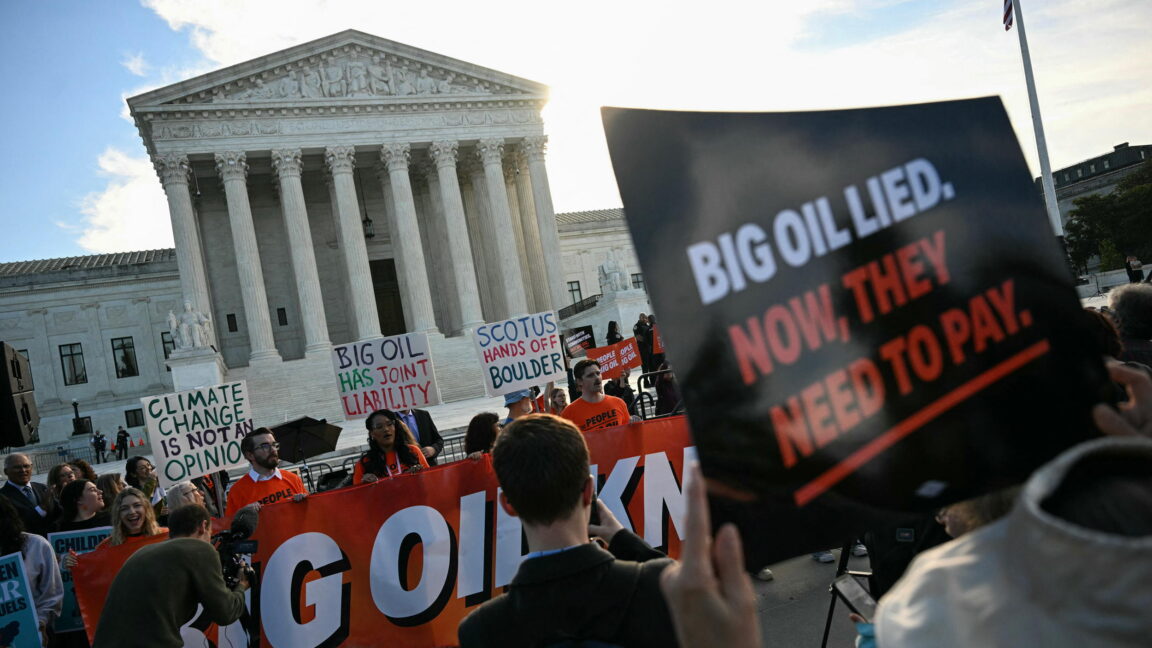
Supporters of the lawsuit held rallies outside the Supreme Court, urging justices to allow the case to move forward. Boulder City Manager Nuria Rivera-Vandermyde stated that taxpayers should not bear the full cost of climate impacts alone if defendants contributed to the harms through deception. As the court deliberates, the decision will shape the future of climate litigation and define the boundaries between federal authority and local accountability in addressing environmental crises.
Sources behind this briefing
Go to the original reporting
- Ars Technica↗Big Oil asks Supreme Court to kill climate lawsuits before trial
- The Guardian Business↗US supreme court hears big oil’s bid to block climate damage lawsuits