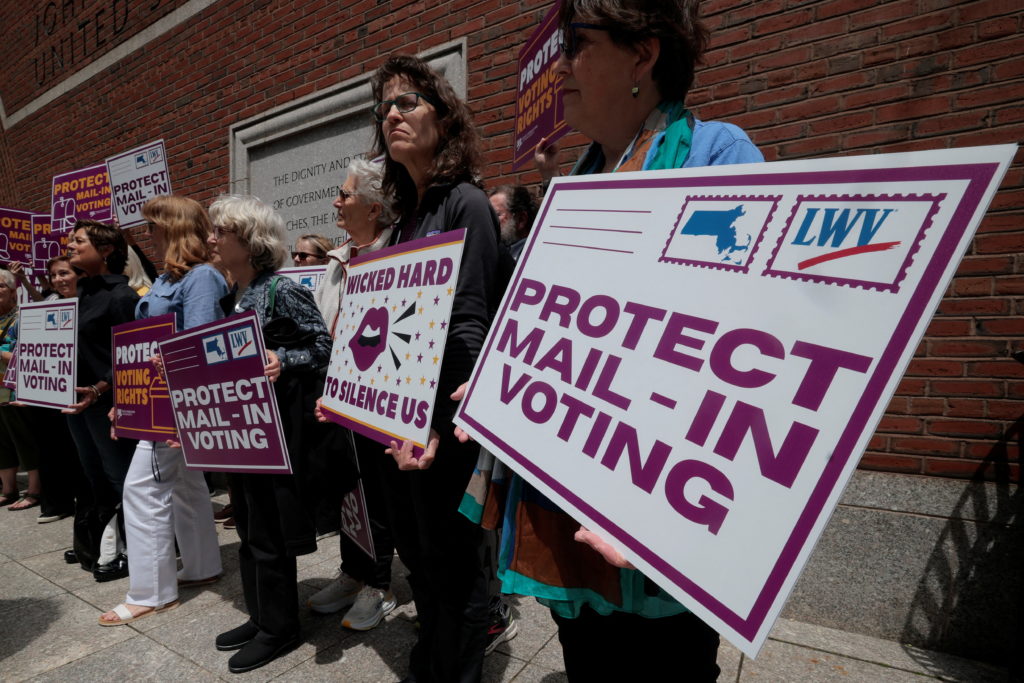
The short version
- The Supreme Court ruled it was premature for states to challenge the president's mail voting restrictions in June, effectively restarting legal proceedings just weeks before midterm elections.
- New postal regulations require specific envelope formatting and electronic voter identification systems that election officials argue cannot be implemented in time for upcoming ballot distribution.
- While a second injunction currently blocks the Postal Service from enforcing these changes, the administration has moved to lift this hold, raising fears of administrative chaos.
The Supreme Court’s recent intervention in the dispute over mail-in voting procedures has introduced significant uncertainty into the upcoming midterm elections. Rather than issuing a definitive ruling on the legality of President Donald Trump’s executive order restricting mail voting, the high court determined that Democratic-led states acted too early when they sought to block the measure in June. This procedural decision effectively resets the legal clock, forcing courts to re-evaluate the restrictions at a moment when election logistics are already finalized.
The timing of this judicial maneuver places immense pressure on state election administrators. Initial ballots for overseas and military voters in North Carolina are scheduled to be dispatched by September 4, leaving less than two weeks for any potential legal or logistical adjustments. While no immediate changes to election procedures have occurred, the possibility that the restrictions could take effect has created an atmosphere of anxiety among officials who manage voting systems across the country.
At the center of the controversy are new regulations proposed by the U.S. Postal Service under the administration’s directive. These rules mandate specific formatting for mail ballot envelopes and require states to utilize an electronic system to identify voters to the postal service. If jurisdictions fail to comply with these requirements, their mail ballots would not be delivered. The administration has filed a motion to remove a second injunction that currently bars the Postal Service from implementing these changes, signaling an intent to enforce the rules if the legal path is cleared.
Election experts and officials have expressed skepticism about the feasibility of complying with these new mandates within such a short timeframe. Jesse Salinas, registrar for Yolo County in California, noted that his county has already printed its ballot envelopes and that ballots are set to go out in eleven days. He stated that last-minute revisions to procedures are not practically possible given the existing capacity constraints and the lack of clarity regarding which envelope designs would meet the new standards.
Tammy Patrick, chief program officer at the Elections Center, emphasized that no state currently conducts elections in a manner consistent with the proposed postal rules. She indicated that there was a widespread assumption among election professionals that these regulations would not be enforced because they are incompatible with existing operational frameworks. The disconnect between federal directives and local implementation capabilities highlights the structural challenges inherent in imposing uniform national standards on decentralized election systems.
In Nevada, where every registered voter receives a mail ballot, Secretary of State Cisco Aguilar pointed to previous issues with postal delivery accuracy. He questioned the ability of the Postal Service to build a massive, error-free database within seven days, describing the task as impossible. His concerns reflect broader doubts about the logistical readiness of federal agencies to support such a sweeping overhaul of voting infrastructure on such short notice.
Justice Ketanji Brown Jackson dissented from the majority’s decision, warning that it needlessly injects chaos and uncertainty into the electoral process. Her critique aligns with statements from David Becker of the Center for Election Innovation & Research, who argued that the majority’s approach creates complete chaos leading up to the midterms. Both perspectives underscore the tension between judicial procedure and the practical realities of administering fair and orderly elections.
The political context surrounding these developments is marked by longstanding disputes over mail voting integrity. President Trump has previously attributed his 2020 election loss to mail-in ballots and promoted conspiracy theories regarding fraud, despite casting his own votes by mail in Florida’s primary. Previous attempts to restrict voting through executive orders were blocked by judges, leading to the current legal battle after legislative efforts stalled in the Senate.
Data from the Election Assistance Commission indicates that nearly 30 percent of voters cast ballots by mail in 2024, with Democrats utilizing this method at higher rates than Republicans. This polarization underscores the stakes involved in the current dispute. However, constitutional principles grant states primary control over voting rules, limiting the president’s authority to unilaterally alter election procedures. Legal experts suggest that despite the Supreme Court’s procedural ruling, the likelihood of Trump’s order fundamentally changing how votes are cast remains low due to these structural constraints.
As the legal fight resumes in a compressed timeline, the focus shifts to whether lower courts will grant emergency relief to prevent potential disruptions. The outcome will determine whether election officials must scramble to adapt to new federal requirements or if the status quo will be preserved for the November elections. Regardless of the final judicial determination, the current uncertainty poses challenges for voter confidence and administrative stability.
Sources behind this briefing
Go to the original reporting
- PBS NewsHour↗Nothing changes yet with the Supreme Court's order on mail voting. But it could open door to 'chaos'

