The short version
- The Supreme Court temporarily suspended a lower court order that would have stopped aboveground construction of the White House ballroom.
- The administration argues the project is essential for national security, while preservationists contend it requires congressional approval and violates historic protection laws.
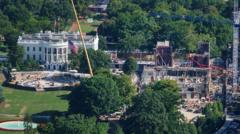
- Work on the 90,000-square-foot structure, which includes an underground military complex, has already demolished the East Wing and is reportedly 65 percent complete.
The United States Supreme Court has issued a temporary stay allowing construction to continue on President Donald Trump’s controversial White House ballroom project. Chief Justice John Roberts signed the one-page order on Friday, effectively pausing a deadline set by a federal appeals court that would have forced an immediate halt to aboveground work. The stay remains in place while the high court considers an emergency appeal from the administration, though the document does not specify when a final ruling will be issued or provide detailed reasoning for the interim decision.
The legal battle centers on whether the president possesses unilateral authority to alter the White House without congressional consent. A federal appeals court panel had previously ruled that Trump acts as a temporary tenant of the executive residence and cannot undertake such significant renovations without legislative approval. That court ordered work to stop, giving the administration two weeks to appeal. The Supreme Court’s intervention prevents that order from taking effect immediately, allowing crews to maintain their current pace while the broader constitutional questions are weighed by the justices.
Government lawyers have framed the ballroom not merely as an entertainment space but as a critical national security infrastructure project. Solicitor General D. John Sauer argued in emergency filings that the construction is vitally required to protect the president, his family, and staff from emerging threats such as drones, ballistic missiles, and biohazards. The administration contends that leaving the site in its current state of partial demolition creates a security vulnerability that outweighs procedural delays. They assert that the president has total authority over federal building renovations and that judicial interference is unlawful.
Opposing this view, the National Trust for Historic Preservation argues that the project causes irreversible damage to a historic landmark and lacks any basis for emergency classification. The group, which filed the original lawsuit in December, maintains that federal review panels should evaluate the plans before further destruction occurs. They accuse the White House of attempting to outrun the courts by accelerating construction timelines. A spokesperson for the trust acknowledged the stay but emphasized that it is not a final decision on the merits of the case and that they await further action from the Supreme Court.
The scope of the project has expanded significantly since its initial announcement in July 2025. Originally described as a 650-person ballroom incorporating existing structures, revised plans now call for a capacity of approximately 1,000 guests. This expansion necessitated the complete demolition of the White House East Wing. The total cost is estimated at $400 million, with about $200 million already spent or committed from private donations, including contributions from the president himself. Court documents indicate that roughly 65 percent of the work is complete, with crews operating twenty hours a day, seven days a week.
Beyond the visible ballroom, the project includes a substantial underground component. The administration describes this as a five-story military complex featuring shelters, a hospital, and other protective features designed to safeguard senior officials during emergencies. Officials state that the aboveground structure will be reinforced with missile-resistant columns and a drone-proof roof, serving as a shield for both the subterranean facility and the wider White House grounds. This dual-purpose design has been central to the administration’s argument that the project transcends typical renovation standards.
The legal proceedings have revealed deep divisions within the judiciary regarding executive power. While two appeals-court judges appointed by Democratic presidents found the project required congressional oversight, a third judge appointed by Trump ruled that the preservation group lacked standing to sue. District Judge Richard Leon, a Republican appointee, had previously allowed belowground work on bunkers to continue while halting aboveground construction. The Supreme Court’s current stay suspends these conflicting lower-court directives, creating a legal limbo that favors the administration’s immediate operational goals.
This dispute is part of a larger effort by the Trump administration to reshape Washington’s cityscape, which includes renovations to the Lincoln Memorial Reflecting Pool and plans for an Arc de Trump. Critics allege these projects sidestep legally required review and public-comment processes, charges the president vehemently denies. The ballroom controversy highlights the tension between presidential assertions of emergency authority and traditional checks on executive power. As the Supreme Court deliberates, the physical transformation of the White House continues, with the East Wing already gone and new structures rising in its place.
The outcome of this case could set a significant precedent for future presidential renovations and the balance of power between the executive branch and Congress regarding federal property. If the Supreme Court ultimately sides with the administration, it would reinforce broad claims of unilateral authority over White House modifications. Conversely, a ruling against the president could impose stricter requirements for legislative approval and historic preservation reviews. Until then, construction proceeds under the temporary protection of the chief justice’s stay, leaving the final resolution of this high-stakes legal and political conflict uncertain.
Sources behind this briefing
Go to the original reporting
- BBC News↗Supreme Court temporarily unfreezes Trump ballroom construction
- NPR↗Supreme Court allows Trump's ballroom construction to continue for now
- PBS NewsHour↗Supreme Court chief justice allows work on Trump's $400M White House ballroom to continue for now
- The Guardian US Politics↗US supreme court lets Trump continue work on White House ballroom for now

