The short version
- The American Civil Liberties Union and other groups have petitioned the Supreme Court to review a Texas law mandating Ten Commandments displays in public schools.
- A split decision by the 5th U.S. Circuit Court of Appeals previously upheld the statute, rejecting lower court blocks on the practice.
- The case could establish new national standards for state-sponsored religious expression in educational settings.
Civil rights advocates have formally requested that the United States Supreme Court examine a Texas statute requiring public school classrooms to display the Ten Commandments. The petition, filed on Monday by over two dozen families represented by the American Civil Liberties Union and allied organizations, challenges a recent ruling by the conservative-leaning 5th U.S. Circuit Court of Appeals. That appeals court issued a narrow 9-8 decision in April upholding the state law, which mandates that schools exhibit a specific version of the biblical text drawn from the King James Bible. The request for review sets the stage for a potential landmark case regarding the boundaries of religious expression within public education.
The legal dispute centers on whether the state can compel the display of scripture in environments where children are present for extended periods each day. Attorneys for the families argue that the law violates core First Amendment principles concerning the separation of church and state. In their brief, they emphasized the unique vulnerability of students, describing them as a captive audience exposed to the displays for nearly every hour of the school day over up to thirteen years of education. They contend that imposing such religious material implicates fundamental constitutional guarantees and national ideals regarding religious neutrality in government institutions.
The 5th Circuit Court of Appeals reversed an earlier lower federal court ruling that had blocked approximately a dozen Texas school districts from posting the materials. The appeals court’s majority opinion noted that no child is forced to recite the Commandments, believe in them, or affirm their divine origin. This reasoning suggests that passive display does not constitute coercion under current legal interpretations. However, the dissenting judges and the petitioners argue that the mere presence of state-mandated religious symbols in classrooms sends a message of endorsement that undermines constitutional protections for non-adherents.
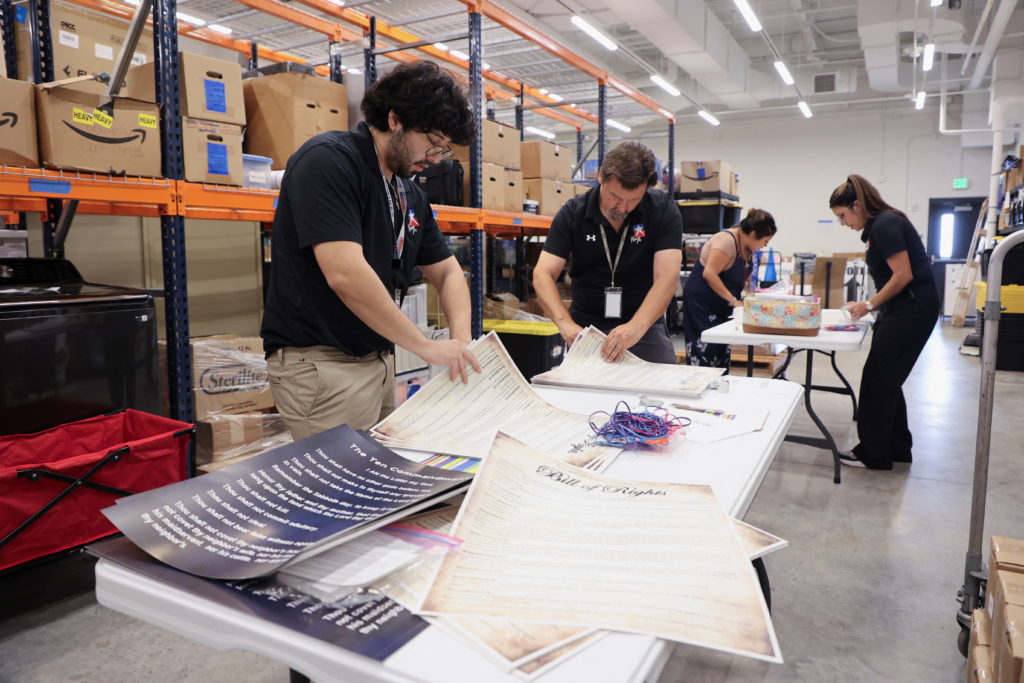
The Texas law, signed by Republican Governor Greg Abbott, took effect last September. It includes a provision requiring districts to hang the Ten Commandments only if they are donated, rather than purchased with public funds. Following the law’s implementation, conservative groups and private individuals began delivering boxes of posters to campuses across the state as the new school year commenced. This donation mechanism was designed to address potential Establishment Clause concerns by avoiding direct government expenditure on religious materials, though critics argue it still constitutes state sponsorship through regulatory mandate.
This case is part of a broader trend in Southern states where Republican lawmakers have advanced legislation requiring the display of the Ten Commandments in public schools. Louisiana became the first state to pass such a requirement in 2024, followed by Arkansas and Texas. Earlier this year, Alabama Governor Kay Ivey signed a similar law into effect. The 5th Circuit Court also ruled in February that Louisiana could enforce its own version of the display mandate, indicating a consistent judicial approach within that circuit regarding these statutes. These legislative actions reflect a growing political effort to integrate religious texts into public educational spaces.
The outcome of this Supreme Court petition will likely influence how lower courts evaluate similar laws in other jurisdictions. If the high court agrees to hear the case, it could set a new national standard for what constitutes permissible state-sponsored religious expression in classrooms. The decision may clarify whether passive displays of religious texts violate the Establishment Clause when they are mandated by law but not actively taught or recited. Legal experts suggest that the Court’s composition and recent jurisprudence on religious liberty will play a significant role in determining the trajectory of this issue.
For now, Texas school districts remain under the obligation to display the Ten Commandments if donations are received, following the 5th Circuit’s affirmation of the law. The families involved in the lawsuit continue to argue that the practice creates an environment hostile to students who do not share the Christian faith represented by the text. Their petition highlights concerns about the psychological impact on impressionable children and the potential chilling effect on religious diversity within public schools. The Supreme Court has not yet indicated whether it will grant certiorari, leaving the legal status of the displays in limbo pending further judicial action.
The debate underscores ongoing tensions between traditional religious values and constitutional mandates for secular governance in public institutions. While supporters of the law argue that displaying the Ten Commandments serves a historical or moral purpose rather than a strictly religious one, opponents maintain that any state endorsement of specific religious tenets crosses a constitutional line. The case may ultimately force the Court to define the limits of neutrality in an era where religious expression in public life is increasingly contested. Until a final ruling is issued, schools must comply with current appellate guidance while awaiting potential intervention from the nation’s highest court.
Sources behind this briefing
Go to the original reporting
- PBS NewsHour↗Supreme Court asked to review Texas law requiring the Ten Commandments in public schools

