The short version
- Starship completed its first full orbit around Earth after a brief pause to assess engine performance following a premature shutdown during ascent.
- The mission successfully deployed twenty-six next-generation Starlink satellites, which are too large for SpaceX’s standard Falcon 9 launch vehicle.
- While the upper stage performed flawlessly for orbital insertion, two engines on the Super Heavy booster failed, highlighting ongoing reliability challenges.
SpaceX achieved a significant milestone in its development of the Starship launch system by completing the first fully orbital flight of the vehicle. The fourteenth test mission, launched from the company’s private spaceport in South Texas, marked a departure from previous suborbital trajectories that intentionally allowed gravity to pull the rocket back into the atmosphere before it could complete a lap around the planet. This time, the massive upper stage accelerated to orbital velocity, establishing a stable orbit at an altitude of approximately 171 miles.
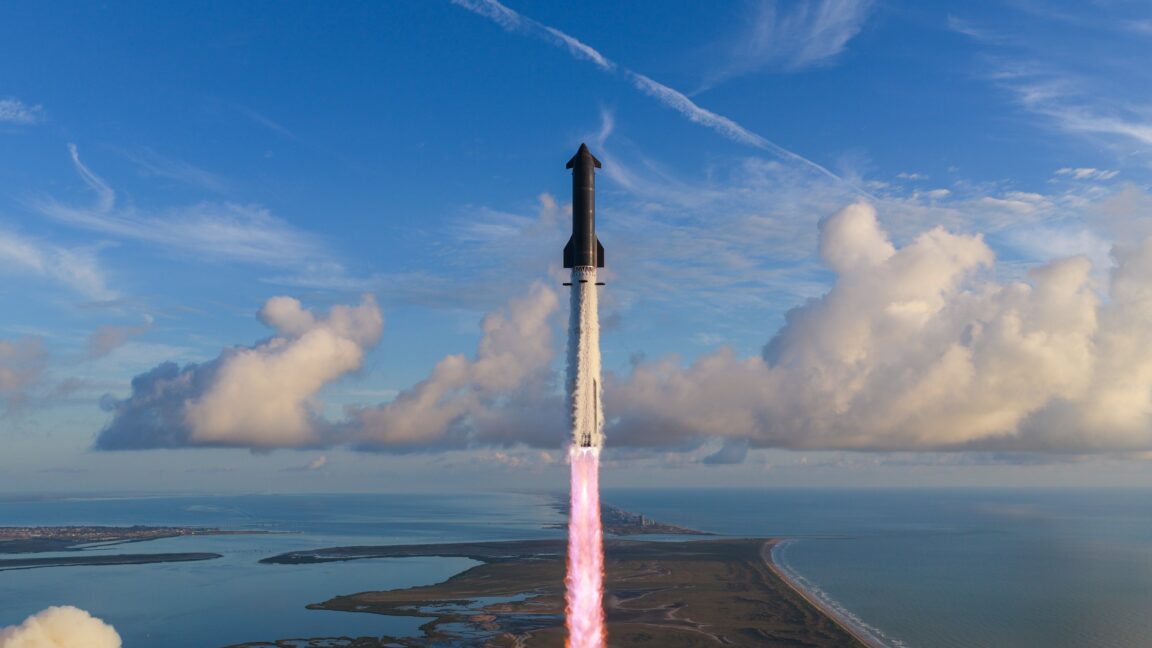
The launch began with thirty-three methane-fueled Raptor engines generating up to eighteen million pounds of thrust to propel the 407-foot-tall rocket off its pad. The Super Heavy booster separated from the upper stage after powering through the sound barrier and into the stratosphere. The first stage executed a high-altitude turnaround maneuver and eventually made a controlled splashdown in the Gulf of Mexico near the coast of Starbase, continuing the pattern of recovery attempts seen in earlier tests.
During the ascent phase, mission controllers encountered a complication when one of the six Raptor engines on the upper stage shut down prematurely. The remaining five engines burned longer to compensate for the loss of thrust, ensuring the vehicle maintained its trajectory. Additionally, two engines on the Super Heavy booster appeared to fail—one during the initial launch and another during the return maneuvers. These malfunctions did not prevent the mission from proceeding but raised questions about the reliability of the propulsion system under full operational loads.
Following the stage separation, flight control teams faced a critical decision regarding whether to attempt the orbital insertion burn. For a brief period, it appeared that SpaceX might abort this phase and allow Starship to coast toward a reentry over the Indian Ocean, similar to previous flights. The hesitation stemmed from concerns about public safety; a failure during the orbital maneuver could have stranded the 100-ton vehicle in space, potentially leading to an uncontrolled reentry. Engineers adopted a conservative approach, verifying that the core systems required for deorbiting were functioning correctly before proceeding.
Ultimately, officials determined that the engine which had failed was not the same one needed for the orbital insertion burn. The selected Raptor engine reignited successfully for nineteen seconds, adding approximately 204 mph to Starship’s speed. This final boost provided the necessary velocity to overcome Earth’s gravitational pull and achieve a stable low-Earth orbit. The successful maneuver validated the vehicle’s ability to perform complex in-space operations after experiencing partial propulsion failures during ascent.
With orbit established, SpaceX proceeded to deploy twenty-six of its newest generation Starlink broadband satellites. These flat-packed units are too large to fit inside the company’s workhorse Falcon 9 rocket, necessitating the use of the larger Starship payload bay. The satellites were released one by one using a system of pulleys and cables that ejected them overboard in a manner described as similar to a candy dispenser. This deployment represents the first time commercial-grade Starlink V3 satellites have been placed into orbit via Starship.
Previous attempts to launch these specific satellites had occurred during suborbital flights, where the vehicles did not achieve sufficient velocity to remain in space. In those earlier instances, the satellites quickly burned up upon reentry. This mission marks the first successful delivery of this next-generation hardware to its intended operational environment, advancing SpaceX’s goal of expanding its global broadband network with higher-capacity equipment.
The success of Flight 14 demonstrates Starship’s growing capability to perform complex missions involving orbital insertion and payload deployment. However, the engine failures on both the booster and upper stage underscore the ongoing technical challenges associated with scaling up such a powerful launch vehicle. As SpaceX continues to refine its systems, future flights will likely focus on improving reliability while expanding the scope of payloads and mission profiles.
This achievement positions Starship as a viable platform for heavy-lift missions that require access to low-Earth orbit. The ability to deploy large satellites directly from the payload bay could reduce launch costs and increase efficiency for SpaceX’s internet constellation. As the company moves forward, the data gathered from this orbital flight will inform design improvements and operational procedures for subsequent test flights and potential commercial missions.
The broader implications of this success extend beyond SpaceX’s own operations. A reliable heavy-lift vehicle capable of reaching orbit with large payloads could influence the competitive landscape of the space industry. Other providers may need to adjust their strategies in response to Starship’s demonstrated capabilities. For now, the focus remains on analyzing the flight data and addressing the propulsion issues identified during this test.
Sources behind this briefing
Go to the original reporting
- Ars Technica↗SpaceX's Starship goes orbital, deploying first next-gen Starlinks

