The short version
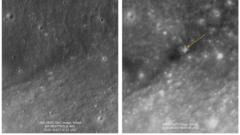
- South Korea's space agency shared images from its Danuri orbiter documenting the site where a SpaceX rocket stage struck the Moon on Wednesday.
- The impact involved a spent upper stage that had drifted in orbit since January 2025, eventually being pulled toward the lunar surface by gravitational forces.
- Experts warn that such incidents underscore the increasing congestion of space and the potential long-term risks to orbital accessibility.
The Korean AeroSpace Administration has released visual evidence confirming that a piece of SpaceX rocket debris struck the Moon on Wednesday. The agency utilized its Danuri lunar orbiter to capture images of the impact site, providing a clear comparison between the lunar surface before and after the collision. This documentation offers rare observational data on an unplanned celestial event, allowing scientists to analyze the physical effects of high-speed impacts in a controlled manner.
The debris involved was the empty upper stage of a Falcon 9 rocket, a component designed to be discarded during launch operations. According to agency reports, the object weighed approximately 4,000 kilograms and measured roughly the size of a five-story building. It struck the lunar surface at around 06:35 GMT, traveling at an estimated speed of 5,400 miles per hour. The velocity and mass of the object generated a brief, dramatic flash upon impact, though this visual cue was too faint for amateur astronomers to detect even with advanced telescopic equipment.
SpaceX has stated that the collision was not intentional. The specific rocket stage had been in orbit since January 2025, following a launch from Florida that carried two lunar landers into space. Its primary function was to propel those landers out of Earth's orbit and onto a trajectory toward the Moon. After completing this task, the spent stage remained in a long, looping orbit that extended outward toward the Moon and back again, leaving it drifting in space for approximately eighteen months.
Over time, subtle gravitational influences from the Earth, Moon, and Sun, combined with pressure from sunlight, gradually altered the trajectory of the discarded rocket part. Astronomers monitoring the object noted that these small nudges eventually placed it on a direct course toward the Moon, causing it to accelerate continuously until impact. The event occurred during broad daylight for many regions of the world, further complicating any potential visual observation by ground-based observers.
While this specific incident did not pose any immediate danger to Earth or human life, it has reignited discussions about the growing volume of objects in space. Matt Bothwell, an astronomer at the University of Cambridge, expressed concern regarding the increasing density of space debris. He noted that as launch frequencies rise annually, the orbital environment becomes more congested, potentially making it difficult to navigate past Earth's orbit within a few decades.
The Falcon 9 rocket system is designed for reusability, allowing certain sections to return to Earth while others are shed in space. SpaceX has employed this technology across numerous missions, including the one that launched the debris in question. Notably, the same booster section involved in the lunar impact is scheduled for its eighteenth flight on August 10, aiming to deploy twenty-nine Starlink satellites into low-Earth orbit. This highlights the complex lifecycle of reusable rocket components and their eventual disposal.
The release of these images by South Korea's space agency provides valuable data for the scientific community. Larger observatories are currently analyzing the information to understand the mechanics of such impacts. As space activities expand, incidents like this serve as reminders of the need for careful tracking and management of orbital objects to prevent future collisions and ensure the sustainability of space exploration.
The event underscores the delicate balance between advancing space technology and managing its environmental footprint. While the impact itself was harmless to Earth, it illustrates the unpredictable nature of long-term orbital dynamics. Scientists continue to study these occurrences to better predict the behavior of space debris and mitigate potential risks associated with an increasingly crowded near-Earth environment.
Sources behind this briefing
Go to the original reporting
- BBC News↗South Korea space agency shares Moon images after SpaceX rocket debris crash

