The short version
- South Korean President Lee Jae Myung has formally proposed talks to end the state of war that has persisted since the 1953 armistice.
- The proposal includes a multi-layered security framework and discussions on halting North Korea's nuclear advancements, though Pyongyang has not yet responded.
- Recent ballistic missile tests by North Korea and previous rejections of diplomatic overcasts highlight the significant challenges to establishing peaceful coexistence.
South Korean President Lee Jae Myung has initiated a new diplomatic push by proposing direct negotiations with North Korea to officially conclude the Korean War. The conflict between the two nations remains technically active, frozen in place by an armistice agreement signed in 1953 rather than a formal peace treaty. Lee’s announcement marks a significant shift in Seoul’s approach, aiming to transition from a state of suspended hostilities to one of recognized peaceful coexistence. This move comes as tensions along the demilitarized zone continue to fluctuate, with both sides frequently accusing each other of provocations.
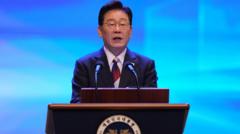
During a ceremony commemorating Liberation Day, which marks the end of Japanese colonial rule over the peninsula, Lee urged both nations to abandon threatening postures. He framed the proposed talks as an opportunity for the directly involved parties to address long-standing issues face-to-face. The president emphasized that such discussions could serve as a platform for mutual growth and stability. By positioning South Korea as a proactive mediator in its own security destiny, Lee seeks to reduce reliance on external powers while addressing immediate regional threats.
Central to Lee’s proposal is the establishment of a multi-layered security system designed to prevent flare-ups along the border. This framework would aim to de-escalate incidents that have historically strained relations, such as the exchange of propaganda balloons and other minor confrontations. Additionally, Lee indicated willingness to discuss practical measures to curb Pyongyang’s nuclear ambitions. He described halting the advancement of North Korea’s nuclear capabilities as a realistic objective, even as Seoul continues to advocate for full denuclearization in the long term.
The diplomatic overture occurs against a backdrop of heightened military activity by North Korea. Just days before Lee’s announcement, Pyongyang fired a ballistic missile into the sea, marking the eleventh suspected test this year. This launch took place shortly before scheduled joint military exercises between South Korea and the United States. Such actions are widely perceived in Seoul and Tokyo as attempts to intimidate neighbors and project power. North Korea declared itself a nuclear power in 2022 and has vowed never to relinquish its arsenal, which is estimated to include dozens of warheads.
Lee’s strategy represents a departure from the policies of his predecessor, Yoon Suk Yeol, who was impeached after attempting to declare martial law. Under Yoon, relations with both North Korea and China had deteriorated significantly. Lee has sought to thaw these ties since taking office last year, recognizing that improved engagement with Pyongyang could also facilitate better relations with Beijing. This broader geopolitical recalibration aims to create a more stable environment for economic and diplomatic cooperation across the region.
The role of the United States remains a complex variable in these negotiations. President Donald Trump, who met with North Korean leader Kim Jong Un during his first term, has expressed interest in another meeting when appropriate. Lee has previously indicated support for a deal between Trump and Kim to freeze nuclear production, viewing it as a pragmatic step forward. However, Pyongyang has criticized recent security agreements between the US and South Korea, including plans for a fleet of nuclear-powered submarines. These disputes underscore the delicate balance Seoul must maintain between its alliance with Washington and its desire for direct dialogue with the North.
North Korea has yet to respond to Lee’s latest proposal. State media reported that Kim Jong Un participated in Liberation Day commemorations by laying a wreath and honoring guards, but no official comment on the peace talks was issued. Historically, Pyongyang has rebuffed similar offers of engagement, often citing perceived hostility from Seoul and its allies. The regime’s consistent rejection of past initiatives suggests that any progress will require significant concessions or guarantees to satisfy North Korean demands for security and recognition.
The path forward remains uncertain, with no guarantee that Pyongyang will accept the invitation to negotiate. The technical state of war has persisted for over seven decades, creating deep-seated mistrust on both sides of the border. While Lee’s proposal offers a potential avenue for reducing immediate risks, the underlying issues of nuclear proliferation and regional security remain unresolved. Observers will closely monitor whether this diplomatic initiative leads to substantive dialogue or if it will be dismissed as another failed attempt at engagement.
If talks do commence, they would represent a historic moment in East Asian geopolitics. Ending the Korean War formally could reshape security architectures across the region, potentially reducing the frequency of missile tests and military drills. However, given the current trajectory of North Korea’s weapons program and its rigid stance on denuclearization, significant hurdles remain. The success of Lee’s proposal will depend on whether both sides can find common ground amidst their divergent strategic interests and historical grievances.
Sources behind this briefing
Go to the original reporting
- BBC World↗South Korea proposes talks to officially end war with North

