The short version
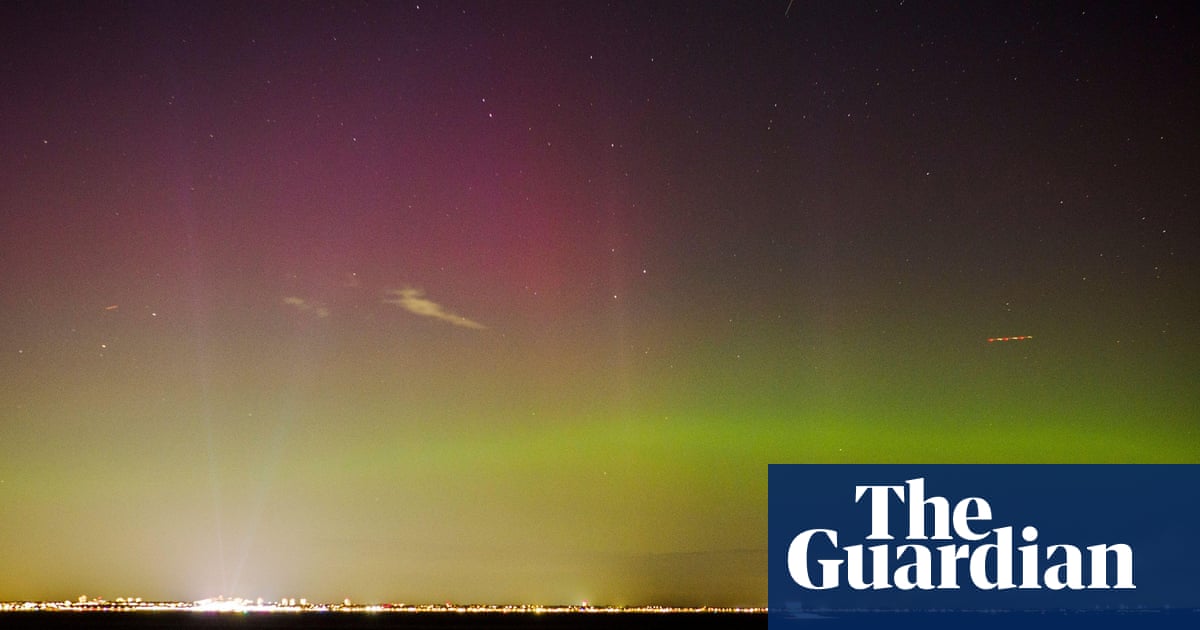
- The northern lights were visible in southern English counties including Devon, Hampshire, and Kent, a significant deviation from their usual Arctic visibility.
- Meteorologists attribute the widespread phenomenon to solar wind interacting with Earth's magnetic field during a period of heightened solar activity.
- Clear skies may allow for continued sightings across Scotland and similar latitudes until Tuesday, marking part of the sun’s 11-year cycle peak.
Unusual atmospheric conditions brought vibrant displays of the aurora borealis to regions far south of their typical range over the weekend. While these natural light shows are generally confined to areas near the Arctic Circle and northern Scotland, observers in Devon, Hampshire, and Kent reported clear views of the phenomenon on Friday and Saturday evenings. The event marks a notable expansion in visibility, allowing sky-gazers across much of the United Kingdom to witness the celestial display without traveling to high-latitude locations.
The Met Office has indicated that the conditions responsible for these sightings are likely to persist. Forecasters stated that clear skies could facilitate further observations until Tuesday, particularly across Scotland and other regions sharing similar geomagnetic longitudes. This extended window offers additional opportunities for public viewing, provided weather patterns remain favorable. The agency emphasized that visibility depends heavily on local cloud cover, meaning that while the geomagnetic activity is present, actual sightings will vary by location.
The underlying mechanism driving this widespread visibility involves complex interactions between solar emissions and Earth’s magnetic environment. The sun continuously emits charged particles known as solar wind, which travel at speeds of approximately one million miles per hour. When these particles reach Earth, they interact with the planet’s magnetic field. This interaction becomes particularly intense when the polarity of the solar wind is opposite to that of Earth’s magnetic field, causing the particles to be funneled toward the magnetic poles.
As these energetic particles descend into the upper atmosphere, they collide with atmospheric gases, releasing energy in the form of light. The specific colors observed depend on the type of gas involved and the altitude of the collision. Oxygen molecules produce the characteristic green hues commonly associated with auroras, while at higher altitudes, they can generate rare red displays. Nitrogen interactions contribute blue and purple tones to the spectacle. These collisions create the dynamic, colorful curtains of light that define the aurora borealis.
This event occurs within the broader context of the sun’s natural 11-year activity cycle. Experts had previously noted that 2026 represents a peak year for solar activity, leading to an increased frequency and intensity of geomagnetic storms. The heightened state of the sun results in more frequent ejections of charged particles, which in turn increases the likelihood of strong auroral displays reaching lower latitudes than usual. This cyclical pattern means that such widespread visibility is not unprecedented but is part of a predictable astronomical rhythm.
The significance of this event extends beyond mere visual spectacle. It serves as a tangible indicator of space weather conditions that can impact technological infrastructure. While the current displays are primarily of interest to observers and photographers, strong geomagnetic storms have the potential to interfere with satellite communications, navigation systems, and power grids. Monitoring these events allows scientists and engineers to better understand and mitigate potential risks associated with solar activity.
Public interest in the phenomenon has surged as social media platforms filled with images from across the country. The accessibility of the event this weekend has democratized the experience, allowing individuals who might never travel to the Arctic to witness a rare natural occurrence. Educational institutions and astronomy groups have used the opportunity to explain the science behind auroras, highlighting the connection between solar physics and atmospheric chemistry.
Looking ahead, the Met Office continues to monitor geomagnetic indices to provide updates on potential future displays. While the current window of opportunity extends through Tuesday, the intensity of the lights may fluctuate based on ongoing solar activity. Residents in northern regions remain the most likely to see strong displays, but those further south should remain hopeful if skies clear. The event underscores the dynamic nature of our planet’s interaction with its star.
As the peak of the solar cycle progresses, similar events may occur throughout the year. Scientists are closely tracking solar flares and coronal mass ejections to predict future geomagnetic storms. This period offers a unique chance for both professional researchers and amateur enthusiasts to study auroral behavior in greater detail. The data collected during these heightened activity periods will contribute to a deeper understanding of space weather and its effects on Earth.
The widespread visibility of the northern lights this weekend serves as a reminder of the interconnectedness of celestial bodies and terrestrial phenomena. It highlights how changes in solar output can have direct, visible consequences on our planet’s atmosphere. For now, the focus remains on enjoying the spectacle while appreciating the complex physics that make it possible. The coming days will reveal whether the current geomagnetic conditions sustain further displays or subside as the solar wind patterns shift.
Sources behind this briefing
Go to the original reporting
- The Guardian World↗Skies across the UK illuminated by the northern lights