The short version
- Small boat crossings from France to the UK fell by 42 percent in the first nine months of 2026 compared to the previous year.
- Smuggling networks are increasingly using launch sites in Normandy and Seine-Maritime, extending voyage distances by up to 80 miles.
- Experts warn that longer journeys increase risks of capsizing, exposure, and dehydration, while overcrowding remains a critical safety concern.
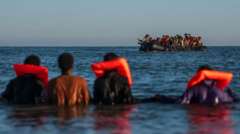
The landscape of irregular migration across the English Channel is shifting as smuggling networks adapt to intensified law enforcement pressure. While the total number of people arriving in the United Kingdom via small boats has decreased sharply this year, authorities report that those who do attempt the crossing are increasingly using longer and more hazardous routes. Migrants are launching from beaches significantly further south and west of the traditional departure points near Calais and Dunkirk, stretching their voyages across wider stretches of open water.
Data from the Home Office indicates that between January 1 and September 27, 2026, a total of 19,135 individuals crossed the Channel by small boat. This figure represents a 42 percent decline compared to the same period in the previous year. Despite this overall reduction, the geographic scope of smuggling operations appears to be expanding. French officials note that attempts originating from Normandy and the Dieppe area in Seine-Maritime have risen, with local authorities recording 58 such attempts this year alone, up from 30 last year.
The shift toward these more distant launch sites introduces substantial new dangers for those on board. One recent incident involved a boat departing from Normandy that spent more than 30 hours at sea before being intercepted by Border Force and taken to Dover. Another vessel launched from the Cherbourg area, nearly 80 miles from the usual crossing points, was met by lifeboats from the Isle of Wight. These extended distances mean migrants are exposed to maritime conditions for longer periods, increasing the likelihood of encountering severe weather.
Marine safety experts emphasize that the increased distance directly correlates with higher risk. David McFarlane, a marine safety consultant, notes that low-pressure systems developing over the Atlantic can cause swells to rise rapidly, leading to seasickness and dehydration among passengers. Winds can pick up quickly, generating waves up to 3.5 meters in height. Such conditions significantly raise the probability of boats being swamped by seawater, posing immediate threats of drowning or hypothermia.
Dr. Peter Walsh, a senior researcher at the University of Oxford's Migration Observatory, suggests that this tactical shift is a direct response to police disruptions in northern France. He describes the new routes as highly plausible adaptations to enforcement efforts, noting that launching from locations 50 miles or more from the destination is far from optimal for safety. The disruption of traditional launch sites near Calais has effectively pushed smuggling operations into less monitored but more dangerous coastal areas.
Local authorities in France are responding to this geographic shift by increasing their presence on the coast. Audrey Baconnais-Rosez, a local government representative in Seine-Maritime, stated that patrols have been bolstered with approximately 50 gendarmes and 20 police officers operating in the Dieppe area and extending toward Le Havre. She noted that while authorities are managing to stop half of the attempts from these regions, smugglers continue to explore alternative methods, including attempting to board ferries bound for Newhaven in Sussex.
The composition of those making the journey also presents ongoing challenges. Nearly all individuals arriving by small boat claim asylum upon reaching the UK, a right protected under international law that allows them to remain while their applications are processed. Small boat arrivals accounted for 40 percent of all asylum applications between July 2025 and June 2026. People from Eritrea represented 18 percent of these arrivals during that period. Additionally, the Home Office identified at least 2,335 potential victims of human trafficking or modern slavery among small boat arrivals in 2025.
Overcrowding remains a persistent issue exacerbating the dangers of these crossings. The average number of people per boat has more than doubled since 2021, with recent vessels carrying an average of 67 individuals. This density increases the risk of capsizing and complicates rescue efforts. At least 84 people died attempting to cross the Channel in 2024, according to United Nations data. While small boat crossings constitute only about 5 percent of total immigration into the UK, they have become the most common method of illegal entry since 2020.
The British government has pledged to dismantle the criminal gangs facilitating these crossings, aiming to reduce both the volume and the danger associated with them. However, the adaptation of smuggling routes suggests that enforcement measures may be displacing rather than eliminating the problem. As patrols tighten in traditional hotspots, migrants are forced into longer, more perilous journeys, highlighting the complex interplay between border security and human safety.
Looking ahead, the focus for authorities will likely remain on intercepting these extended voyages and prosecuting those involved in organizing them. The data indicates that while overall numbers are down, the nature of the crossings is evolving. With other methods of unauthorized entry also seeing a 17 percent decline, small boats remain the primary channel for irregular migration. The challenge lies in balancing effective border control with the imperative to prevent loss of life in increasingly treacherous maritime conditions.
Sources behind this briefing
Go to the original reporting
- BBC News↗Migrants using longer, more dangerous routes across Channel