The short version
- A young eastern imperial eagle named Feliks has been released back into the wild in Serbia following a complex international rescue operation.
- Conservationists tracked the bird to Syria where it was abducted, then held in Lebanon while traffickers demanded a ransom that officials refused to pay.
- The successful repatriation highlights both the vulnerability of migratory species and the growing population of this critically endangered raptor in Serbia.
A rare eastern imperial eagle has returned to the wild in Serbia after being rescued from animal traffickers who had held the bird captive for months across two countries. The release marks the conclusion of a tense international effort involving conservationists, diplomatic negotiations, and military logistics to secure the freedom of the young raptor, known as Feliks. His return underscores the persistent threats facing migratory wildlife in conflict zones while demonstrating the expanding capacity of regional conservation networks to intervene effectively.
Feliks hatched in Serbia and left his nest last year, at which point experts began tracking his movements for conservation purposes. The eastern imperial eagle is a critically endangered species, making every individual vital to the survival of the population. When the bird flew toward the Middle East in July 2025, researchers grew concerned as he entered an extremely unsafe region. His tracking signal disappeared in October, leading initial fears that the device had malfunctioned. However, subsequent intelligence revealed a darker reality: Feliks had been abducted by poachers.
The abduction triggered a protracted diplomatic and conservation response. Weeks after the signal loss, a partner organization in Lebanon contacted Serbian conservationists to report that unnamed captors were demanding a ransom for the bird’s release. Uros Stojiljkovic of the Bird Protection and Study Society of Serbia stated that authorities categorically refused to pay. This decision was strategic; paying ransoms is widely viewed as fueling the smuggling economy by validating the value of trafficked wildlife. Instead, officials engaged in lengthy negotiations to secure Feliks’ freedom without financial compensation.
The logistics of the rescue involved significant risk and unconventional methods. Reports indicate that refugees carried Feliks in a potato sack across the Nahr al-Kabir river, which forms part of the northern border between Syria and Lebanon. This clandestine transfer allowed the bird to escape the immediate control of traffickers and enter a wildlife center in Beirut. There, he spent more than half a year recuperating under professional care before his final journey home could be arranged.
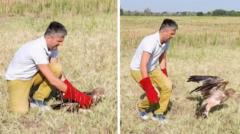
In June of this year, Serbian peacekeepers returning from Lebanon facilitated the bird’s repatriation. Feliks was transported on a military plane to Palic Zoo in Serbia, where he arrived in an exhausted state after the demanding journey. Sonja Mandić, the zoo director, noted that his health required daily monitoring upon arrival. The bird underwent more than a month of careful recovery at the shelter, allowing veterinarians and conservationists to ensure he was physically capable of surviving in the wild once again.
The successful rescue of Feliks occurs against a backdrop of significant conservation progress in Serbia. According to the Bird Protection and Study Society of Serbia, dedicated efforts since 2017 have increased the local population of eastern imperial eagles from just one pair to twenty-nine pairs this year. This growth is remarkable for a species classified as critically endangered. An adult eastern imperial eagle possesses a wingspan of approximately six feet, making them imposing predators that require large, undisturbed territories to thrive.
Milan Ružić, executive director of the BPSSS, expressed hope that Feliks will regain his strength quickly and overcome future adversities. The goal is for him to conquer his own territory and eventually leave descendants, thereby contributing to the genetic diversity and resilience of the species. Experts plan to monitor the young eagle closely in the coming weeks to assess his adaptation to the wild environment.
This case illustrates the complex intersection of wildlife conservation and geopolitical instability. While Feliks’ story ends with a successful release, it highlights the dangers faced by migratory birds passing through regions affected by conflict and organized crime. The refusal to pay ransom sets a precedent for future cases, signaling that conservation agencies will not legitimize trafficking networks. As Serbia continues to expand its protected populations, the safety of individual birds like Feliks remains dependent on international cooperation and vigilant monitoring.
Sources behind this briefing
Go to the original reporting
- BBC World↗Kidnapped rare Serbian eagle freed into wild after rescue