The short version
- The president reportedly switched aircraft mid-flight using a catering truck transfer, leaving decoys on the original plane.
- Security experts interpret this unusual maneuver as evidence of a serious and specific threat assessment by intelligence agencies.
- Such deceptive tactics have historical precedents in high-risk travel but remain rare for standard diplomatic summits.
Reports emerging from Ankara suggest that US President Donald Trump did not fly directly to the United Kingdom on Air Force One after departing the NATO summit in Turkey. Instead, accounts indicate the president was secretly transferred to a C-32A military aircraft while the primary plane remained airborne with unaware passengers and crew serving as decoys.
The maneuver involved moving the president via a catering truck upon landing or during a brief stop, allowing him to board the smaller Boeing 757 variant. This secondary aircraft then proceeded to RAF Mildenhall in the United Kingdom. Those remaining on the original Air Force One had no indication that the commander-in-chief was no longer traveling with them, effectively turning the iconic plane into a diversion.
Security analysts describe this operation as an extreme version of standard protective protocols. Ronald Kessler, an author specializing in agency operations, noted that misleading potential attackers is a long-standing strategy for the Secret Service. Robert McDonald, a former high-ranking agent who served during the Bush administration, characterized these tactics as a 'shell game' designed to create uncertainty for adversaries.
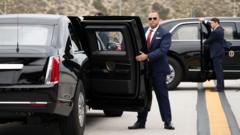
In routine motorcade operations, two armored limousines known as 'Beasts' often travel together, switching positions under bridges or in tunnels to confuse observers. Similarly, Marine One helicopters frequently fly in groups of three, altering their formation so that threats cannot easily identify which rotorcraft carries the president. These measures are standard practice for domestic and lower-risk international travel.
However, transferring a sitting president between aircraft mid-journey is far less common. Former Secret Service agent Paul Eckloff stated that while such options exist for executive protection teams, they are not frequently employed. He emphasized that these elaborate deceptions are typically reserved for complex trips to war zones or areas with elevated risk profiles where creating doubt about the leader's location is critical.
Historical precedents for similar covert movements exist but are rare. In 2000, Bill Clinton flew from India to Pakistan on an unmarked jet while a decoy Air Force One landed separately. Three years later, George W. Bush arrived in Baghdad aboard a blacked-out aircraft after public statements suggested he would spend Thanksgiving in Texas. More recently, Joe Biden traveled to Ukraine with a minimal press pool in 2023. In each instance, media personnel on board were aware of the deception but agreed not to report it immediately.
The specific nature of the threat that prompted this latest action remains unclear. The Secret Service has not commented on the incident, and the White House neither confirmed nor denied the transfer, stating only that it utilizes every available tool to ensure presidential safety. Experts suggest that contingency plans are developed in advance, but flexibility is required to improvise when new intelligence emerges overseas.
McDonald argued that the decision to execute such a significant deception implies that multiple agencies assessed the danger level in Turkey as substantial. He suggested that staff from the Secret Service, the White House Military Office, and intelligence communities likely convened to review specific threats before implementing the plan. Marc Polymeropoulos, a former CIA veteran, echoed this view, noting that the severity of the perceived risk must have been considerable to justify such operational complexity.
Questions remain regarding the ethical and procedural implications of leaving decoys unaware of the danger. Polymeropoulos raised concerns about whether those on the original aircraft had a right to be warned if the plane was targeted based on known intelligence. While protecting the president is paramount, the use of unwitting civilians or staff as bait presents complex moral dilemmas for security agencies.
As details continue to emerge, the incident highlights the evolving nature of presidential protection in an era of heightened geopolitical tension. The reliance on deception underscores the challenges faced by security teams tasked with safeguarding leaders while maintaining operational secrecy. Future travel protocols may see increased use of such tactics if threat assessments remain elevated.
Sources behind this briefing
Go to the original reporting
- BBC World↗Inside the Secret Service 'shell game' to hide US presidents in plain sight

