The short version
- A team led by Northwestern University trapped a single positron for months, a first in particle physics.
- The achievement allows scientists to compare magnetic properties of matter and antimatter to test the standard model.
- This research addresses the mystery of why the universe contains more matter than antimatter.
In a significant breakthrough for particle physics, researchers have successfully trapped a single antimatter particle for months. The study, published on October 21 in Physical Review Letters, describes how scientists used electric and magnetic fields to capture and maintain a positron, the antimatter counterpart of an electron. This achievement marks the first time such a long-term containment of an individual antiparticle has been accomplished, opening new avenues for testing fundamental theories about the universe.
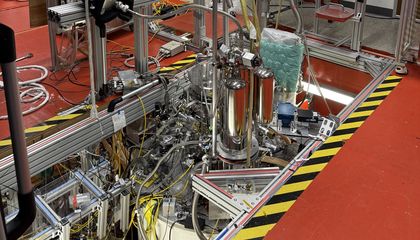
The team, led by Gerald Gabrielse at Northwestern University, faced considerable challenges in this endeavor. Antimatter particles are notoriously difficult to contain because they annihilate upon contact with regular matter, converting their mass into energy. To prevent this, the researchers constructed a specialized trap that isolates the positron from any surrounding material. The ability to keep the particle stable for months allows for precise control and study, which was previously impossible due to the fleeting nature of antimatter interactions.
This work is particularly important because it addresses one of the biggest mysteries in cosmology: why the universe is dominated by matter rather than antimatter. According to the Big Bang theory, equal amounts of matter and antimatter should have been created at the beginning of the universe. If this had occurred, all particles would have annihilated each other, leaving nothing behind. The fact that we exist suggests an imbalance, but the standard model of particle physics does not fully explain this discrepancy.
By trapping a positron, scientists can now compare its magnetic properties with those of an electron. Any differences between the two could provide clues about why matter prevailed over antimatter. Gabrielse noted that while the standard model has been extraordinarily accurate in many respects, it fails to predict why the universe exists as we know it. This experiment offers a direct way to probe these limitations and potentially uncover new physics.
Experts outside the study have praised the achievement. Stefan Ulmer, a researcher at RIKEN, described trapping an antiparticle as 'extremely difficult,' while Barbara Latacz from CERN called it a 'remarkable achievement.' These endorsements highlight the technical skill and innovation required to succeed in this experiment. The ability to control and study a single positron for extended periods represents a major step forward in experimental physics.
The implications of this research extend beyond theoretical curiosity. Understanding the asymmetry between matter and antimatter could reshape our understanding of the universe's origins and evolution. If the standard model is found to be incomplete, it may necessitate new theories or modifications to existing ones. This could have far-reaching consequences for how we view fundamental forces and particles.
The methodology used in this study involves sophisticated techniques for manipulating electric and magnetic fields. These fields create a 'bottle' that holds the positron in place without physical contact. The precision required to maintain this trap is immense, as any disturbance could cause the particle to escape or annihilate. The success of this approach demonstrates the advancement of experimental capabilities in modern physics laboratories.
As researchers continue to analyze data from this trapped positron, they will look for subtle deviations in its behavior compared to electrons. These deviations, if found, would be significant evidence against the current standard model. Even if no differences are detected, the experiment provides valuable constraints on theoretical models and helps refine our understanding of particle interactions.
This breakthrough underscores the importance of continued investment in fundamental science. While the immediate applications may not be obvious, discoveries in particle physics often lead to technological advancements and deeper insights into the natural world. The ability to trap antimatter for months is a testament to human ingenuity and the relentless pursuit of knowledge.
Sources behind this briefing
Go to the original reporting
- Smithsonian Magazine↗For the First Time, Scientists Trapped an Elusive Antimatter Particle—and Contained It for Months. It Could Allow Them to Test an Enduring Physics Theory
- Scientific American↗Physicists trap a single antimatter particle for a month
- Northwestern Now News↗Scientists trap and tame a single particle of antimatter for months
- ScienceAlert↗Physicists Trapped a Particle of Antimatter And Kept It Caged For Months