The short version
- Leaders from Saudi Arabia, Turkey, and Pakistan signed a defense pact in Mecca stating that an attack on one member is considered an attack on all three.
- The agreement aims to stabilize security ties as regional conflicts involving Iran and its allies disrupt shipping through the Red Sea and Strait of Hormuz.
- While the pact combines Saudi financial power, Turkish military capacity, and Pakistani nuclear capabilities, it lacks specific details on individual obligations.
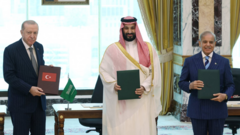
A significant shift in Middle Eastern security architecture occurred this week as Saudi Arabia, Turkey, and Pakistan formalized a joint defense agreement. The leaders of the three nations—Saudi Crown Prince Mohammed bin Salman, Turkish President Recep Tayyip Erdogan, and Pakistani Prime Minister Shehbaz Sharif—concluded the signing ceremony in the holy city of Mecca. This tripartite arrangement marks a notable expansion of existing bilateral ties, specifically building upon the defense pact previously established between Riyadh and Islamabad last year.
The core provision of the newly announced Mecca Joint Defence Agreement establishes a collective security principle. According to statements from Pakistan’s foreign ministry, any aggression directed at one of the signatory states will be interpreted as an assault against all three parties. This mutual support framework is designed to deter potential threats by presenting a unified front among these major Sunni-majority nations. The agreement signals a coordinated effort to manage regional instability without relying solely on external powers.
The timing of this diplomatic move reflects growing anxiety over the widening conflict between the United States and Iran. Tensions have escalated significantly since February, when US and Israeli forces conducted attacks against Iranian targets. In response, Iran and its allied networks have intensified operations against Gulf states, including Saudi Arabia. These actions have included strikes on strategic infrastructure and a blockade of commercial shipments, creating severe disruptions to global trade routes.
Shipping through the Strait of Hormuz and the Red Sea has become increasingly hazardous due to these hostilities. In Yemen, Houthi rebels, who are backed by Iran and control northern territories, have declared a maritime embargo against Saudi Arabia. Their campaign has targeted airports, oil facilities, and tankers navigating the Red Sea. This aggression has forced Saudi Arabia to respond with airstrikes on Houthi positions and the formation of a new naval coalition aimed at protecting commercial traffic in the Gulf of Aden.
The strategic rationale behind the pact lies in the complementary strengths each nation brings to the alliance. Saudi Arabia contributes substantial financial resources and serves as one of the world’s largest purchasers of military equipment. Turkey offers robust military capabilities, including its status as the second-largest armed force within NATO and a sophisticated domestic defense production industry. Pakistan adds significant strategic weight through its possession of nuclear weapons and experienced military personnel.
Despite the high-profile nature of the announcement, the specifics of the agreement remain somewhat opaque. A Turkish official described the pact as purely defensive in character, emphasizing its role in safeguarding national sovereignty rather than projecting power offensively. However, the text of the Mecca Joint Defence Agreement does not outline detailed obligations for each member state regarding troop deployment, financial contributions, or specific response protocols in the event of an attack.
The formation of this alliance underscores a broader trend of regional actors seeking greater autonomy in security matters. With their common ally, the United States, facing challenges in containing the repercussions of the Israel-Iran conflict, these nations appear motivated to bolster their own defensive capacities. The lack of clarity regarding the abatement of hostilities between Israel and Iran has further incentivized this cooperative approach.
Looking ahead, the practical implementation of this defense pact will depend on how effectively the three nations can coordinate their military and diplomatic efforts. The success of the agreement may be tested by ongoing Houthi attacks and potential further escalations involving Iranian proxies. Observers will likely monitor whether this new framework leads to tangible changes in regional security dynamics or remains primarily a symbolic gesture of solidarity among key Sunni powers.
The geopolitical implications extend beyond immediate security concerns, potentially reshaping alliances in the Middle East and South Asia. By linking their defense interests, Saudi Arabia, Turkey, and Pakistan are creating a bloc that could influence future negotiations and conflict resolution efforts. The absence of detailed operational plans leaves room for interpretation, but the commitment to mutual defense represents a clear statement of intent in an increasingly volatile region.
Sources behind this briefing
Go to the original reporting
- BBC World↗Saudi Arabia, Turkey and Pakistan sign defence pact

