The short version
- Russian drone strikes killed at least seven people and injured more than eighty across multiple Ukrainian cities, including significant damage to a national science academy in Kyiv.
- Diplomatic prospects for ending the invasion appear dim as Russian officials warn of consequences for recent Ukrainian actions, while battlefield positions remain largely static despite localized offensives.
- Ukrainian forces report recapturing territory in eastern Donetsk using modified armored vehicles and robots, though independent verification of these claims remains unavailable.
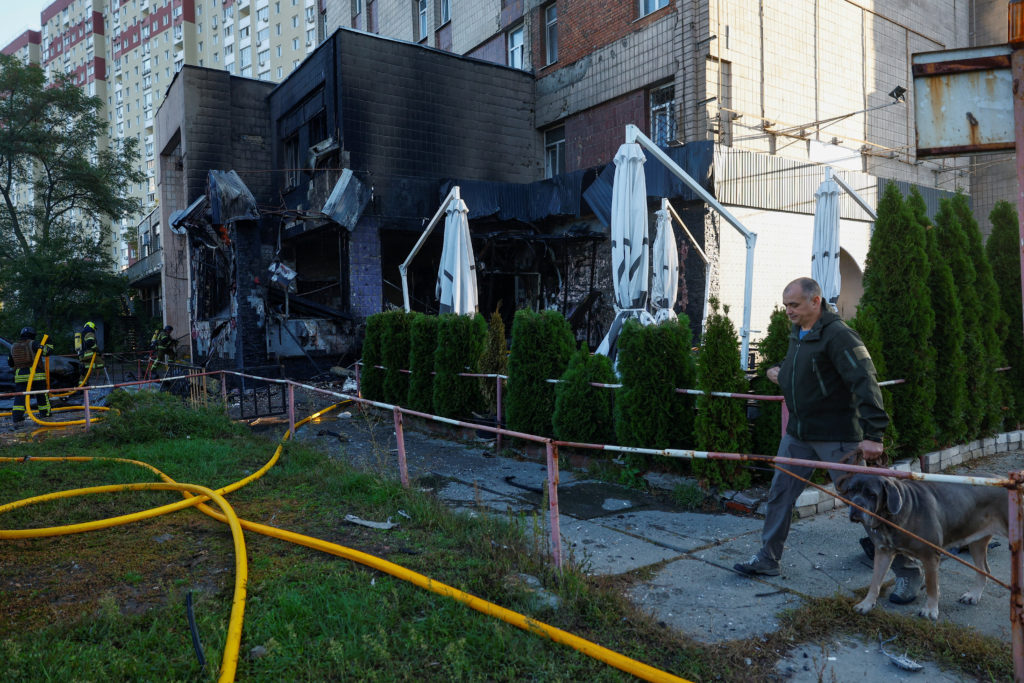
A relentless wave of Russian drone attacks struck multiple Ukrainian cities on Monday, killing at least seven civilians and wounding more than eighty others. The bombardment targeted a wide array of locations, including apartment complexes, commercial offices, gas stations, data centers, and a prominent cultural institution in the capital. Officials described the strikes as part of a sustained effort to degrade Ukraine’s economic capacity and erode public resilience after four and a half years of conflict.
In Kyiv, one drone hit a building housing the National Academy of Sciences, marking another blow to the city’s cultural heritage sites. Emergency responders assisted staff members who escaped the burning structure by climbing down from windows onto firefighter ladders. Mayor Vitali Klitschko characterized the ongoing assaults as a campaign of terror designed to disrupt daily life and destroy infrastructure. The strikes also affected a pharmaceutical facility and several fuel stations in the capital.
The violence extended beyond the capital, with significant casualties reported in other regions. In Dnipro, a drone struck an office center during working hours, killing three people and injuring at least eighteen. In Kharkiv, a nine-story residential building was hit, wounding forty-three individuals, including eleven children. Additional injuries were reported in Zaporizhzhia, Odesa, and the Chernihiv region, where a residential area was struck late Sunday evening.
Russian authorities stated that their forces targeted two data centers in Kyiv, gas stations, and a distribution hub for Nova Poshta, a major postal service, in Odesa. The military also claimed to have hit cargo ships in the Black Sea and at the port of Chornomorsk. Moscow asserts these strikes aim to limit Ukraine’s grain exports, a move that could potentially trigger food shortages in nations dependent on Ukrainian agricultural imports. Russian officials maintain that they only target military-related sites, despite evidence of regular hits on civilian areas.
Diplomatic efforts to end the war have stalled amid rising tensions. Recent negotiations at the United Nations failed to produce significant progress. Kremlin spokesman Dmitry Peskov suggested that the likelihood of a swift peace settlement was low, citing recent Ukrainian attacks on Russian soil, including incidents during parliamentary elections in Russia. He warned that Ukraine would face consequences for these actions, implying that the current bombardment serves as retribution.
On the battlefield, large-scale movements remain restricted by dense drone surveillance, leading to a stalemate along much of the front line. However, Ukrainian forces have launched a localized offensive known as Operation Vivaldi in the Donetsk region. The Third Army Corps reported recapturing an additional fifty-one square kilometers of territory, bringing the total reclaimed area to one hundred seventy-six square kilometers since the operation began several months ago.
To achieve these gains, Ukrainian troops reportedly converted Soviet-era BTR-60 armored personnel carriers into explosive-laden kamikaze vehicles to breach heavily fortified Russian positions. Ground robots were also deployed to attack enemy lines. These tactical adjustments aim to break through defenses in eastern Ukraine, an area Moscow has sought to conquer without full success. Russian officials did not immediately comment on the Ukrainian claims of territorial gains.
Conversely, Russia’s Defense Ministry announced that its troops had captured the villages of Novovodiane in Donetsk and Ulanove in the northern Sumy region. Independent verification of these conflicting reports was not possible at the time of publication. Meanwhile, President Volodymyr Zelenskyy stated that Ukrainian long-range drones had struck defense plants in the Tula and Voronezh regions, as well as oil facilities in Krasnodar, continuing a pattern of targeting industrial sites critical to Russia’s war economy.
The conflict continues to exact a heavy toll on civilian populations while diplomatic channels remain blocked. The combination of aerial bombardment, economic pressure, and localized ground combat underscores the entrenched nature of the war. With no clear path to negotiation emerging, both sides appear committed to sustaining their respective strategies, leaving the prospect of an immediate resolution increasingly distant.
Sources behind this briefing
Go to the original reporting
- PBS NewsHour↗Russian drones hammer apartments and cultural landmark in Ukraine, killing 7