The short version
- Roland Mouret designed the Galaxy dress in 1998 after discovering that extending a garment’s length did not increase production costs, allowing for a versatile, signature piece.
- The bodycon silhouette became iconic in the early 2000s, worn by numerous celebrities and royalty, though some high-profile wearers requested modifications to remove the back zipper for security or symbolic reasons.
- Mouret observes that the tight, severe aesthetic of similar dresses is now prevalent among women in the Trump administration, interpreting this trend as a reflection of current sociopolitical tensions.
The narrative behind one of the most recognized garments of the past half-century began with a practical manufacturing insight rather than a purely artistic vision. In 1998, Roland Mouret, having just presented his debut collection at London Fashion Week, sought efficient methods to produce high-quality clothing rapidly. Through collaboration with a small British atelier, he learned that extending a seam length did not necessarily raise production expenses. This realization shifted his design strategy toward creating longer, more substantial pieces that could function as complete outfits when paired with accessories, ultimately leading to the creation of the Galaxy dress.
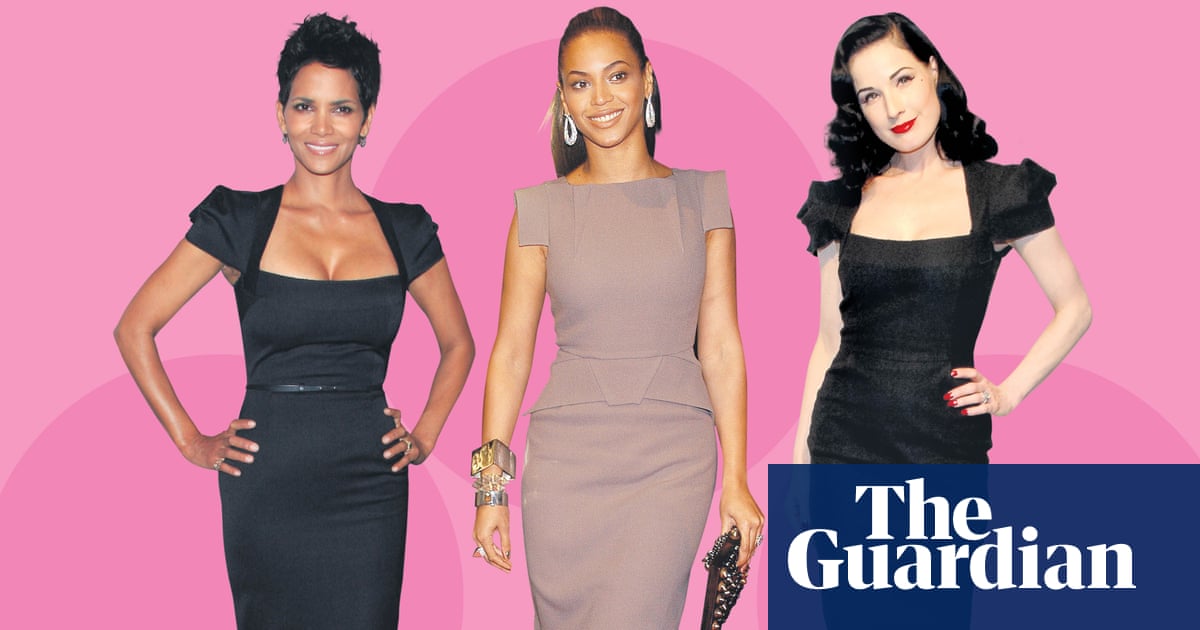
The resulting garment was a hyper-bodycon sheath featuring a distinctive industrial zipper on the back. It quickly established itself as a defining silhouette of the late 1990s and early 2000s in London, standing alongside the work of contemporaries like John Galliano and Alexander McQueen. The dress gained widespread visibility through its appearance on high-profile figures such as Beyoncé, Halle Berry, and Victoria Beckham, whose own early designs reflected Mouret’s influence. Mouret has noted that he often conceptualized his designs from the rear perspective, believing that seeing a face stops the imagination, whereas the back of a garment allows for more abstract interpretation.
Mouret describes the dress as an attempt to create a feminine equivalent of a man’s suit, emphasizing structure and equality rather than traditional femininity. The design featured a sharp neckline and a cinched waist reminiscent of 1950s cinema icons, yet maintained comfort and a masculine edge. In his new autobiography, Mouret connects this aesthetic choice to his personal experiences and sexual exploration during his youth, framing the garment as a collaboration that celebrated bodily discovery without attempting to prove masculinity. The dress was intended to offer strength and choice to the wearer.
Despite its widespread adoption by Hollywood stars like Scarlett Johansson and Naomi Watts, the Galaxy dress faced specific modifications for certain high-status wearers concerned with security or symbolism. Catherine, Princess of Wales, commissioned a version without the back zipper due to concerns about paparazzi exploiting it as a vulnerability. Similarly, Robin Wright, who portrayed the female president Claire Underwood in House of Cards, requested the removal of the gold hardware. Wright explained that while she appreciated the dress as a woman, the visible zipper felt inappropriate for a character representing political authority, requiring that element to remain invisible.
The physical experience of wearing the dress was also central to its design philosophy. Mouret highlighted the use of power mesh lining, which created a dramatic effect when the zipper was removed, describing it as an intense sensory experience. This aspect of the garment underscored themes of liberation and emotional release. However, the practicality of the zipper remained a point of contention for those in public life who prioritized discretion or security over the theatrical element of undressing.
In recent years, the aesthetic principles embodied by the Galaxy dress have re-emerged in a different cultural context. Although Mouret no longer produces new Galaxy dresses, similar bodycon sheaths from his label have been worn by women associated with the Trump administration, including Ivanka, Melania, and Lara Trump. The severe, tight-fitting silhouette has become part of a broader visual style linked to this political circle, characterized by extreme eyelashes, sleek hair, and cosmetic enhancements. This shift marks a departure from the dress’s earlier associations with Hollywood glamour and royal elegance.
Mouret interprets this contemporary adoption through a sociopolitical lens, suggesting that fashion reflects the underlying anxieties of its era. He notes that the current iteration of this style is extreme, with garments so tight and heels so high that they would impede physical escape or self-defense. According to Mouret, this decadent look signals a future defined by fear, contrasting sharply with the empowering intentions behind the original design. The garment’s journey from a symbol of bodily autonomy in the 1990s to a marker of political affiliation today illustrates the complex ways clothing acquires meaning over time.
The story of the Galaxy dress underscores how a single design can transcend its initial context to become a cultural artifact. From its origins in cost-effective manufacturing decisions to its adoption by global celebrities and now political figures, the garment has accumulated layers of significance. Mouret’s reflections highlight the tension between artistic intent and public interpretation, as well as the enduring power of silhouette in shaping both personal identity and collective style. As fashion continues to mirror societal shifts, the Galaxy dress remains a testament to the interplay between design, politics, and perception.
Sources behind this briefing
Go to the original reporting
- The Guardian US↗‘I wanted to create the female version of a man’s suit’: how Roland Mouret’s Galaxy dress took over the world