The short version
- A single rare coin found among thousands in the Mørstad hoard has been designated a national treasure due to its direct link to King Olaf II Haraldsson.
- The artifact features Christian iconography and inscriptions that scholars interpret as a deliberate political tool used to legitimize royal authority and promote the new faith.
- Ongoing cataloging of the cache suggests the total count may exceed 6,000 items, making it the largest Viking Age coin collection ever discovered in Norway.
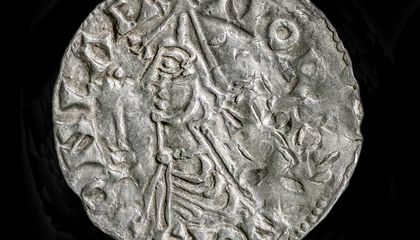
Archaeologists working on a massive silver coin discovery in eastern Norway have identified a singular artifact that significantly elevates the historical importance of the find. The Mørstad hoard, initially uncovered by metal detectorists in April, already held the distinction of being the largest Viking Age coin stash ever located in the country. However, the recent identification of an exceedingly rare silver piece minted during the reign of Olaf II Haraldsson has transformed the cache into what experts are now calling a national treasure.
Anne Skogsfjord, an archaeologist with the University of Oslo’s Museum of Cultural History, recognized the coin's significance only after closely examining its inscription. The text reads “ONLAF R+ NORMANORV,” which translates to Olaf, King of the Norwegians. This specific type of currency is exceptionally uncommon; prior to this discovery, only four such coins had ever been found worldwide. Just one of those previous examples was discovered in Norway during church restoration work in 1924.
The scarcity of these artifacts makes the new find particularly striking. Fewer than twenty coins minted under Olaf’s authority have ever been recovered, and the vast majority were located outside of Norway. Jon Anders Risvaag, a numismatist at the Norwegian University of Science and Technology, described the likelihood of finding such an item as comparable to locating a needle in a haystack. The rarity stems from the limited duration and scale of coin production during Olaf’s reign compared to later periods.
Visual analysis of the coin reveals deliberate design choices that reflect broader political and religious strategies. The obverse side displays Olaf’s left-facing bust wearing a conical battle helmet, accompanied by a Golgotha cross on three steps, a motif inspired by Byzantine coinage. The reverse features a double cross and an inscription meaning “My leader, my lord.” Researchers view these elements as emblematic of Olaf’s efforts to establish Christianity in Norway and legitimize his rule through European-style branding.
Svein Gullbekk, a numismatist at the University of Oslo, characterized the artifact as a Christianization coin on a grand scale. He noted that the design demonstrates how Olaf used currency to assert himself as a Christian king of European standing. Because only three types of coins were issued during his reign, it is likely that the king and his inner circle were intimately involved in the production process. This level of oversight suggests the minting was a calculated political power move rather than a routine economic activity.
Historical context indicates that coin production in Norway did not become widespread until Harald Hardrada assumed power in 1045 C.E. For Olaf, who ruled from 1015 to 1028, minting coins served as a demonstration of kingship and an attempt to emulate practices abroad. Born around 995, Olaf encountered Christianity during Viking raids against England and France before being baptized in Rouen around 1013. His subsequent push for religious acceptance faced significant resistance, particularly in Trøndelag and eastern inland districts.
Physical evidence on the coin suggests it was not merely a ceremonial object but also circulated as currency. The artifact bears numerous small cuts made by a knife, a common method used during transactions to test silver content. These marks indicate the coin changed hands multiple times between its production around 1024 to 1028 and its burial in the late 1040s. This timeline places the hoard’s deposition near the end of the Viking Age, following Olaf’s death in 1030 and his subsequent canonization.
The museum plans to feature this rare coin in an upcoming exhibition dedicated to the Mørstad hoard, marking the first public display of any part of the collection. Meanwhile, researchers continue the labor-intensive process of cataloging the entire cache. Florent Audy, who oversees the project, estimates the current count at 5,500 coins and anticipates the total may soon exceed 6,000. The ongoing work promises to yield further insights into the economic and social dynamics of medieval Norway.
Olaf’s legacy grew substantially after his death, with churches and shrines built in his honor across the world. Historical accounts of his life are relatively scarce, making physical artifacts like this coin invaluable for understanding his royal power and religious policies. The 1024 religious code he established is considered the founding document of the Church of Norway. This discovery provides a tangible link to that pivotal era, offering a rare glimpse into how a monarch navigated the complex transition from pagan traditions to Christian statehood.
Sources behind this briefing
Go to the original reporting
- Smithsonian Magazine↗In a Hoard of 5,500 Viking Age Coins, Archaeologists in Norway Found One So Rare That They Already Consider It a 'National Treasure'