The short version
- Cleaning and security costs for three Banksy works have reached almost £150,000, with expenses likely to increase as removal efforts continue.
- The Ministry of Justice is using laser technology to strip a mural from the Royal Courts of Justice after initial scrubbing attempts failed to fully remove the paint.
- Officials and critics remain divided on whether these interventions constitute damaging vandalism or valuable public art that boosts tourism.
British taxpayers have borne nearly £150,000 in costs related to three recent artworks attributed to Banksy, with expenditures expected to climb as authorities attempt to restore affected sites. The financial burden stems from cleaning operations, security measures, and administrative responses to installations on historic and public properties. These figures were revealed through Freedom of Information requests and highlight the ongoing tension between heritage conservation and the unauthorized placement of high-profile street art.
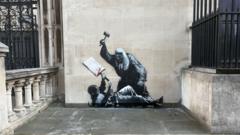
The largest portion of this spending concerns a mural that appeared on the Royal Courts of Justice in London in September 2025. The Ministry of Justice has allocated £50,000 specifically for removing paint from the Grade II-listed building’s exterior wall. An additional £35,300 was spent on overtime and security personnel tasked with guarding the site while removal efforts proceeded. The mural depicted a judge in traditional wig striking a protester with a gavel, an image Banksy claimed as his own via social media shortly after its appearance.
Initial attempts to clean the court wall using standard scrubbing methods proved insufficient. Consequently, contractors have deployed laser technology to strip the remaining pigment without damaging the historic stonework. Westminster City Council must inspect the results; if the removal is deemed incomplete, alternative cleaning methods will be required. In a worst-case scenario, sections of the affected stone may need to be entirely removed and replaced, which would significantly increase costs and disruption.
The Metropolitan Police confirmed that officers received reports of criminal damage on the day the mural appeared. No arrests have been made, and the investigation remains open. Court staff immediately barricaded the area and installed security guards to manage crowds and protect the site. A spokesperson for HM Courts and Tribunals Service emphasized the obligation to maintain the original character of the listed building, underscoring the legal imperative to remove unauthorized alterations.
Beyond the Royal Courts of Justice, other public bodies have incurred substantial expenses dealing with Banksy’s interventions. In April, a statue depicting a man carrying a flag that obscured his face appeared in Waterloo Place near Trafalgar Square. Westminster City Council, which owns the land, reported spending nearly £60,000 on safety barriers, administrative work, and security guards to monitor the installation. The council stated it had no prior knowledge of the statue’s placement and is currently reviewing options for its short-, medium-, and long-term management.
A third incident involved a sentry box in the City of London, which Banksy painted with images of piranha fish in August 2024. This structure, installed in the 1990s following IRA attacks, was removed at a cost of £2,200 and placed into storage. It has not been replaced at its original location. These cumulative costs illustrate the financial impact of Banksy’s work on public institutions responsible for maintaining historic infrastructure and public safety.
The spending has reignited debate over the classification of Banksy’s work. Shadow Justice Secretary Nick Timothy condemned the use of taxpayer money to clean up what he described as vandalism, arguing that the artist should bear the costs imposed on others. Timothy emphasized that courts are national symbols of justice and should not be defaced with impunity. He called for an end to such unauthorized acts and for accountability regarding the financial burden placed on the public.
Conversely, art critic Estelle Lovatt defended the cultural value of Banksy’s interventions, noting their ability to attract tourism and foster public engagement. She compared the artist’s impact to that of a town crier or Pied Piper, suggesting his work brings people together in ways politics often divides them. While acknowledging the intimidation factor for building owners facing sudden crowds, Lovatt highlighted the accessibility of street art, which requires no gallery fees and reaches broader audiences than traditional museum exhibits.
As cleaning operations continue behind scaffolding and locked doors at the Royal Courts of Justice, a Listed Building Consent application has been submitted to install railings across the targeted wall. If approved, the cost of these protective measures remains unknown but would add to the total expenditure. The situation underscores the complex challenge faced by heritage managers in balancing preservation duties with the public interest in contemporary art.
The outcome of these cases may set precedents for how future unauthorized artworks on historic sites are handled. Authorities must weigh the legal requirements of maintaining listed buildings against the cultural and economic benefits associated with Banksy’s global fame. Until a resolution is reached, the financial toll on taxpayers will likely continue to rise, reflecting the high stakes involved in preserving Britain’s architectural heritage.
Sources behind this briefing
Go to the original reporting
- BBC News↗Banksy works cost public almost £150,000

