The short version
- Prime Minister Andy Burnham has committed to finding a solution to keep Jodrell Bank Observatory open after UK Research and Innovation excluded it from future funding priorities.
- The Lovell telescope, a key component of the e-Merlin array operated by the University of Manchester, faces the cessation of all scientific observations in April 2028 without new financial support.
- A broad coalition including scientists, musicians, and public figures has signed a letter demanding immediate government intervention to preserve the site's research and heritage value.
The United Kingdom’s premier radio astronomy facility is facing an existential threat after the national research funding body decided not to prioritize the Jodrell Bank Observatory for future financial support. Prime Minister Andy Burnham intervened directly in the matter during a session in the House of Commons, declaring that the government would find a way to preserve the institution. His intervention marks a significant shift from the initial stance taken by UK Research and Innovation, which had determined that the site would not receive further funding once its current agreement expires in March 2028.
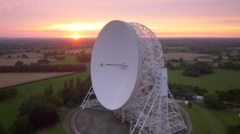
The Lovell telescope, located in Cheshire, has been a cornerstone of British scientific infrastructure since its installation in 1957. As the world’s third-largest steerable radio telescope, it plays a critical role in the e-Merlin array, a network of telescopes managed by the University of Manchester. The facility is not merely a modern research tool but also a historical landmark that has contributed to major discoveries in quasars, pulsars, and gravitational lenses. Its early work in tracking spacecraft during the space race further cements its status as both a scientific and cultural asset.
UK Research and Innovation defended its decision as the outcome of a comprehensive and evidence-based prioritization process. The agency indicated that resources must be allocated strategically across the broader research landscape, leading to the exclusion of Jodrell Bank from the next funding cycle. This administrative determination has created a tight deadline for the observatory, with all scientific operations expected to halt on April 1, 2028, unless alternative financing is secured before then.
Political pressure has mounted rapidly in response to the funding cut. Sarah Russell, the Member of Parliament for Congleton, which encompasses the Jodrell Bank site, highlighted the medium-term risks posed by these reductions. She urged the Prime Minister and Downing Street to collaborate with her and Tim Roca, the MP for Macclesfield, to resolve the crisis. Burnham responded affirmatively, agreeing to convene a meeting to address the concerns raised by local representatives and stakeholders.
The Prime Minister emphasized the dual nature of Jodrell Bank as both a heritage asset and a vital research institution. He recalled his own childhood visits to the site during school trips, framing its preservation as a matter of national pride and educational continuity. Burnham stated that he could not accept the demise of such an iconic facility under his administration, signaling a firm political commitment to overturning the funding body’s decision.
Support for the observatory extends well beyond political circles into the realms of science, arts, and public life. More than 150 prominent figures have signed a petition calling for the government to reverse the funding cut and provide immediate financial assistance. The signatories include astronaut Tim Peake, renowned physicists such as Jim Al-Khalili and Brian Cox, and Scotland’s Astronomer Royal, Catherine Heymans. Their involvement underscores the broad consensus that the closure would represent a significant loss to British science.
The cultural resonance of Jodrell Bank has also mobilized support from the entertainment industry. Musicians including Sir Brian May, Johnny Marr, and Jarvis Cocker, along with bands like New Order, Elbow, and Doves, have joined the campaign. Comedian Dara Ó Briain and Judy Spence, daughter of the site’s founder Sir Bernard Lovell, are also among those advocating for its survival. This cross-sector alliance highlights the observatory’s deep roots in British popular culture, from its appearances in Doctor Who to The Hitchhiker's Guide to the Galaxy.
Scientists have reacted strongly to the funding decision, describing it as heartbreaking and scientifically misguided. They argue that the loss of Jodrell Bank would impair the UK’s ability to conduct cutting-edge radio astronomy research. While the Jodrell Bank Centre for Engagement is currently considered safe from these cuts, the core scientific operations remain in jeopardy. The coming months will be critical as the government works to identify a sustainable funding model that aligns with national research priorities while preserving this historic institution.
The situation remains fluid as negotiations and discussions take place behind the scenes. While the Prime Minister has offered a verbal guarantee of support, concrete financial plans have not yet been detailed. The outcome will depend on whether the government can reconcile its broader fiscal constraints with the specific needs of one of the country’s most prestigious scientific sites. All eyes are now on Downing Street and UK Research and Innovation to see how this conflict between administrative prioritization and political preservation is resolved.
Sources behind this briefing
Go to the original reporting
- BBC News↗'We'll find way to save Jodrell Bank,' Burnham says

