The short version
- Riot police secured Poland’s constitutional court in Warsaw following the suspension of its president and deputy by government-appointed judges.
- President Karol Nawrocki returned from a state visit to confront security forces at the building, declaring the move a violation of constitutional order.
- The incident highlights the unresolved conflict between Prime Minister Donald Tusk’s reform agenda and opposition efforts to maintain control over the judiciary.
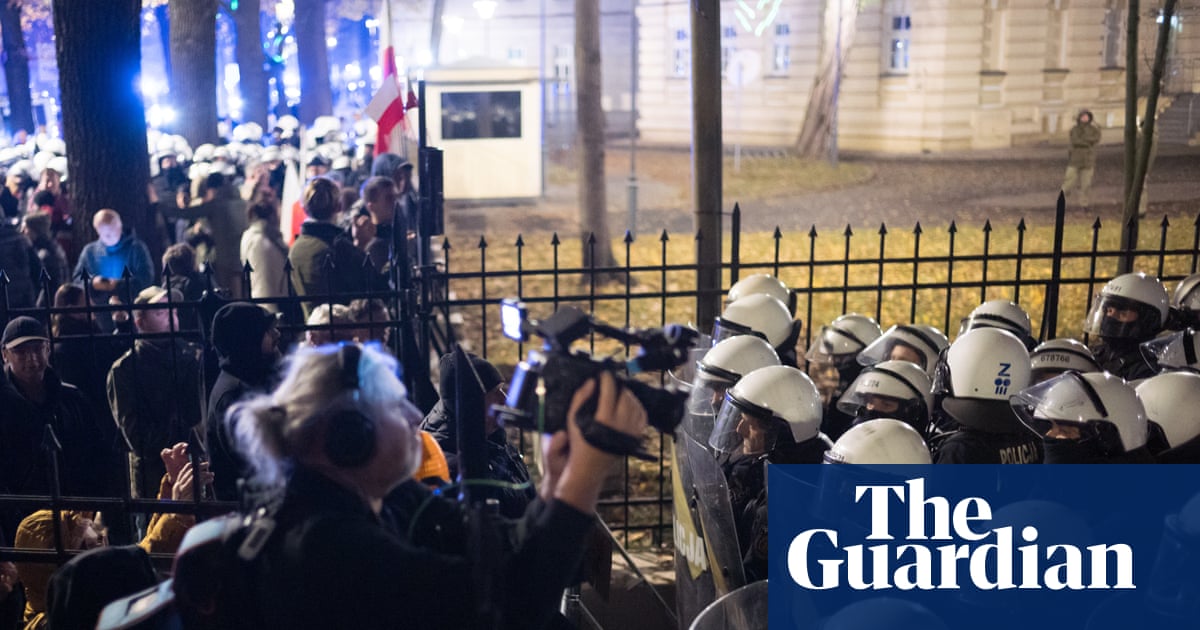
A severe political confrontation unfolded in Warsaw on Friday night when riot police established a perimeter around Poland’s constitutional court. The security deployment followed a controversial decision by a faction of government-appointed judges to suspend the court’s president, Bogdan Święczkowski, and his deputy, Bartłomiej Sochański. This action marks a significant escalation in a long-standing dispute regarding the legal status and composition of the nation’s highest judicial body.
The suspension triggered an immediate and volatile response from opposition figures. Hundreds of protesters, including members of parliament from the right-wing Law and Justice party, gathered outside the courthouse to demonstrate support for the suspended leaders. The situation deteriorated into a physical standoff, with reports indicating that three individuals were arrested after attempting to breach the heavy police presence guarding the entrance.
President Karol Nawrocki played a central role in the night’s events. Originally en route to Senegal for a state visit, Nawrocki diverted his flight back to Warsaw upon learning of the developments. Video footage captured the president struggling with security personnel and other judges as he attempted to force entry into the building. He remained inside the premises well into the early hours of Saturday morning.
From within the court, Nawrocki issued a strong condemnation of the actions taken by the government-aligned judges. In a statement read aloud at dawn, he characterized the suspension as a seizure of a constitutional body by force and a direct violation of Poland’s constitutional order. He demanded that security forces withdraw from the premises and asserted that the individuals who initiated the suspension were not legitimate judges of the constitutional court.
The conflict stems from a deeply entrenched division over the legitimacy of the bench, dating back to 2015. During that period, successive governments engaged in legally questionable maneuvers to appoint their own allies to the judiciary. The previous right-wing administration stacked the court with loyalists, leading to rulings that often favored domestic legislation over European Union law. This alignment drew sharp criticism from Brussels, which accused the court of being too closely tied to nationalist political power.
Since returning to power in 2023, Prime Minister Donald Tusk has pursued a strategy to reverse these reforms and restore relations with the European Union. His administration refuses to recognize the current composition of the court as legitimate. However, Tusk’s efforts have faced significant resistance from opposition-aligned presidents who have utilized veto powers and broad interpretations of executive authority to block judicial reforms.
The legal basis for Friday’s suspension remains highly contested among experts. Marcin Matczak, a prominent legal scholar and critic of the former government, stated that while he did not wish to defend Święczkowski, the legal grounds for his removal were nonexistent. Conversely, Justice Minister Waldemar Żurek announced that he had requested the stripping of legal immunity from both Święczkowski and Sochański, accusing them of obstructing the court’s work.
This latest crisis is expected to further polarize Polish society ahead of next year’s parliamentary elections. Polls suggest the populist-right coalition has a viable chance of returning to power, making the control of state institutions a critical battleground. The Venice Commission, an advisory body on rule of law matters for the Council of Europe, recently stated that presidential refusals to swear in judges should not prevent them from assuming their posts, adding another layer of complexity to the ongoing institutional struggle.
Tusk has maintained that restoring the rule of law is a necessary duty, despite the painful and decisive actions required. He has pledged that the court will eventually operate in accordance with the constitution, regardless of public sentiment. Foreign Minister Radosław Sikorski echoed this stance, noting that the tribunal had been politicized under the previous administration and that current measures aim to allow duly elected judges to function properly.
As the standoff continues, the incident underscores the fragility of Poland’s democratic institutions. The clash between the executive branch’s reform agenda and the opposition’s defense of established judicial appointments has created a deadlock with no immediate resolution in sight. The presence of riot police at the constitutional court serves as a stark symbol of the deep divisions that currently define Polish politics.
Sources behind this briefing
Go to the original reporting
- The Guardian World↗Riot police deployed to Poland’s constitutional court after judge suspended