The short version
- A massive new statue of the Virgin Mary has been consecrated in rural Poland, standing as the tallest such figure on the continent.
- The unveiling coincides with a broader decline in Catholic Church influence among younger generations and urban residents in the country.
- Former President Lech Wałęsa attended the ceremony, highlighting the enduring symbolic power of Catholicism in Poland's political history.
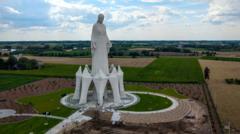
A monumental concrete statue of the Virgin Mary has been formally unveiled in the rural village of Konotopie, Poland, marking a significant addition to the country’s religious landscape. Standing at 55.6 meters, or approximately 182 feet, the figure is now recognized as the tallest depiction of the Virgin Mary in Europe. The inauguration took place on Saturday, a date deliberately selected to align with the Feast of the Assumption of the Blessed Virgin Mary, a major holiday in the Catholic calendar that commemorates the belief that Mary was taken up into heaven.
The scale of the new monument is substantial when compared to other global religious icons. It rises nearly 18 meters higher than Rio de Janeiro’s Christ the Redeemer, a structure widely considered one of the most recognizable religious symbols in the world. While it dwarfs its Brazilian counterpart, the Polish statue remains smaller than a 98-meter Virgin Mary figure located in the Philippines. The physical presence of the sculpture is designed to be imposing; it depicts the Virgin Mary with open arms, standing within a large crown, and was celebrated during the ceremony with helicopters circling overhead to drop rose petals.
The location of the statue reflects the private nature of its commissioning rather than public municipal planning. Situated in a field miles away from Poland’s major population centers, the remote placement is largely attributed to the fact that it was funded by a millionaire couple who reside locally. This private patronage allowed for the construction of such a large-scale project without the need for urban zoning approvals or integration into dense city infrastructure, resulting in an isolated landmark visible primarily to those seeking it out.
Bishop Krzysztof Wętkowski presided over the consecration ceremony, using the occasion to address contemporary spiritual concerns. He remarked that many people today focus exclusively on earthly matters and their own self-interests. In contrast, he suggested that the towering figure serves as a visual cue to redirect attention upward toward God and heaven. The bishop’s comments underscored the intended theological message of the monument: to inspire humility and spiritual elevation among viewers.
The unveiling occurs against a backdrop of changing religious demographics in Poland. While the nation remains predominantly Catholic, the influence of the Church on public life has been declining in recent years. This shift is particularly evident among younger Poles living in urban areas, who have increasingly distanced themselves from traditional church practices and institutions. The construction of such a prominent religious symbol in a rural setting highlights the tension between enduring traditional faith in countryside communities and the secularizing trends observed in cities.
Despite these shifting tides, the event drew notable figures from Poland’s political past, illustrating the deep historical entanglement of Catholicism and national identity. Lech Wałęsa, the leader of the movement that helped end communist rule in Poland and the country’s first democratically elected president, was among the attendees. At 82 years old, Wałęsa has long been associated with the Church, famously wearing a Virgin Mary pin badge during his political campaigns.
Wałęsa credited his Catholic faith as a central component of his resistance against the communist regime. Reflecting on his life’s journey at the ceremony, he stated that his path began and ended with the Virgin Mary. His presence served as a reminder of how religious symbolism played a crucial role in Poland’s transition to democracy, even as the current generation navigates a more secular future.
The statue’s inauguration thus represents a complex intersection of private wealth, traditional faith, and national history. It stands as a physical testament to the enduring power of Catholic imagery in Poland, even as the institutional authority of the Church faces challenges from a modernizing society. The remote location ensures that while it is a record-breaking monument, its impact will be felt more by pilgrims and visitors than by the daily lives of urban residents.
Looking ahead, the statue will likely become a site for religious tourism and reflection, particularly during significant Catholic holidays. Its existence may also spark further discussion about the role of large-scale religious monuments in public spaces and how they are funded and maintained. As Poland continues to evolve socially and politically, the Virgin Mary of Konotopie will remain a fixed point of reference, embodying both the height of traditional devotion and the changing contours of faith in contemporary Europe.
Sources behind this briefing
Go to the original reporting
- BBC World↗Europe's tallest Virgin Mary statue unveiled in rural Poland

