The short version
- Perseverance is set to exceed 45 kilometers of travel, breaking the long-standing record held by the Opportunity rover.
- Advanced onboard computing allows approximately ninety percent of the journey to be autonomous, significantly increasing scientific efficiency compared to earlier missions.
- The mission focuses on analyzing ancient rocks in Jezero Crater to assess historical habitability, with hardware improvements reducing mechanical wear concerns.
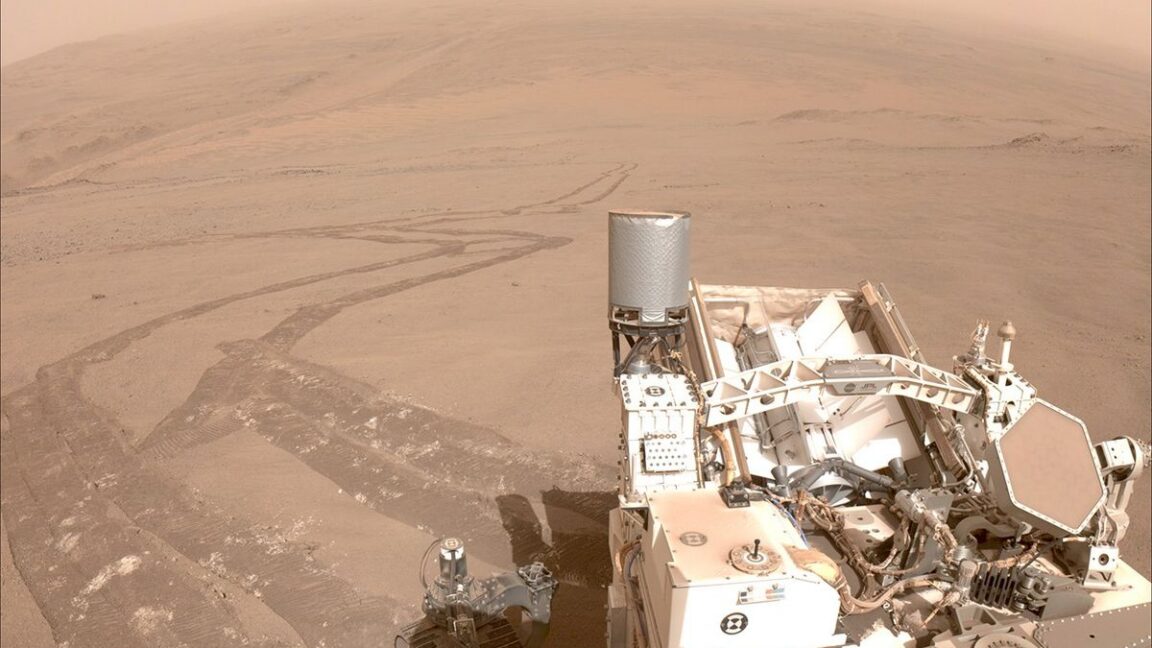
NASA’s Perseverance rover is poised to establish a new benchmark for extraterrestrial exploration by surpassing the total distance traveled by any vehicle on another world. The automobile-sized machine, which touched down in February 2021, will soon exceed forty-five point one six kilometers across the Martian surface. This achievement eclipses the previous record set by the Opportunity rover, a long-serving explorer that ceased operations in 2018. Reaching this milestone in roughly one-third of the time it took Opportunity highlights a significant shift in how planetary missions are conducted.
The primary driver behind this accelerated progress is the rover’s sophisticated autonomous navigation system. Unlike earlier missions that relied heavily on ground-based commands for movement, Perseverance utilizes onboard cameras and processing units to map terrain and calculate safe routes in real time. Steven Lee, the project manager at NASA’s Jet Propulsion Laboratory, identified this auto-navigation capability as the critical enabling technology. While terrestrial self-driving cars benefit from established infrastructure like lanes and signs, Perseverance must navigate a landscape filled with boulders and sandy slopes without such aids.
The contrast with previous rovers underscores the technological leap represented by Perseverance. Curiosity, which launched nine years prior and shares many design similarities, possesses similar imaging capabilities but relies on older computing hardware. Some of Curiosity’s chipsets date back to the 1990s, resulting in processing speeds that limit autonomous driving to only about ten percent of its journey. Consequently, Curiosity has traveled thirty-eight point six kilometers over fifteen years, often stopping frequently to await navigation instructions from Earth.
Perseverance’s Vision Compute Element is slightly more modern, allowing the vehicle to perform sensing and computation while its wheels are in motion. Although the rover moves at a maximum speed of approximately one hundred fifty meters per hour, the ability to drive continuously without pausing for command uploads maximizes scientific return. Vivian Sun, the mission’s deputy project scientist, noted that this driving efficiency expands the scope of investigation beyond what was possible with previous missions. The rover can reach new sites ahead of schedule, providing unexpected opportunities for data collection.
The mission’s location in Jezero Crater presents unique scientific challenges and rewards. The area contains some of the oldest rocks in the solar system, dating back approximately four billion years to a period following the heavy bombardment era. During this time, Mars is believed to have hosted large lakes and possibly oceans, creating conditions that may have been conducive to life. Perseverance is examining these ancient geological formations to understand the environmental history of the planet, with some scientists comparing the landscape to Earth’s Mojave Desert.
Hardware improvements also contribute to the rover’s sustained performance. Curiosity experienced significant wheel wear after several years of operation, prompting engineers to redesign the wheels for Perseverance. Early assessments indicate no appreciable wear on the newer vehicle’s treads. However, mission controllers are monitoring the actuators within the wheels, which were initially tested for twenty kilometers of driving. NASA is currently working to certify these components for at least one hundred kilometers of travel, potentially extending their operational life further.
The rover operates using radioisotope thermoelectric generators and carries no propellants, consumables, or lubricants that could deplete over time. This design choice supports long-term autonomy, allowing Perseverance to continue traversing the Martian surface for many years. As the vehicle breaks distance records, it provides a growing dataset on ancient Martian geology. The combination of advanced navigation, durable hardware, and strategic site selection positions Perseverance to deliver substantial insights into whether Mars ever supported life.
While Curiosity continues its slow ascent up Mount Sharp in Gale Crater, focusing on detailed measurements at higher altitudes, Perseverance’s broader roaming capability offers a different perspective. The ability to cover ground quickly allows for a wider survey of Jezero Crater’s diverse terrain. This approach complements the systematic study conducted by earlier missions, adding depth to our understanding of Mars’ past. As Perseverance pushes beyond previous limits, it demonstrates how incremental technological advancements can dramatically enhance the reach and impact of space exploration.
Sources behind this briefing
Go to the original reporting
- Ars Technica↗The first self-driving vehicle on Mars has proven to be a smashing success
