The short version
- The National Park Service has issued a report supporting President Trump's proposed arch, citing the site's historical appropriateness despite adverse effects on key sightlines.
- Legal challengers argue the project transforms the National Mall and should require congressional approval rather than executive action.
- The arch is part of a broader series of construction initiatives aimed at altering Washington’s landscape, including renovations to the Kennedy Center and Lincoln Memorial Reflecting Pool.
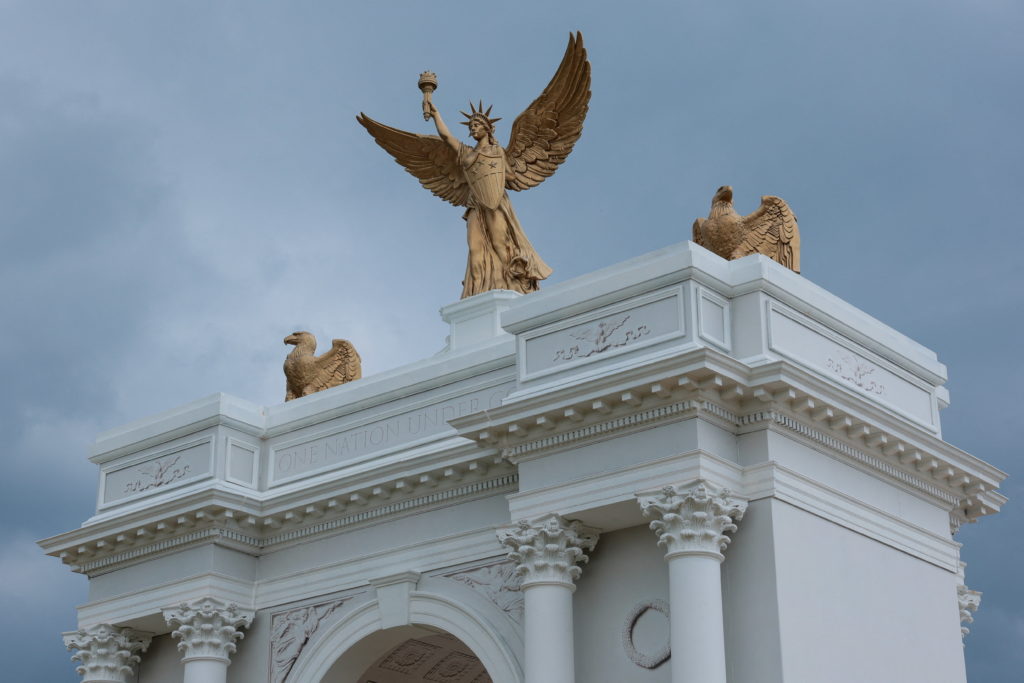
A newly released report from the National Park Service endorses President Donald Trump’s proposal for a large memorial arch in Washington, D.C., even as it acknowledges that the structure will negatively impact visual connections between several of the capital’s most significant historic landmarks. The document, published late last week, serves as a critical piece of evidence in an ongoing legal dispute over the project’s validity and its potential to alter the character of the National Mall.
The proposed arch stands 250 feet tall and is planned for construction adjacent to Memorial Bridge. According to the Park Service analysis, this location disrupts the historical significance of dozens of nearby sites. Many of Washington’s monuments were deliberately positioned over decades to create symbolic sightlines that connect different eras and figures in American history. The report indicates that the arch will interfere with more of these alignments than previously anticipated.
Despite these concerns, the agency concluded that Memorial Circle remains the most historically appropriate site for the memorial. The report argues that moving the project elsewhere or removing its central commemorative feature would defeat the purpose of the undertaking. Consequently, alternative locations outside the designated circle are not considered reasonable options for avoiding the identified impacts.
One of the most prominent disruptions cited involves the alignment between the Lincoln Memorial, Memorial Bridge, and Arlington House, the former residence of Confederate General Robert E. Lee. This specific visual corridor was designed to symbolically unite the North and South through a coordinated monumental composition spanning the Potomac River. The arch would break this intended connection, altering the spatial relationship that has defined the area’s aesthetic and historical narrative for generations.
The report also lists numerous other sites likely to be affected by the new structure. These include the U.S. Capitol, the Washington Monument, the Jefferson Memorial, the Georgetown Historic District, the Old Naval Observatory, Key Bridge, and the National Cathedral. The cumulative effect of these changes raises questions about how the project fits within the broader preservation goals for the nation’s capital.
Legal opponents of the arch argue that the Park Service’s findings validate their claims that the project will fundamentally transform the National Mall. Nicolas Sansone, an attorney representing a group of veterans and an architectural historian who filed suit against the plan, stated that the report confirms the enormous impact of the development. He emphasized that decisions of this magnitude should be made by Congress rather than through executive decree.
The arch has already received preliminary approval from the U.S. Commission of Fine Arts, whose members were all appointed by President Trump. The National Capital Area Planning Commission also approved the site and initial plans during a meeting in July. The commission is expected to revisit the matter later this year as the project moves through further regulatory stages.
This memorial is one of several major construction initiatives the administration is pursuing to leave a lasting imprint on Washington’s skyline and public spaces. Other projects include renaming and renovating the Kennedy Center, constructing a new White House ballroom, refurbishing the Lincoln Memorial Reflecting Pool, and rebuilding a golf course in East Potomac Park. Critics argue that these combined efforts significantly reduce public access to recreational paths and alter the civic character of the city.
The 133-page document is expected to play a pivotal role in bolstering the administration’s defense against the legal challenge. By formally recognizing the site’s historical suitability while documenting the unavoidable visual impacts, the Park Service provides a nuanced justification for proceeding with the project. The outcome of the lawsuit could set precedents for how future executive-led developments are evaluated against preservation standards.
As the debate continues, stakeholders remain divided over the balance between commemorative intent and historic preservation. The arch represents a significant departure from traditional approaches to memorial design in Washington, where subtlety and integration with existing sightlines have long been prioritized. The final resolution will depend on judicial interpretation of federal authority and the weight given to aesthetic versus historical considerations.
Sources behind this briefing
Go to the original reporting
- PBS NewsHour↗National Park Service backs Trump's arch, despite its impact on key Washington sightlines

