The short version
- Panama declared a state of emergency following two significant earthquakes that caused structural damage across ten provinces and two indigenous territories.
- While no deaths were confirmed, twenty-seven injuries were reported and hundreds of homes and schools sustained damage, particularly in the central regions.
- International assistance has begun arriving, including US military airlifts of food and a federal pledge of humanitarian funding for recovery efforts.
The government of Panama has instituted a state of emergency following a series of powerful seismic events that shook the country on Friday. The declaration was announced by presidential minister Juan Carlos Orillac during a press conference in the capital, marking a significant escalation in the national response to the disaster. This measure allows authorities to mobilize resources more rapidly as they assess the extent of the destruction and coordinate relief efforts across affected areas.
Two distinct earthquakes struck the nation, with magnitudes recorded at 7.7 and 6.6 respectively. The initial tremor originated approximately ten kilometers southwest of Pitaloza Arriba, a remote settlement in Herrera province. According to data from the US Geological Survey, this primary quake occurred at a depth of ten kilometers. The intensity of the shaking was sufficient to be felt in neighboring Colombia, highlighting the broad reach of the seismic activity beyond Panama’s borders.
In the hours following the main shocks, seismologists documented more than one hundred aftershocks. Several of these subsequent tremors were substantial, with magnitudes reaching 5.8, 5.5, and 5.2. These ongoing quakes have continued to rattle communities and complicate rescue operations, forcing residents to remain in temporary shelters or on the streets out of fear that damaged structures could collapse further.
Despite the severity of the ground motion, officials reported no fatalities as of Saturday morning. This outcome has been attributed in part to Panama’s strict building codes, particularly those governing high-rise construction in urban centers. Carlos Valdés, head of the seismology department at Mexico’s National Autonomous University, suggested that these regulations likely prevented a higher death toll. However, the absence of deaths does not diminish the scale of the physical damage inflicted upon the country’s infrastructure.
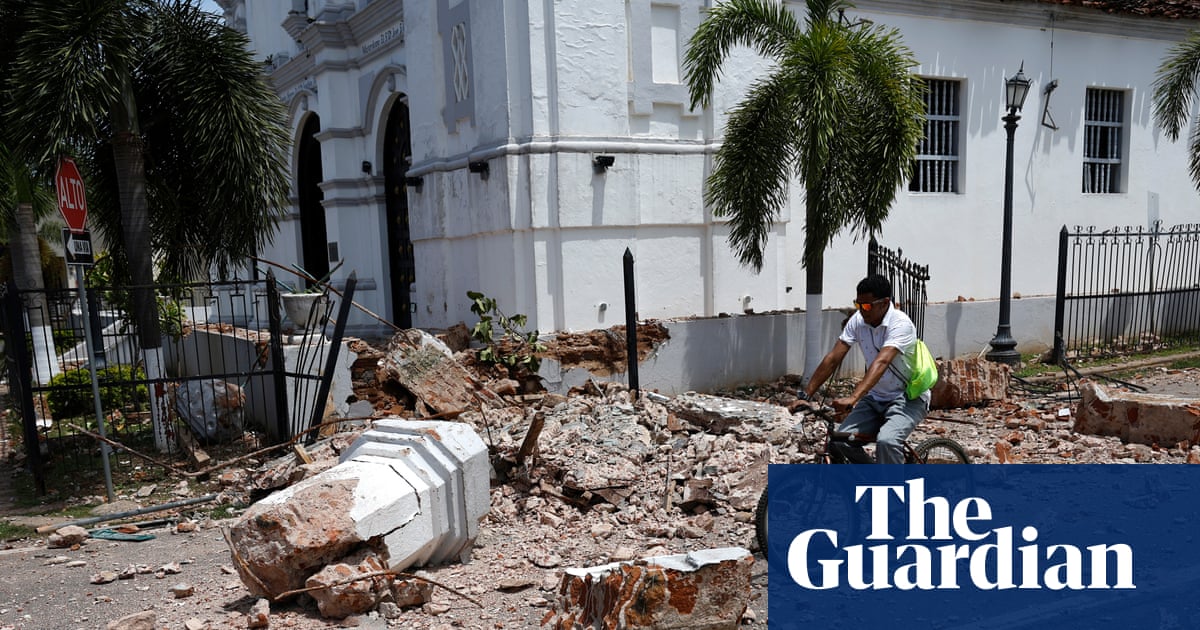
Damage assessments indicate that all ten of Panama’s provinces and two indigenous territories have been affected. The most severe destruction was concentrated in the central provinces of Veraguas, Herrera, Coclé, and Los Santos. In La Villa de Los Santos, a historic colonial town located about sixty-four kilometers from the epicenter, several homes and a Catholic church collapsed completely. Residents who had fled their buildings remained on the streets overnight, awaiting official guidance on whether it was safe to return.
The National Civil Protection System reported that approximately four hundred twenty homes and an equal number of public schools sustained damage. Additionally, seven hotels, at least thirteen churches, and nine bridges were impacted by the tremors. Twenty-seven individuals were treated for injuries ranging from minor to moderate. While no missing persons were officially reported, some communities remained isolated due to landslides and compromised road networks, hindering immediate access for emergency responders.
International support has begun to flow into the region. The US Department of State announced the deployment of a disaster response team to assist with search and rescue operations, as well as aerial and ground-based damage assessments. The United States also pledged five million dollars in humanitarian assistance. Furthermore, the US Southern Command utilized two helicopters to deliver two thousand pounds of food supplies to affected populations, supported by personnel from the State Department’s drug control bureau.
Regional leaders have expressed solidarity with Panama. President Mulino acknowledged communications with counterparts from Chile, Uruguay, and Guatemala, among others, who offered assistance. As the immediate crisis phase transitions into recovery, the focus remains on repairing critical infrastructure, providing shelter for displaced families, and ensuring that aftershocks do not exacerbate the existing damage. The long-term impact on local economies and social stability will depend on the speed and effectiveness of these reconstruction efforts.
Sources behind this briefing
Go to the original reporting
- The Guardian US↗‘It was a terrible thing’: Panama declares state of emergency as quake aftershocks rattle communities
