The short version
- Kaylub Giamanco fired his legally stored pistol at a teenage gunman during the Silver Rail Elementary School attack, an incident that killed three students and one teacher.
- Data from Texas State University indicates that armed civilian intervention ending active attacks is statistically rare, accounting for only about 4.6 percent of cases resolved before law enforcement arrival.
- President Donald Trump praised Giamanco’s actions, reinforcing a narrative favored by gun rights advocates regarding the role of armed citizens in public safety.
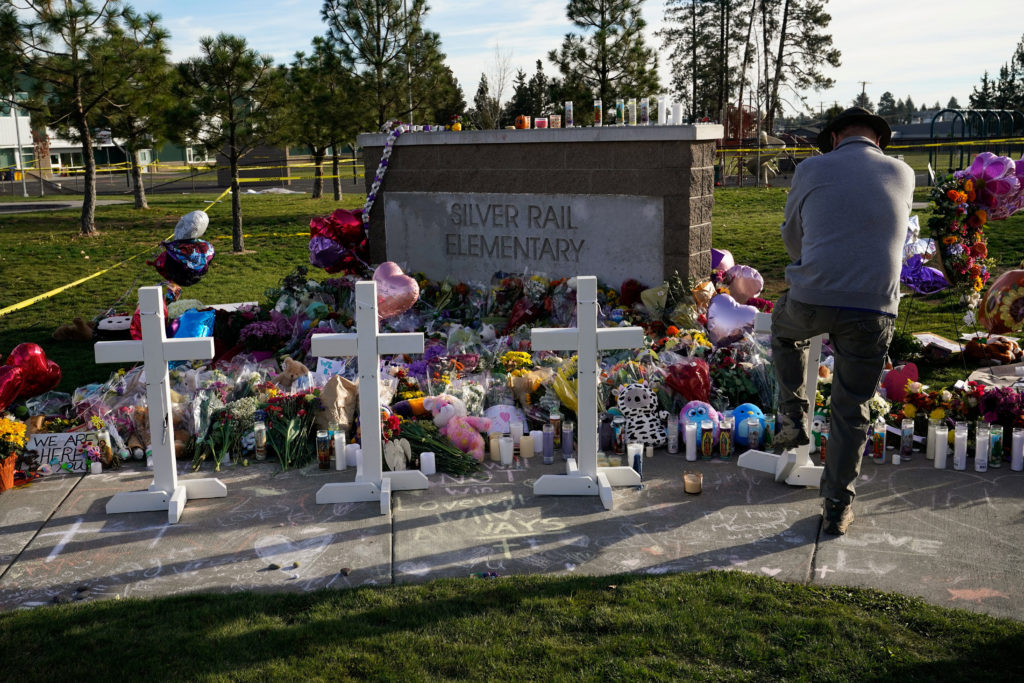
The mass shooting at Silver Rail Elementary School in Bend, Oregon, concluded with an outcome that distinguishes it from most similar tragedies in recent U.S. history: an armed civilian engaged and neutralized the attacker before law enforcement could intervene. Kaylub Giamanco, a 36-year-old carpenter and father of two students at the school, entered the building after hearing gunfire. According to Bend Police Chief Mike Krantz, Giamanco witnessed a teacher struggling with the teenage shooter and subsequently fired his own weapon, which was legally stored in his vehicle as a .40-caliber pistol.
The attack resulted in the deaths of three students and one teacher. The intervention by Giamanco has drawn significant attention from national political figures. President Donald Trump addressed reporters at the White House on Friday, expressing gratitude for the presence of an armed individual who knew how to use a firearm in such a crisis. Trump characterized the event as a terrible occurrence but emphasized the positive role played by the civilian’s readiness and capability.
This incident has reignited discussions regarding the frequency and efficacy of armed civilian intervention in mass violence scenarios. Gun rights advocates have long promoted the concept of the 'good guy with a gun' as a critical first line of defense, arguing that citizens can protect themselves and others when police response times are insufficient. Proponents suggest that allowing trained or prepared individuals to carry weapons in public spaces can deter attackers or stop them more quickly than waiting for official responders.
However, statistical analysis suggests that such interventions remain exceptional rather than common. The Advanced Law Enforcement Rapid Response Training Center (ALERRT) at Texas State University has tracked active attack incidents involving firearms, blades, or vehicles from 2000 to 2025. Their data covers 634 cases, of which 374 ended before police arrived on the scene. Within this subset, only 29 incidents were stopped by armed civilians shooting the attacker. Another 31 incidents were resolved when civilians subdued attackers through non-lethal means, such as wrestling or disarming.
James Keith, a spokesperson for ALERRT, noted that individuals who intervene often recognize they may be the sole barrier between the attacker and further casualties before law enforcement arrives. While some interveners have military or law enforcement backgrounds, others are ordinary citizens reacting instinctively to chaos. The rarity of these events underscores the complexity of relying on civilian action as a primary safety strategy, even as anecdotal examples continue to circulate in public discourse.
Legislative approaches to school safety vary significantly across states, reflecting differing views on armed presence in educational settings. Texas, for example, established a school marshal program in 2013, permitting trained teachers and staff to carry concealed firearms on campus. This policy expanded following mass shootings at a Houston-area high school in 2018 and Robb Elementary School in Uvalde in 2022. In contrast, Oregon is rated by the Giffords Law Center to Prevent Gun Violence as having some of the strongest gun control laws in the nation, while Texas maintains some of the least restrictive regulations.
Historical precedents for armed civilian intervention include several high-profile cases. In August 2026, an off-duty officer and an armed customer exchanged fire with a gunman at an In-N-Out Burger restaurant, potentially preventing additional casualties before the attacker killed himself. Jordan Salinas, the civilian involved, stated he did not hesitate to confront the shooter upon hearing gunfire and seeing people flee. Similarly, in December 2019, Jack Wilson, a 71-year-old firearms instructor and former reserve sheriff’s deputy, shot and killed an attacker at West Freeway Church of Christ after the gunman had already killed two worshippers.
Another notable case occurred in 2017 at a church in Sutherland Springs, Texas, where Stephen Willeford, a former National Rifle Association instructor, ran barefoot from his home across the street to confront the shooter. Willeford wounded the attacker, who fled and eventually killed himself after being pursued by Willeford and another driver. These instances are frequently cited in debates over gun policy, illustrating both the potential for civilian intervention to save lives and the unpredictable nature of such encounters.
The Oregon shooting adds a new data point to an ongoing national conversation about violence prevention and response. While political figures may highlight individual acts of bravery to support specific policy positions, experts caution against generalizing from rare events. The statistical reality remains that most active attacks are resolved through other means, and the role of armed civilians, while visible in media coverage, represents a small fraction of overall outcomes. As communities grapple with the aftermath of the Bend tragedy, the balance between individual preparedness and systemic safety measures continues to evolve.
Future research may further clarify the conditions under which civilian intervention is most effective or risky. For now, the incident serves as a stark reminder of the volatility of mass shootings and the split-second decisions that can alter their trajectory. Whether such interventions become more common or remain statistical outliers will depend on broader societal choices regarding gun ownership, training, and public safety infrastructure.
Sources behind this briefing
Go to the original reporting
- PBS NewsHour↗Oregon father is the latest armed civilian to confront a gunman in a U.S. mass shooting