The short version
- Novaya Gazeta has shut down its Moscow offices, citing relentless coercion from government officials and security services that made continued operations impossible.
- The newspaper faced a series of punitive measures including fines, revocation of media registration, seizure of printing facilities, and the designation of its leadership as foreign agents.
- While the domestic entity has ceased activity, some staff previously established an independent project abroad, signaling a potential continuation of their journalistic mission outside Russian borders.
Novaya Gazeta, widely recognized as Russia’s most prominent independent newspaper, has permanently closed its Moscow offices. The decision to cease operations follows what the publication described as relentless pressure from government officials and security services. In a statement issued in late October, the editorial team announced that authorities had effectively forced them to stop working. This closure represents a significant milestone in the erosion of independent media within Russia, marking the end of the last major domestic outlet that maintained a critical stance toward the Kremlin.
The newspaper’s leadership stated that human rights and freedoms have been abolished in the country, with the defense of these principles now treated as criminal activity. They noted that elected governing bodies have been dismantled and civil society institutions wiped out. The statement emphasized that freedom of conscience and human dignity have been severely compromised under the current political climate. This assessment reflects a broader environment where dissent is increasingly met with state repression rather than legal recourse or public debate.
Established in 1993, Novaya Gazeta built its reputation on fierce investigative reporting focused on corruption and human rights abuses. Its history is marked by significant personal risk for its staff, including the deaths of six journalists. Among those killed was Anna Politkovskaya, who reported extensively on atrocities during the second Chechen War before being fatally shot in her apartment building in 2006. On the final day of operations, remaining journalists removed portraits of their deceased colleagues from the newsroom, a symbolic act marking the end of an era for the organization.
The pressure on the publication intensified significantly after President Vladimir Putin ordered military action in Ukraine in February 2022. Prior to this escalation, other independent media outlets had already closed or relocated their operations abroad. Novaya Gazeta remained active for several years longer but faced growing hostility from the state. Tatiana Britskaya, editor of the investigations desk, indicated that she had anticipated the closure daily for the past four and a half years. She described the office not merely as a workplace but as a home, highlighting the emotional weight of losing their physical base of operations.
Administrative and legal measures against the newspaper were systematic and severe. Authorities accused the outlet of discrediting the Russian armed forces, resulting in substantial fines. The publication was also declared a foreign agent, a designation that carries strong negative connotations in Russia and subjects individuals and organizations to heightened government scrutiny. Additionally, all online platforms associated with the newspaper were blocked, its printing house was seized, and its media registration was revoked. These actions effectively cut off the organization’s ability to distribute content and receive financial support from readers.
The leadership of Novaya Gazeta has also faced direct personal threats. Dmitry Muratov, the longtime editor-in-chief and a co-recipient of the 2021 Nobel Peace Prize, was attacked on a train in 2022. An assailant poured red paint over him, causing severe irritation to his eyes. Muratov stepped down from his editorial role in 2023 after being named a foreign agent by Russian authorities. His departure and the subsequent targeting of the newspaper’s infrastructure illustrate the personal risks associated with independent journalism in the current political landscape.
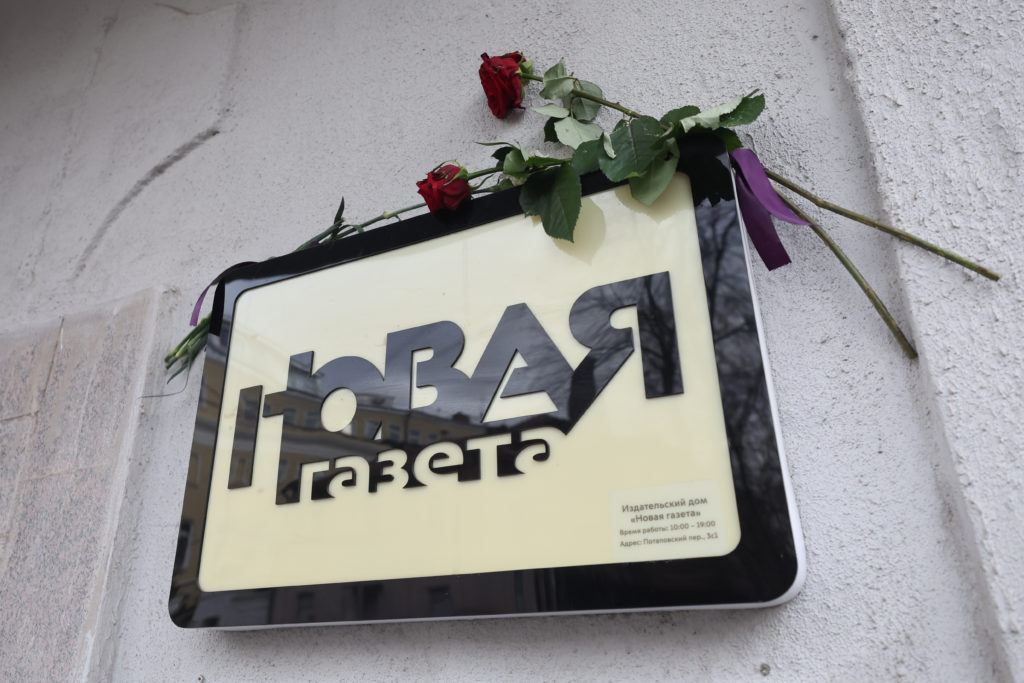
As staff members vacated the premises, they gathered outside the building where a new sign was affixed above the former nameplate. The sign read, “Here lived Novaya Gazeta,” serving as a memorial to the institution’s three-decade presence in Moscow. Sergei Sokolov, the current editor-in-chief, expressed hope that the newspaper would eventually return with renewed strength. He stated his belief that the country will eventually stir from its current state and that the publication will reemerge for its readers and colleagues when signs of change appear.
Despite the closure of the Moscow office, some members of Novaya Gazeta’s staff had already left Russia in 2022 to establish a separate project known as Novaya Gazeta Europe. This new outlet continues to operate independently and has maintained a sharp critical stance toward the Kremlin and its military actions in Ukraine. The existence of this parallel entity suggests that while the domestic operation has been extinguished, the journalistic mission may persist in exile, continuing to report on events within Russia from abroad.
The shutdown of Novaya Gazeta underscores the complete consolidation of media control by the Russian state. With no major independent outlets remaining active within the country, the space for critical reporting and accountability has virtually disappeared. The case illustrates how legal mechanisms, administrative hurdles, and physical intimidation can be combined to eliminate dissenting voices. For international observers, this event signals a definitive end to the era of domestic independent journalism in Russia, leaving only state-aligned or exiled media sources to cover developments within the nation.
Future developments will likely focus on the activities of Novaya Gazeta Europe and other exiled Russian journalists. Their ability to access information and maintain safety while reporting from abroad remains uncertain. Meanwhile, the situation inside Russia suggests that any attempt to revive independent media domestically would face insurmountable legal and physical barriers. The closure serves as a stark indicator of the current political reality in Moscow, where freedom of the press has been effectively nullified by state power.
Sources behind this briefing
Go to the original reporting
- PBS NewsHour↗Citing government pressure, Russia's top independent newspaper closes its office after three decades


