The short version
- Researchers developed a software tool called FLIP that uses gradient descent to optimize physical models of the James Webb Space Telescope's hardware.
- The technique improves signal-to-noise ratios by factors of up to two, enabling the detection of planets previously obscured by stellar glare.
- By fine-tuning parameters on actual observation data, the method allows for more precise imaging of exoplanet atmospheres and potentially older, dimmer worlds.
Astronomers have introduced a new computational method that enhances the imaging capabilities of the James Webb Space Telescope by significantly reducing background noise in exoplanet observations. This development addresses one of the most persistent challenges in planetary science: distinguishing the faint light of a distant world from the overwhelming brightness of its host star. While physical instruments known as coronagraphs can block much of a star’s glare, they are limited by subtle variations in telescope configuration and pointing accuracy between different observations. The new software package optimizes a physical model of the telescope to account for these differences, producing clearer images that allow researchers to probe atmospheric conditions on exoplanets with greater precision.
The core of this innovation lies in refining how scientists understand the point spread function, which describes how a telescope distorts a single point of light due to hardware imperfections and pointing limits. Traditionally, determining this function involves either imaging known targets to derive mathematical descriptions or building complex hardware models. The former approach is effective but struggles with temporal changes in telescope behavior and wavelength variations. The latter is often computationally prohibitive because modern telescopes involve countless parameters that are difficult to ascertain even with detailed engineering schematics. The new method bridges this gap by leveraging techniques previously reserved for training large neural networks.
The research team created a process named FLIP, which stands for Physics-based Learning for Imaging Planets. This system integrates a physical model of the Near-Infrared Camera on the James Webb Space Telescope, incorporating approximately 10^6 possible parameters. Instead of manually tuning these variables, the software employs gradient descent to optimize performance against data from actual stars. Running on current graphics processing units, this optimization phase takes slightly more than thirty minutes. The resulting model is then fine-tuned on the specific scientific image being analyzed, a critical step that accounts for observational variables unique to each dataset.
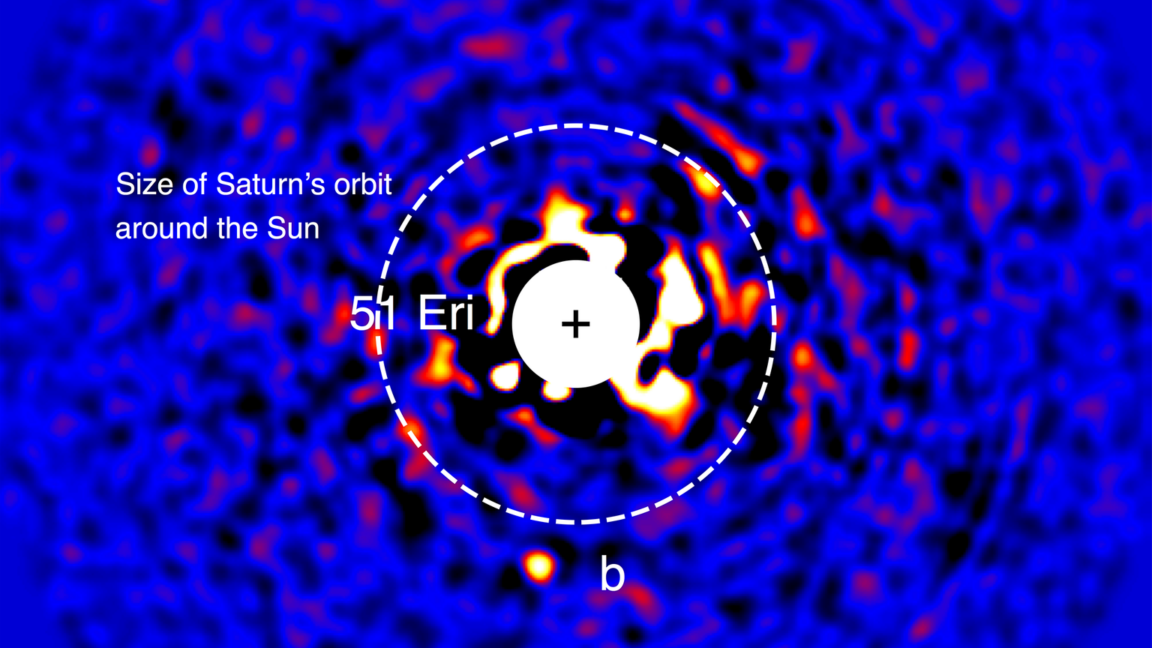
To validate the effectiveness of FLIP, researchers applied it to observations of three distinct stars: HIP 65426 and 51 Eridani, both known to host massive, young planets still warm from gravitational collapse, and TYC 5899, a variable star with no confirmed exoplanets. The software successfully boosted the signal-to-noise ratio by a factor of 1.5 to 2 across these observations. Notably, at wavelengths capable of detecting carbon dioxide, the team identified one planet in the Webb data for the first time using this enhanced processing. For the variable star TYC 5899, the approach increased observational sensitivity by a factor of 15, demonstrating its robustness even in challenging conditions where stellar variability typically complicates analysis.
The implications of this software extend beyond improving views of already known planets. By lowering the noise floor, astronomers may now detect dimmer exoplanets that are older or have lower masses, populations that have historically eluded detection due to their faint signals. This capability could expand the catalog of observable worlds and provide more diverse samples for atmospheric study. Furthermore, the researchers suggest that FLIP can be modified to highlight areas where it makes the most dramatic adjustments to the hardware model. These insights could offer valuable diagnostic information about the telescope’s physical state, helping engineers understand subtle shifts in instrument performance over time.
This advancement represents a convergence of astrophysics and machine learning optimization techniques. By treating the telescope’s hardware behavior as a tunable parameter set rather than a fixed constraint, scientists can adapt to real-time changes in instrument performance. The use of gradient descent, a mathematical technique central to artificial intelligence development, allows for efficient computation on specialized hardware. This approach not only improves current data analysis but also sets a precedent for future telescopes, where software-driven corrections may play an increasingly vital role in extracting scientific value from complex optical systems.
As the catalog of known exoplanets continues to grow, the ability to characterize their environments becomes paramount. Direct imaging and atmospheric transmission spectroscopy require high-contrast data that was previously difficult to achieve consistently. The FLIP method offers a pathway to more reliable measurements, potentially revealing biosignatures or climatic details on worlds orbiting nearby stars. While the technology is currently applied to Webb data, its underlying principles could be adapted for other observatories facing similar challenges in separating planetary signals from stellar noise.
The study, published in Nature, underscores the evolving role of computational tools in observational astronomy. Rather than relying solely on hardware upgrades, researchers are finding new ways to squeeze more information from existing instruments through sophisticated modeling. This software-driven enhancement does not replace physical coronagraphs but complements them by addressing residual noise that hardware alone cannot eliminate. As exoplanet science moves toward detailed atmospheric characterization, such methods will likely become standard practice in data processing pipelines.
Future applications may include broader surveys for Earth-like planets, which are significantly fainter and closer to their stars than the massive gas giants currently being imaged. The ability to boost sensitivity by large factors could make these elusive targets accessible within reasonable observation times. Additionally, the diagnostic potential of the software offers a feedback loop for telescope maintenance and calibration, ensuring that instruments remain optimized throughout their operational lifespans. This dual benefit of scientific discovery and instrument health monitoring highlights the versatility of physics-based learning in modern space exploration.
The success of this approach depends on the accuracy of the initial physical model and the quality of the reference star data. While the current results are promising, ongoing refinement will be necessary to handle a wider variety of stellar types and planetary configurations. Researchers must also ensure that the software does not introduce artifacts or biases into the processed images. As the James Webb Space Telescope continues its mission, tools like FLIP will play an increasingly important role in unlocking the secrets of distant worlds, turning raw data into actionable scientific insights.
Sources behind this briefing
Go to the original reporting
- Ars Technica↗Software squeezes more data out of Webb Telescope for imaging exoplanets
