The short version
- A study published in Digital Medievalist argues the manuscript's current binding is incorrect, suggesting pages were originally loose sheets stacked in sequence.
- Analysis of handwriting styles reveals illogical alternations between scribes within single booklets, contradicting standard medieval production methods.
- Physical anomalies, including asymmetric water stains and images that span across non-adjacent pages, support the theory of improper assembly.
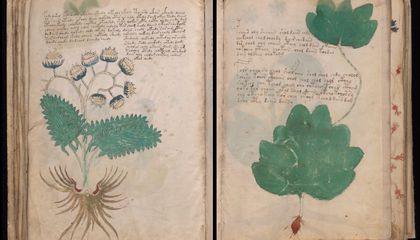
The Voynich Manuscript, a sixteenth-century document that has defied decryption for more than a hundred years, may have been assembled incorrectly. A new study published in the journal Digital Medievalist presents strong evidence that the pages are currently bound out of order. This structural error could be the primary reason why scholars, including those utilizing artificial intelligence tools, have failed to decipher the unique script known as Voynichese.
The manuscript is housed at Yale University’s Beinecke Rare Book and Manuscript Library. It consists of two hundred forty pages of vellum, or calf skin, which carbon dating places in the early fifteenth century. The text features colorful illustrations of fantastical plants, astronomical diagrams, and bathing women, alongside lines of repetitive inked letters that resemble modern Western alphabets but remain unreadable. The book was named after Wilfrid Voynich, a Polish-American bookseller who purchased it from a Jesuit college in Italy in 1912 before it eventually reached Yale in 1969.
Lisa Fagin Davis, executive director of the Medieval Academy of America and co-author of the study, suggests that the manuscript was originally designed as a collection of individual bifolia. These are sheets folded in half to form two pages, meant to be stacked and read in sequence. The current binding, however, sews these pages together into quires, or booklets. Davis argues that any research relying on the existing page sequence must be revisited because the order is fundamentally flawed.
The conclusion stems from an analysis of handwriting patterns conducted by Davis and Colin Layfield, an information scientist at the University of Malta. They utilized latent semantic analysis to compare text segments and derive similarity scores based on word usage and relationships. Their findings revealed that penmanship alternates illogically between pages. One page might be written by one scribe, while the next is penned by another, a pattern that does not align with typical medieval manuscript creation processes.
In standard medieval practice, a single scribe would typically write within a specific quire. The current binding of the Voynich Manuscript places different scribes within the same booklet, which Layfield describes as inconsistent with historical norms. Davis had previously determined in 2020 that five distinct scribes created the text. The recent study builds on this by showing how their work was likely interleaved incorrectly during binding.
Physical evidence further supports the theory of improper assembly. Davis points to a large water stain on the top of the book that does not appear symmetrically on concurrent pages, suggesting the sheets were not aligned correctly when the damage occurred. Additionally, there are instances where illustrations extend off one page and reappear on another, despite multiple intervening pages in the current binding. These artistic anomalies resolve logically only if the pages are treated as loose sheets stacked together.
The implications of this finding are significant for ongoing decryption efforts. If the pages are reordered according to their original sequence, patterns in the text may become apparent that are currently obscured by the incorrect binding. The study draws a parallel to Cain’s Jawbone, a 1934 puzzle book published with out-of-order pages, which has been solved by only four people officially. Correcting the Voynich Manuscript’s structure could provide a similar key to unlocking its contents.
Despite this structural insight, the meaning of the text remains unknown. Experts continue to debate whether the script represents a code, a lost language, nonsense, or a hoax designed to dupe collectors. Some theories suggest the scribes encoded the text to keep it secret, while others believe they were attempting to transcribe a spoken language that had no written form. Davis posits that the object was likely created by a community intending to pass knowledge forward, with illustrations hinting at themes of female sexuality and reproduction.
The survival of the manuscript may ironically be due to the person who incorrectly compiled it. Few medieval manuscripts survive because they were often not bound securely. The incorrect binding may have protected the pages from disintegration over centuries. As researchers revisit the text with this new structural understanding, the hope is that the logical sequence will reveal the manuscript’s true purpose and content.
Sources behind this briefing
Go to the original reporting
- Smithsonian Magazine↗This Mysterious Medieval Manuscript Has Stumped Scholars for Well Over a Century. Could Its Pages Have Been Bound Out of Order This Whole Time?
