The short version
- Recent scientific testing indicates the skeleton inside a limestone sarcophagus found at Westminster Abbey dates to the early 11th century.
- Researchers propose the remains belong to Aelfwig or his successor Wulfnoth, abbots who served around the year 1020.
- The coffin itself is Roman, likely from the fourth century, and was repurposed for a Christian burial centuries after its initial use.
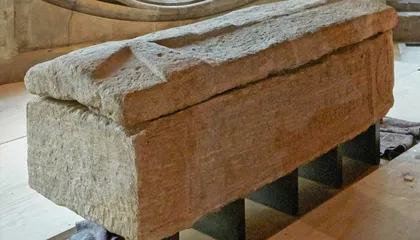
A longstanding archaeological puzzle concerning a limestone sarcophagus discovered at Westminster Abbey in London has been addressed through new scientific analysis. The coffin, unearthed by workers in 1869 during the dean’s absence from an Italian trip, presented a confusing mix of historical eras. While the stone structure bore a Latin inscription dating to the Roman occupation of Britain, its lid featured a prominent cross more typical of the early medieval period. This discrepancy left scholars debating for over a century whether the remains inside belonged to a Roman figure or a later Christian leader.
Recent research led by archaeologist and architectural historian Warwick Rodwell offers a resolution to this mystery. By combining radiocarbon dating with skeletal analysis conducted by colleague James Langthorne, the team has narrowed down the identity of the individual buried within. The findings suggest the skeleton is not Roman, as some Victorian scholars initially suspected based on the inscription, but rather belongs to an 11th-century monk. Specifically, Rodwell argues in a paper published in the Journal of the British Archaeological Association that the occupant was likely Aelfwig, who served as Westminster’s abbot until his death around 1020.
Another plausible candidate for the burial is Wulfnoth, the successor to Aelfwig. Both men fit the physical profile established by the new skeletal assessment. Langthorne’s analysis identified the remains as those of a man approximately five feet nine inches tall, aged between 35 and 49 at death. This contradicts earlier evaluations that suggested the individual was shorter and no older than thirty. Rodwell noted that either abbot would align with the data if one assumes they were appointed in their early twenties and died near age fifty.
The sarcophagus itself tells a different story, originating from the Roman era. The inscription on the coffin honors Valerius Amandinus, commissioned by his sons Valerius Superventor and Valerius Marcellus. Victorian scholars dated the object to between the second and fifth centuries based on this text. Rodwell supports the theory of Oxford archaeologist Martin Henig, who posited that the coffin represented a Christian burial from the Constantinian era in the early fourth century. The high quality of the inscription suggests Amandinus was a significant figure in Roman London, though his specific career details remain unknown.
The presence of a Roman coffin in a medieval abbey is not entirely unprecedented, as ancient sarcophagi were sometimes reused centuries later. Rodwell points to historical accounts by the English monk Bede, who recorded that the body of the seventh-century saint Elethdreda was interred in a beautifully wrought white marble coffin found near the walls of a Roman town and transported to her monastery. Similarly, Rodwell suggests the Westminster sarcophagus was not originally buried at the abbey site.
Instead, the archaeologist theorizes that the coffin was removed from a wall recess in a mausoleum located elsewhere. This explanation accounts for the lack of decoration on all sides except the front and lid, which would have been visible when housed in such a niche. The original Roman occupant’s remains are no longer present, having been replaced by those of the medieval abbot. Radiocarbon testing of the current skeleton places its date between 987 and 1052, providing a clear window for when the repurposing occurred.
During this transition, the Roman-era lid was modified to include a relief carving of a long cross, marking it as an important Christian burial. The coffin was then placed beneath the floor of Westminster Abbey, where it likely remained undisturbed until the mid-13th century. At that time, King Henry III initiated a major reconstruction of the church in the Gothic style. Medieval builders moved the remains to the abbey’s sacristy, an L-shaped structure used for storing sacred vessels and vestments.
The sarcophagus remained in the sacristy until workers removed it from the ruins of the demolished courtyard in 1869. Arthur Penrhyn Stanley, the dean at the time, documented his study of the find in an 1870 journal article, noting the absence of clear indicators regarding the rank of the person buried inside, aside from the skeleton and fragments of Roman brick. While the exact fate of Amandinus’ original remains and the specific reasons for selecting this particular coffin for the abbot remain unclear, the new analysis provides a coherent narrative linking the Roman artifact to its medieval reuse.
This resolution highlights the complex layering of history within Westminster Abbey, where few other Roman artifacts have been found. The study underscores how scientific methods can clarify historical ambiguities that textual records and visual inspection alone could not resolve. By identifying the likely occupant as an 11th-century abbot, researchers have bridged the gap between the coffin’s fourth-century origins and its discovery in the modern era.
The findings contribute to a broader understanding of how early Christian communities in Britain reused Roman materials for burial purposes. The practice reflects both practical resourcefulness and a desire to associate new religious figures with the prestige of the ancient empire. As Rodwell’s work demonstrates, even objects that seem out of place can reveal significant insights into the continuity and transformation of cultural practices over centuries.
Sources behind this briefing
Go to the original reporting
- Smithsonian Magazine↗Archaeologists May Have Solved the Mystery of a Roman Sarcophagus Excavated at Westminster Abbey in 1869