The short version
- NASA is upgrading its Icing Research Tunnel with new measurement tools to better simulate and analyze rare icing conditions involving unusually large water droplets.
- Supercooled large droplets can freeze on unprotected aircraft surfaces, posing a risk that current engineering models may not fully capture due to their size and behavior.
- The testing campaign supports the Subsonic Flight Demonstrator project, with findings intended for eventual sharing with the broader aerospace industry.
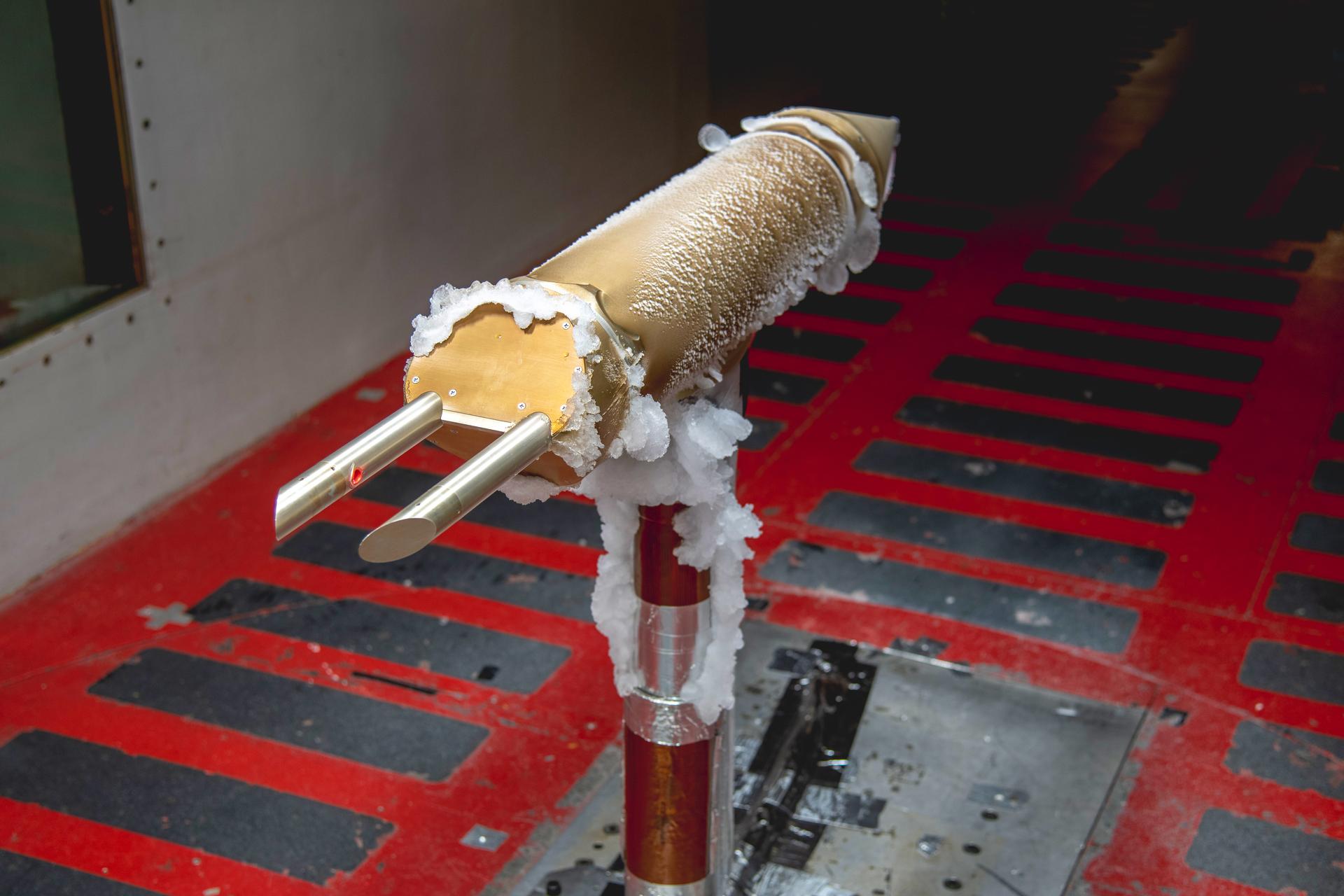
NASA has initiated a series of tests at its Glenn Research Center in Cleveland designed to improve the aviation industry’s understanding of a specific and hazardous weather phenomenon. The agency is leveraging its existing expertise while simultaneously upgrading its test facilities to address the challenges posed by supercooled large droplet icing. This hazard, though rare, persists as a significant concern for aircraft safety because it involves water droplets that are unusually large and extremely cold yet remain in a liquid state until they impact an aircraft surface.
The core issue arises when aircraft fly through clouds containing these specific droplets. Unlike typical icing conditions, which involve smaller particles, supercooled large droplets can rapidly freeze upon contact with parts of the plane that are not equipped with standard ice protection systems. These larger drops have the momentum to splash or travel further back along the fuselage, reaching areas behind conventional de-icing mechanisms. This behavior creates a vulnerability that standard design parameters may not adequately address, prompting the need for more precise experimental data.
To contextualize the scale of the problem, typical cloud droplets range from 2 to 100 microns in diameter, a size spectrum that current aircraft designs are well-equipped to handle. For comparison, a human hair is approximately 70 microns wide. However, in rarer atmospheric conditions, clouds can contain supercooled large drops measuring up to 2,000 microns in diameter. Individuals on the ground may encounter similar droplets during freezing rain events, but when these occur at altitude, they present a distinct engineering challenge due to their ability to bypass protective coatings and freeze on critical aerodynamic surfaces.
The aviation industry currently relies on established engineering tools to design aircraft capable of withstanding standard icing conditions. While these tools perform reliably for typical cloud formations, engineers have expressed uncertainty regarding their accuracy when applied to the physics of supercooled large drops. The gap in knowledge centers on how well existing models account for the unique behavior of these larger particles, including their trajectory and freezing dynamics upon impact. NASA’s testing aims to fill this informational void by providing high-fidelity data that can validate or refine current design assumptions.
A key component of this effort involves enhancing the equipment used to generate and measure experimental clouds within the Icing Research Tunnel. Researchers have introduced new probes capable of calibrating droplet sizes in real time. These advanced instruments can detect and analyze drops larger than 45 microns, providing immediate feedback on the characteristics of the simulated cloud environment. This capability represents a significant improvement over previous methods, which required laborious post-processing of image data to determine droplet size distributions.
The new measurement approach is designed to work in conjunction with existing technology that measures smaller droplets, those under 45 microns. By combining data from both the new large-droplet probes and the traditional small-droplet sensors, researchers can achieve a complete picture of the droplet size spectrum within the tunnel. This comprehensive view allows for more accurate simulation of real-world conditions where mixed droplet sizes may be present, ensuring that the experimental results reflect the complexity of actual atmospheric icing events.
This test campaign represents an important milestone for NASA’s Subsonic Flight Demonstrator project, which falls under the agency’s Research and Technology Mission Directorate. The project focuses on advancing technologies that improve the efficiency and safety of subsonic flight. By addressing the uncertainties surrounding supercooled large droplet icing, NASA is contributing to broader efforts to enhance aircraft resilience against extreme weather conditions. The data collected will help inform future design standards and operational guidelines for commercial aviation.
Detailed analysis of the experimental data is currently underway. Once the evaluation process is complete, NASA’s project team plans to share the results with the wider aerospace community. This dissemination of information is intended to support industry-wide improvements in aircraft design and safety protocols. By making these findings available, NASA aims to help manufacturers and regulators better understand and mitigate the risks associated with rare but dangerous icing conditions, ultimately contributing to safer air travel.
Sources behind this briefing
Go to the original reporting
- NASA↗NASA Testing Aims at Supercooled Large Droplet Aviation Safety

