The short version
- NASA has completed the design and integration of the final pre-flight telescope unit for the LISA mission, moving from prototype testing to production readiness.
- The all-glass instruments are engineered to measure distance changes smaller than a helium atom between satellites separated by 1.6 million miles.
- Led by the European Space Agency with significant NASA hardware contributions, the observatory is scheduled for launch in the mid-2030s.
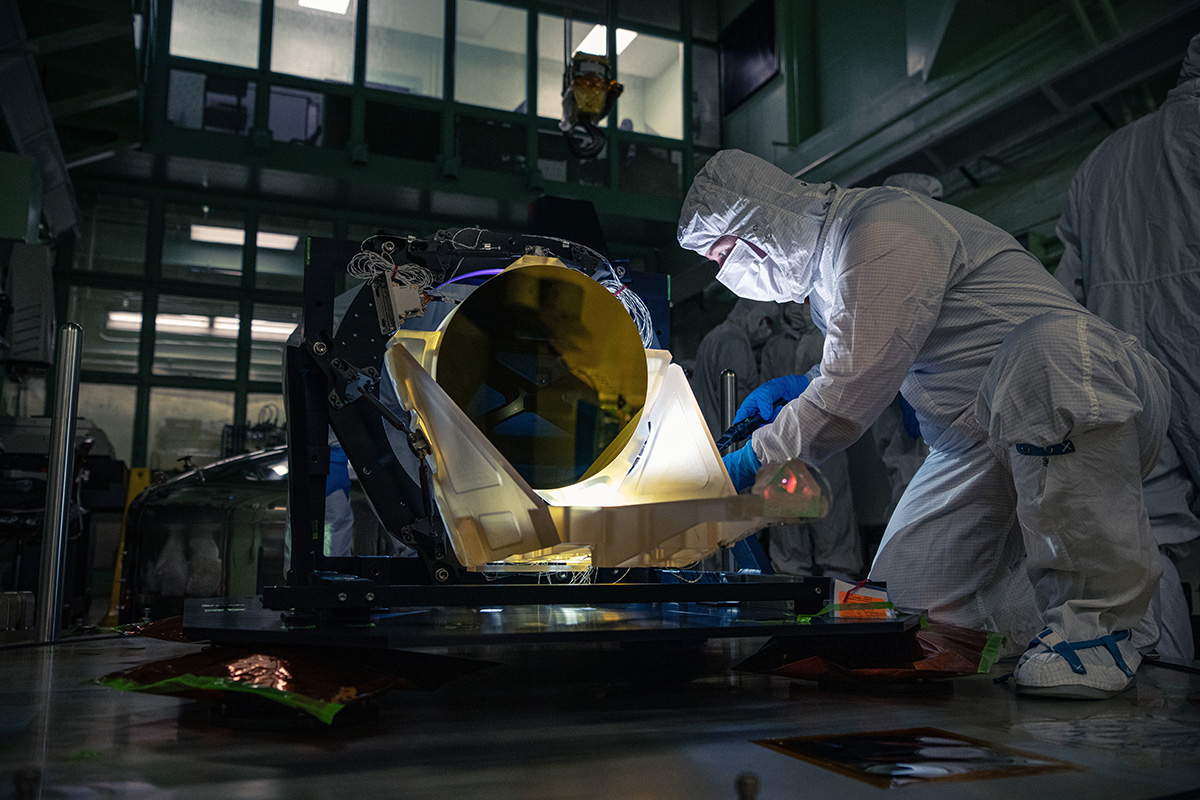
NASA has advanced its contribution to the Laser Interferometer Space Antenna mission by finalizing the development of a new test telescope. This component, known as the Engineering Test Unit, represents the last major step before the production of flight hardware for the space observatory. L3Harris Technologies designed, assembled, and integrated the instrument for the agency, marking a transition from earlier engineering models to a unit ready for final validation.
The LISA mission is an international collaboration led by the European Space Agency, with NASA providing critical hardware including telescopes, laser systems, and scientific support. The observatory is scheduled to launch in the mid-2030s. Its primary objective is to detect gravitational waves, which are ripples in the fabric of spacetime predicted by Albert Einstein’s general theory of relativity. While ground-based facilities have detected high-frequency waves since 2015, they cannot observe the lower frequencies that LISA is designed to capture.
The mission architecture involves deploying three satellites into an Earth-following orbit. These spacecraft will form a triangular array with sides stretching 1.6 million miles, or approximately 2.5 million kilometers. Each satellite will carry two telescopes that use infrared laser beams to transmit and receive signals between adjacent craft. By measuring minuscule changes in the relative distances between the satellites, the system will identify the passage of gravitational waves.
Precision is paramount for this detection method. The changes in distance caused by passing waves are smaller than the width of a helium atom. To achieve the necessary stability, each telescope is constructed entirely from Zerodur, an amber-colored ceramic-glass composite. This material is selected for its ability to resist shape changes across wide temperature ranges, ensuring that thermal fluctuations do not interfere with the sensitive measurements required for data collection.
The development process has involved rigorous testing of earlier models. In 2024, L3Harris delivered a prototype telescope that served as an engineering development unit. More recently, in June, the team provided a structural model made from metal rather than glass. The current Engineering Test Unit incorporates lessons learned from these previous iterations. It serves as the final pre-flight unit and will be the first optical telescope delivered to the European Space Agency for integration into the mission hardware.
Inside each spacecraft, a free-floating gold-platinum cube, known as a proof mass, will drift under the influence of gravity alone. The spacecraft will maneuver around these cubes to shield them from non-gravitational forces. This concept was validated in 2016 by ESA’s LISA Pathfinder mission, which demonstrated that such forces could be reduced to levels compatible with gravitational wave detection. NASA is also contributing devices to manage electric charge buildup on these proof masses.
The scientific potential of the observatory extends beyond simple detection. Researchers anticipate that LISA will reveal a background sea of low-frequency gravitational waves currently invisible to Earth-based instruments. The data could provide insights into the mergers of supermassive black holes billions of light-years away. Additionally, the mission aims to map compact pairs of white dwarfs, neutron stars, and stellar-mass black holes within our local galactic neighborhood.
Beyond the telescopes, NASA’s involvement includes providing the laser system and expertise in data analysis to identify and characterize individual wave sources. The agency’s Goddard Space Flight Center plays a central role in these efforts. As the mission moves closer to launch, the completion of the telescope hardware signifies that the collaborative framework is functioning as intended. The next phase will involve integrating these components into the final spacecraft configuration.
Gravitational waves offer a unique window into the cosmos because they travel at the speed of light and are unaffected by intervening matter. This allows astronomers to probe regions of space that are obscured from traditional optical telescopes. By combining NASA’s hardware contributions with ESA’s leadership, the LISA mission aims to expand our understanding of gravity and the evolution of massive objects in the universe. The successful delivery of the test telescope confirms that the technical challenges of building such a vast interferometer are being met.
As the project enters its final pre-flight stages, attention will shift to ensuring that all systems work together seamlessly. The triangular formation of satellites must maintain precise alignment over millions of miles. Any deviation could compromise the sensitivity required to detect signals smaller than an atom. With the telescope hardware now finalized, engineers can focus on the broader integration and testing phases that will precede the mid-2030s launch window.
Sources behind this briefing
Go to the original reporting
- NASA↗NASA Advances LISA Mission Contributions With New Test Telescope

