The short version
- Min Aung Hlaing arrived in Thailand for high-level meetings, marking his first official foreign visit since seizing power in a 2021 coup that triggered a civil war.
- Thailand’s strategy of calibrated re-engagement contrasts with the stance of several ASEAN members who demand concessions before restoring full diplomatic ties.
- The visit follows similar recognition from China and India, raising concerns among critics that such engagement lends legitimacy to a regime accused of human rights abuses.
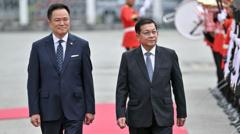
Min Aung Hlaing has arrived in Thailand for an official state visit, marking a significant diplomatic development as it is his first international trip since launching the military coup in February 2021. The general, who recently transitioned from his role as military commander to become president following a widely criticized election, received a formal welcome from Thai Prime Minister Anutin Charnvirakul. This engagement includes attendance at an official dinner, meetings with leaders of both houses of the Thai parliament, and participation in a bilateral business forum aimed at strengthening economic relations between the two nations.
The timing and nature of this visit underscore a strategic divergence within the Association of Southeast Asian Nations regarding how to handle Myanmar’s ongoing political crisis. While Thailand pursues what it describes as calibrated re-engagement, other member states including Indonesia, Malaysia, the Philippines, and Singapore maintain a more restrictive approach. These nations argue that full diplomatic contact should remain suspended until the Myanmar military makes tangible concessions to alleviate the humanitarian crisis and initiate genuine negotiations with opposition groups.
Thailand’s rationale for this high-profile engagement centers on practical border management issues. Sharing a 2,400-kilometer boundary with Myanmar, Thai officials contend that direct communication at the highest levels of government is essential to address pressing concerns such as transnational crime and regional stability. By treating the visit as business as usual, Bangkok signals its priority on immediate security and economic cooperation over conditional diplomatic pressure.
This diplomatic move aligns Thailand more closely with Myanmar’s larger neighbors, China and India, both of which have recognized the new government and invited Min Aung Hlaing for official visits shortly after his presidential declaration. China’s support has been particularly influential in recent months, providing critical assistance that helped the military regime regain territory lost to armed opposition forces during the civil war that erupted following the coup.
The election that paved the way for Min Aung Hlaing’s presidency was condemned by international observers and domestic critics alike for lacking fairness and freedom. Major opposition parties were barred from participation, and voting did not occur in large swathes of the country controlled by armed insurgents. Consequently, the military-backed party now dominates the new parliament, consolidating political control despite widespread resistance.
Critics argue that Thailand’s approach undermines efforts to isolate the junta and hold it accountable for its actions. Justice for Myanmar, a campaigning group, stated that the Thai government continues to lend false legitimacy to the regime through ongoing diplomatic engagements. They contend that this policy of calibrated re-engagement will only prolong the suffering of the Myanmar people by failing to pressure the military into meaningful reforms.
Min Aung Hlaing remains an international pariah in Western countries, where he is barred from entry and faces accusations of crimes against humanity. These charges stem largely from his involvement in the 2017 mass expulsion of Muslim Rohingyas, which drew global condemnation and led to sanctions against him and other military officials. His refusal to implement the five-point consensus signed with ASEAN member states in 2021 has further complicated regional diplomacy.
The five-point consensus required the Myanmar military to de-escalate violence, allow humanitarian aid access, and begin dialogue with opposition groups. Min Aung Hlaing’s failure to adhere to these commitments has resulted in his exclusion from ASEAN meetings, highlighting the tension between individual member states’ bilateral strategies and the bloc’s collective diplomatic framework.
As the civil war continues to claim thousands of lives and devastate Myanmar’s economy, the question remains whether millions who opposed military rule have seen their hopes for revolution dashed. The contrasting approaches of regional powers suggest a fragmented response to the crisis, with some prioritizing stability and engagement while others emphasize accountability and human rights.
Looking ahead, the implications of Thailand’s decision could influence broader regional dynamics. If other ASEAN members follow suit in engaging directly with the Myanmar leadership, it may weaken the unified front that has sought to pressure the junta into compliance. Conversely, continued division within ASEAN could embolden the military regime, allowing it to navigate international isolation by leveraging relationships with key neighbors like China and India.
Sources behind this briefing
Go to the original reporting
- BBC News↗Myanmar's Min Aung Hlaing arrives in Thailand on first trip as civilian leader

