The short version
- Moroccan security forces detained approximately 111 migrants near Fnideq, using tear gas and riot gear to disperse groups attempting to reach the Spanish exclave of Ceuta.
- Spanish authorities deployed more than 1,500 officers and reinforced physical barriers, including metal fences and floating obstacles, in response to social media rumors of coordinated crossing attempts.
- The incident follows a late July crisis where roughly 78,000 migrants arrived by sea, resulting in at least 100 deaths and triggering diplomatic friction within the European Union over border control responsibilities.
Security tensions escalated along the border between Morocco and the Spanish territory of Ceuta on Saturday, as Moroccan authorities intercepted a significant number of migrants attempting to cross into Europe. According to security sources cited by international news agencies, more than 100 individuals were blocked from reaching the frontier near the town of Fnideq. The majority of those detained were reported to be from sub-Saharan Africa. This development marks a renewed effort by both nations to secure the perimeter following a chaotic period in late July that saw tens of thousands of people arrive in Ceuta by sea.
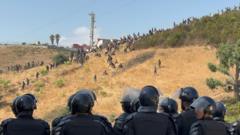
The operation involved substantial police presence and force. Moroccan officers, some equipped with riot gear, utilized tear gas to disperse gatherings on hills overlooking the border area. Reports indicate that 111 people were taken into custody in or around Fnideq, also known as Castillejos in Spanish, which lies approximately three kilometers from the actual boundary. The use of chemical dispersants and physical detention underscores the severity with which Moroccan officials are treating these unauthorized crossing attempts.
Spanish authorities responded with a massive deployment of their own security personnel. Madrid sent more than 1,500 officers to patrol the region, aiming to bolster defenses against potential breaches. Local media outlets noted that security at the breakwater entrance was significantly stronger than in previous days. In addition to human resources, physical barriers were enhanced; metal fencing and floating obstacles installed earlier in the week remain in place to hinder access from the sea.
The heightened alert came amid circulating rumors on social media platforms suggesting a coordinated mass crossing event for that weekend. Moroccan officials stated they had been monitoring posts and messages of unknown origin that appeared to call for such an action. Rabat warned that it would prosecute both organizers and participants involved in these planned movements. The government’s stance reflects a determination to disrupt the networks facilitating irregular migration, particularly those leveraging digital channels to coordinate large-scale actions.
This latest incident occurs just two weeks after a dramatic surge in arrivals that overwhelmed local infrastructure and sparked international concern. During that earlier crisis, approximately 78,000 migrants reached Ceuta by sea within a matter of hours. The city’s mayor reported that at least 100 people died during those events, highlighting the lethal risks associated with such mass movements. The sheer volume of arrivals exposed vulnerabilities in border management and raised urgent questions about humanitarian response capabilities.
The aftermath of the July influx has strained diplomatic relations within the European Union. Several member states have criticized Spain’s handling of the situation, arguing that it undermines the integrity of the Schengen area. Italy suspended its participation in the open-border arrangement with Spain, a move supported by Finland and Denmark. Additionally, the Czech Republic called for a temporary suspension of Spain’s membership in the bloc. These reactions reflect broader anxieties among EU nations regarding uncontrolled migration flows and the potential spillover effects on other member states.
Spanish Prime Minister Pedro Sánchez has defended his government’s actions, noting that Ceuta is not technically part of the Schengen zone despite being Spanish territory. He has placed blame on human traffickers for orchestrating the dangerous crossings. Meanwhile, investigations are ongoing into Instagram accounts and other online platforms that allegedly provided paid advice to migrants seeking assistance with crossing borders. These digital facilitators are seen as key enablers of the crisis, prompting calls for stricter regulation of social media content related to migration.
Looking ahead, both Morocco and Spain appear committed to maintaining a high level of security at the border. Moroccan forces have dispatched army officers, navy speedboats, and drones to monitor the area closely. The combination of technological surveillance and physical barriers aims to deter future attempts while ensuring rapid response capabilities. However, the underlying drivers of migration remain unresolved, suggesting that tensions may persist despite immediate containment efforts.
The situation highlights the complex interplay between national security, humanitarian obligations, and international cooperation. As both countries work to stabilize the border, the broader implications for European migration policy continue to unfold. The incident serves as a stark reminder of the challenges faced by nations at the forefront of global migration routes, where political pressures and human suffering intersect.
While the immediate crisis has calmed since late July, the potential for further disruptions remains. Authorities on both sides of the border are likely to remain vigilant, anticipating possible shifts in migrant movements or new tactics employed by trafficking networks. The coming weeks will be critical in determining whether these enhanced security measures can effectively prevent another large-scale influx and restore stability to the region.
Sources behind this briefing
Go to the original reporting
- BBC World↗Morocco detains dozens of migrants trying to cross into Ceuta

