The short version
- DNA analysis confirmed the identities of two Belgian men found on the Trift Glacier after disappearing near Weissmies mountain thirty-four years ago.
- Swiss glaciers have lost a quarter of their mass in the decade leading up to 2025, with accelerated shrinkage continuing into the current year.
- This event follows similar discoveries in recent years, highlighting how warming temperatures are exposing historical remains previously preserved in ice.
Police in Switzerland’s Valais region have confirmed the identification of two men whose bodies were discovered on the Trift Glacier. The remains, found by a hiker on July 26, belong to two Belgian mountaineers who vanished in 1992 near the Weissmies mountain. DNA testing established their identities after authorities recovered the bodies from the ice and transported them to a hospital in Sion for examination. The men were thirty-nine and forty-one years old at the time of their disappearance.
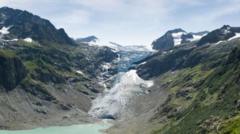
The exposure of these remains is directly linked to the rapid melting of the glacier, which has been retreating significantly in recent years. The Trift Glacier, located south of Lucerne, has lost substantial ice volume, revealing objects and bodies that had been frozen for decades. This discovery marks another instance where glacial retreat has uncovered historical tragedies, adding to a growing list of such findings in the Swiss Alps.
Scientific data indicates that Switzerland’s glaciers have shrunk by approximately twenty-five percent between 2015 and 2025. According to Glacier Monitoring in Switzerland, or Glamos, this trend has accelerated since the year 2000. The European Commission’s Copernicus monitoring body notes that global glacier shrinkage rates have increased steadily since the 1990s, with particularly sharp declines observed in recent years.
In 2025 alone, Swiss glaciers experienced a further three percent reduction in mass. This follows record-breaking ice loss in 2022 and 2023. The upward trend in global average temperatures has led to unseasonably warm weather at higher altitudes in Switzerland. These conditions have not only accelerated melting but also reduced snow cover, impacting local ski resorts and winter sports competitions.
Regional police maintain a database of missing persons dating back to 1925. Most entries involve individuals who disappeared in mountains or bodies of water. Authorities noted that the current discovery is not an isolated incident. In 2023, remains found on a glacier near the Matterhorn were identified as those of a German climber who had been missing since 1986.
The Weissmies mountain, where the Belgian hikers went missing, peaks at over four thousand meters. It is a popular destination for mountaineers in the Saas Valley. The recovery operation organized by local police involved careful extraction of the bodies from the melting ice. Identification procedures were completed through standard forensic methods, including DNA comparison with family members.
The broader implications of these discoveries extend beyond individual cases. They serve as visible markers of environmental change in the Alpine region. As glaciers continue to retreat, more historical artifacts and remains may be exposed. This trend raises logistical challenges for authorities managing missing persons cases and for communities dealing with the physical changes to their landscape.
Local officials are monitoring the situation closely. The database of missing persons will likely see updates as new discoveries are made. Scientists continue to track glacier mass balance, providing data that informs climate models and policy decisions. The loss of ice cover affects water resources, tourism, and geological stability in the region.
The case of the two Belgian hikers remains a poignant example of how climate change impacts human history. Their disappearance was once considered a closed chapter, frozen in time. Now, it has been reopened by environmental forces beyond human control. The recovery of their bodies provides closure for families while highlighting the ongoing transformation of the Swiss Alps.
Future monitoring will focus on both the environmental data and the humanitarian aspects of these discoveries. Authorities are likely to develop protocols for handling similar findings as they become more frequent. The intersection of climate science and forensic investigation continues to evolve, requiring coordination between scientific agencies and law enforcement.
Sources behind this briefing
Go to the original reporting
- BBC World↗Bodies of two hikers missing for decades found after Swiss glacier melts

